Self-Betrayal vs Sacrifice: How to Tell the Difference
You keep asking yourself one quiet question. Am I sacrificing, or am I betraying myself? You have given up things for this career for years. Some of it was worth it. Some of it left a residue you cannot name. This is the felt state Silent Collapse™ describes: the slow blur between what you chose and what you abandoned. Most high performers never learn to tell the two apart. That confusion is not a character flaw. It is a missing skill. You can read the manifesto for why the return matters more than the climb.
Written by Baz Porter®
What this covers
Key takeaways
A sacrifice gives something up for a value you still hold. Self-betrayal gives up the value itself.
The test is direction, not difficulty. Both can hurt. Only one grows you.
Self-betrayal leaves a specific residue: resentment, numbness, a self you perform.
Healthy sacrifice leaves you tired but intact. You still recognize yourself.
The move is return, not another round of pushing harder.
The one-line answer
Here is the difference, stated plainly.
A healthy sacrifice costs you something for the sake of what you value most. Self-betrayal costs you what you value most for the sake of something else. One serves your self. The other spends it.
Difficulty is not the marker. A hard, painful cost can be deeply healthy. A small, easy compromise can be quiet betrayal. The question is never how much it hurt. The question is what it served. Sacrifice moves toward the person you want to be. Betrayal moves away from them and calls it maturity.
The hidden pattern under the confusion
The two feel identical in the moment. Both ask you to give something up. Both can be framed as being responsible. That is why they blur.
Self-determination research draws the line for us. Ryan and Deci, writing in American Psychologist (2000), separate autonomous motivation from controlled motivation. Autonomous action is chosen and endorsed by your deeper values. Controlled action is driven by pressure, guilt, or the fear of what people will think. A sacrifice is autonomous. You choose the cost because it fits who you are. Self-betrayal is controlled. You pay the cost to manage other people, and you tell yourself you had no choice.
There is a second signal, and it is louder over time. Moral injury research names it. Litz and colleagues, in Clinical Psychology Review (2009), describe the lasting harm that follows acting against your own deeply held values. It is not simple stress. It is a wound of conscience. When a decision keeps aching long after it should have healed, that ache is data. It is telling you a value was crossed, not merely a comfort surrendered.
So the pattern is this. Sacrifice tires the body. Betrayal wounds the conscience. You have been treating both as fatigue. One of them is not.
The RAMS™ reframe across five pillars
RAMS™ gives you five lenses to run any hard choice through. Use them before you decide, not after you regret.
Results
Ask what the cost actually bought. A healthy sacrifice produces a result you would choose again. Betrayal produces a result you have to keep defending. If you find yourself justifying the same decision on a loop, the return was not worth the price. Real results settle. They do not need constant rescue.
Attitude
Watch the story you tell after. Sacrifice leaves you steady. You can name what you gave and why. Betrayal leaves you brittle. You get defensive when someone touches the subject. If a choice makes you flinch when it is questioned, your attitude already knows what your mind will not admit.
Authenticity
This is the deciding pillar. After a healthy sacrifice, you still recognize yourself. You are tired, not estranged. After self-betrayal, a small distance opens between you and you. You start performing a version of yourself that is easier to sell. That distance is the truest reading you have. Trust it over any argument you can construct.
Mastery
Discernment is a skill, and skills improve with reps. Each time you name a choice correctly, the next one gets clearer. Most leaders never build this muscle. They react, then rationalize. You can do the opposite. Pause. Name it. Then act. That sequence is masterable.
Systems
Stop relying on willpower in the moment. Build a rule you decide once. A simple one works: before any costly yes, ask which value it serves and whether you would choose it if no one were watching. If the honest answer is fear or image, it is betrayal wearing the mask of duty. A system catches what a tired mind misses.
Here is the contrast, felt from the inside.
Collapsed: you give until you go numb, then call the numbness discipline.
Sovereign: you give from a full self, and you notice the moment you start running on empty.
Collapsed: you defend the cost so no one sees the doubt.
Sovereign: you let the cost be questioned, because you already know its reason.
Collapsed: you measure loyalty by how much of yourself you surrender.
Sovereign: you measure loyalty by whether you can stay yourself while you serve.
The leaders who last are not the ones who sacrifice the most. They are the ones who know the difference between a cost and a wound.
If you cannot tell which one your daily choices are, that uncertainty is worth an hour. The Silent Collapse Diagnostic™ is a free audit built for exactly this. Book the free diagnostic here.
A leader who learned the difference
A managing director came to this work sure they had a discipline problem. They kept saying yes. Longer hours, more travel, one more board seat. On paper it looked like commitment. Inside, something had gone quiet.
We ran their last two years through the five pillars. The pattern was clean. The yeses that grew them shared one trait. They were chosen, and they served a value the leader still held. The yeses that hollowed them shared a different trait. Every one was driven by how it would look, or who might be disappointed.
Nothing about their calendar changed for a month. What changed was the reading. They could finally name a betrayal as it happened. The relief was immediate. They were not weak. They had simply been calling every cost the same word. Once the words split, the choices did too.
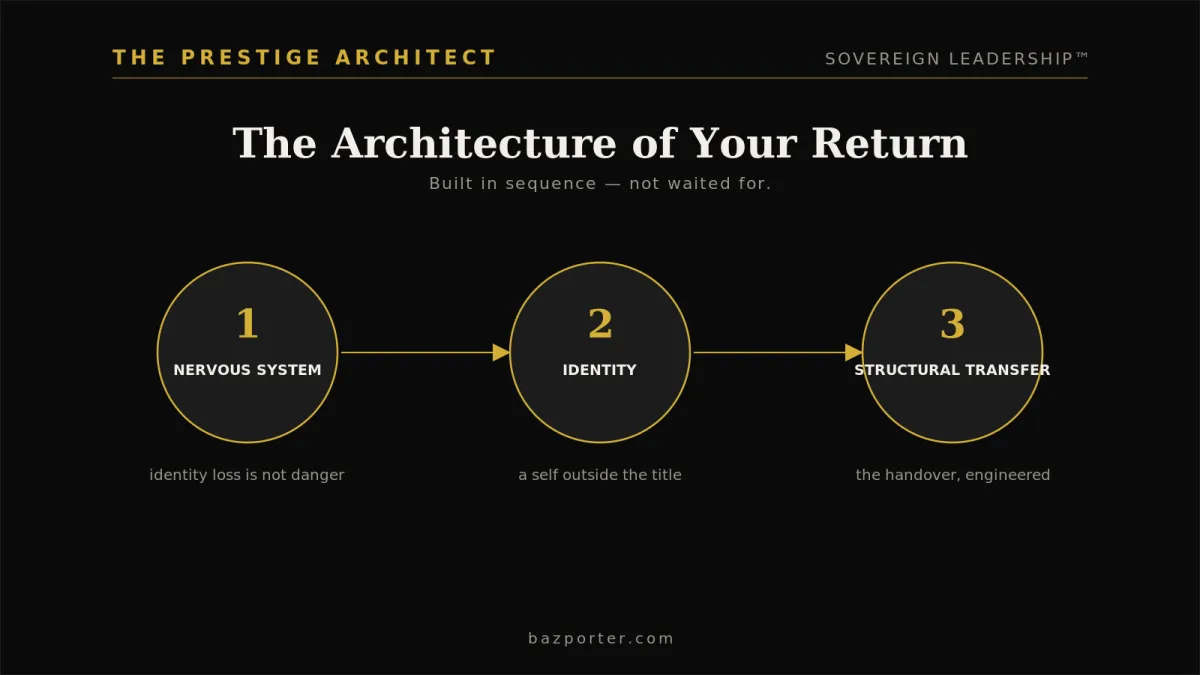
The architecture of your return
Return is not a dramatic exit. You do not blow up the built life to find yourself again. You rebuild the way you decide, one choice at a time.
It works in three moves. First, name the residue. When a decision keeps aching, treat the ache as a signal, not a weakness. Second, run the value test. Ask what each costly yes actually serves. Third, decide once and let the rule carry you, so the tired version of you is not making the call at nine at night.
This is architecture, not motivation. You are not trying to feel stronger. You are building a structure that keeps you honest when you are depleted. That structure is what returns you to yourself while the career stays intact.
If you want the map for that return, start with the free audit. Apply for the Silent Collapse Diagnostic™. It shows you, in one hour, where you are sacrificing and where you are quietly spending yourself.
Questions leaders ask
How do I tell self-betrayal from a healthy sacrifice in the moment?
Ask what the cost serves. If it serves a value you hold, it is likely a sacrifice. If it serves your image or your fear of disappointing people, it is likely betrayal. The feeling afterward confirms it. Sacrifice leaves you tired but whole. Betrayal leaves a residue that will not settle.
Is all sacrifice at work bad for me?
No. Sacrifice is a normal part of any life that means something. The danger is not the cost. The danger is paying it for the wrong reason, over and over, until you no longer recognize yourself. Chosen sacrifice builds you. Compelled sacrifice erodes you.
Why does a decision still bother me months later?
A lingering ache usually signals a crossed value, not a passing discomfort. Moral injury research links that specific, durable distress to acting against what you believe is right. Ordinary trade-offs fade. Betrayals of your own values keep speaking until you address them.
Can I fix years of self-betrayal without leaving my career?
Yes. The return happens in how you decide, not where you work. You rebuild the rule you use for costly choices, and the change compounds quietly. Most leaders never need to walk away. They need to stop abandoning themselves inside the life they already have.
What is the first step to coming back to myself?
Start by naming one recent cost accurately. Was it a sacrifice or a betrayal? That single honest reading begins the return. From there, a free audit can map the pattern across your calendar and show you where to start.
About the author
Baz Porter® helps accomplished leaders come back to themselves without dismantling the lives they built. His work names the Silent Collapse™ that success can quietly cost, and rebuilds the way leaders decide, lead, and live from their real selves.