How to Build a Second Brain for Your Business
Written by Baz Porter®
You have more ideas than you can hold. None get finished. Every week you start from nothing. This is not a discipline problem. It is a storage problem. Your best thinking lives in your head, and your head leaks. A second brain fixes it. It is one system that holds every idea, so your business stops living in your memory. I named the slow erosion under the overwhelm Silent Collapse™. Before we build the system, read the manifesto. It names what you carry.
On this page
Key takeaways
Ideas everywhere, nothing finished is a storage failure, not a willpower failure.
A second brain is one trusted place that holds every idea and next step.
Your mind offloads what it knows is saved elsewhere. That is proven science.
Capture, organize, and review on a set schedule. The schedule is the system.
Build it once. Stop rebuilding your business from zero every week.
What a second brain for your business really is
A second brain is one external system that holds every idea, task, and decision your business needs. It lives outside your head, in one trusted place. You capture an idea the moment it arrives. You organize it so you can find it. You review it on a set schedule. Nothing is lost. Nothing is rebuilt from memory. It is the storage layer of Sovereign Leadership™. It is not another app to master. It is the end of carrying your whole company in your mind.
Here is the plain version. Brains are for having ideas. They are not for holding them. When you hold ideas in your head, they scatter. When you save them in one place, they compound. That single move is the difference between a founder who finishes and one who starts over forever.
The hidden pattern: your brain was never the filing cabinet
Here is what almost no one tells you. Your memory is built to have ideas, not to store them. In 2011, researchers Betsy Sparrow, Jenny Liu, and Daniel Wegner proved something strange. When people know information is saved somewhere, their brain lets it go. It remembers where to find it instead. They published this in the journal Science (Sparrow, Liu and Wegner, 2011). Columbia University called it the way memory now works in the age of search (Columbia News).
Read that again. Your mind clears space the moment it trusts a system. No system, no trust. No trust, no space. So the ideas pile up and stay unfinished. You are not scattered because you are weak. You are scattered because you never built the place the ideas were meant to live. The overwhelm is not a flaw in you. It is a gap in your architecture.
The RAMS™ rebuild across five pillars
RAMS™ is my operating system. Results, Attitude, Authenticity, Mastery, Systems. A second brain touches all five. Here is how.
Results
Finished work is the only result that counts. A captured idea moves forward. A remembered idea rots. Track what closes, not what you start.
Attitude
You stop treating your memory as the enemy. It was never meant to hold this much. Give it less to carry and it steadies.
Authenticity
Your ideas are worth keeping. When you save them, you say so. That quiet act rebuilds trust in yourself, one entry at a time.
Mastery
One system, used daily, beats ten apps used once. Master the habit of capture. Everything else follows from it.
Systems
The schedule is the system. Capture as it comes. Sort it once a day. Review it once a week. That is the whole machine.
Keep the tool simple. A notes app, a doc, a board. The tool is not the point. The habit is. If saving an idea takes more than a few seconds, you will quit. So make capture friction free. One tap. One place. Every time.
Here is the shift, laid out plainly.
Collapsed: ideas in your head, in three apps, on scraps. Nothing connects.
Sovereign: one place holds it all. You open it and know where you are.
Collapsed: every Monday you rebuild your plan from memory.
Sovereign: Monday you open the system. The plan is already there.
Collapsed: your best idea from Tuesday is gone by Friday.
Sovereign: your best idea is saved, sorted, and waiting.
Baz Porter does not motivate. He does not inspire. He architects the system that carries the weight you were never meant to carry alone.
If your ideas keep dying in your head, the problem is the architecture, not you. The Silent Collapse Diagnostic™ shows you where your system leaks.
A founder who stopped losing their ideas
A founder came to me worn down. Smart, respected, quietly drowning. There were four notebooks and three apps. The best ideas lived in all of them, which meant none of them. Every week the plan got rebuilt from scratch. Every week that rebuild whispered the same lie. You cannot run this.
We built one system. One place to capture. One daily sort. One weekly review. Nothing fancy. Within a month the noise dropped. The starting over stopped. The finishing started. The ideas did not change. The storage did. That is the whole point. You are not short on ideas. You are short on a place to keep them.
The architecture of your return
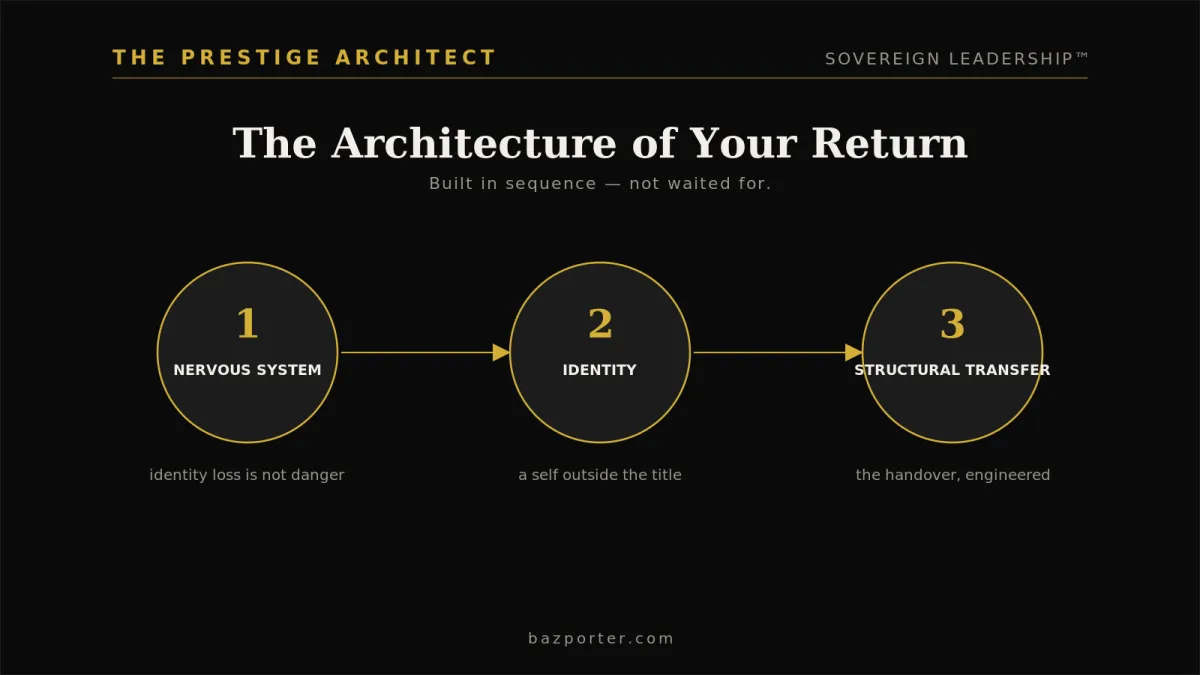
You do not need more ideas. You have plenty. You need one place to keep them, and a rhythm to work them. That is the whole rebuild. This is the storage layer of the work I do as The Prestige Architect™. It is not another course. It is the room where your business stops living in your head.
Your first step is small. Choose one place today. Move every loose idea into it before you close the laptop. Tomorrow, do it again. That is how the rebuilding ends and the finishing begins.
If you are ready to stop rebuilding from zero, start here. The Silent Collapse Diagnostic™ maps where your system leaks and what to build first.
Questions leaders ask
What is a second brain for a business?
It is one external system that holds every idea, task, and decision. It lives outside your memory, in a single trusted place. You capture, organize, and review on a schedule. Your business stops depending on what you can recall.
How do I start building a second brain when I have too many ideas?
Start with one inbox. One place where every idea lands the moment it arrives. Do not sort yet. Just capture. Once capture is a habit, add a daily sort and a weekly review. Small first, then steady.
Why do I keep rebuilding my business from zero every week?
Because the plan lives in your head, and your head resets. Nothing is saved in a form you trust. A second brain holds the plan so Monday starts where Friday ended. The rebuilding stops when the storage starts.
What is the difference between a second brain and a to-do list?
A to-do list holds tasks for today. A second brain holds ideas, projects, notes, and decisions over time. The list is one drawer. The second brain is the whole cabinet, sorted so you can find any drawer.
Is a second brain just another app to manage?
No. The app is not the system. The habit is. One place, used daily, beats ten apps used once. Pick the simplest tool you will actually open, then build the capture habit around it.
About the author
Baz Porter® is the founder of Baz Porter LLC® and The Prestige Architect™. A British Army veteran and international bestselling author, he architects the return from Silent Collapse™ to Sovereign Leadership™. Power Without Performance. Peace Without Retreat.™