How to Redesign a Life You Outgrew, in Place
Part of you wants to blow it all up. Not tweak it. Detonate it. You built a life that works on paper, and lately you keep imagining walking out of it. That pull has a name. It is Silent Collapse™, the quiet cost of staying loyal to a life you have already outgrown. Most people read the urge as a threat. It is closer to a signal. Before you torch anything, read the manifesto for the frame underneath what follows.
Written by Baz Porter®
On this page
Key takeaways
Outgrowing your life is not failure. It is evidence you grew.
You rarely need a new life. You need a redesigned one.
Redesign in place beats escape. Escape resets the scoreboard, not the self.
Change the structures one at a time. The calendar, the roles, the yes.
The goal is return, not reinvention. You are coming back to yourself.
The short answer
Here is the definitive answer. You redesign a life you outgrew by changing its structures in place, not by walking away from it. The restlessness is real. The exit fantasy is usually wrong. You do not need a different life. You need the same life, rebuilt around who you actually are now. That is a design problem, not a crisis. And design problems have a method.
The move is return, never reinvention. Reinvention asks you to become someone else. Return asks you to stop abandoning the person you already are. One is exhausting. The other is quiet, and it holds.
The hidden pattern
The trap is not the life. The trap is treating it as fixed. You built it in one season. You are living it in another. The mismatch feels like being trapped, so the mind reaches for the biggest lever it can find. Quit. Leave. Disappear. Start over somewhere no one knows your name.
But the research points elsewhere. Work on job crafting, covered in Harvard Business Review, shows that people can reshape the meaning and boundaries of a role from the inside, without changing the role itself. The structure stays. The relationship to it changes. That is redesign in place.
The American Psychological Association describes how adults hold "possible selves," the versions of you that could still exist. Midlife restlessness is often those possible selves knocking. The answer is not to chase every one by torching the present. It is to let them inform a redesign of the life you already have.
So the pattern is simple. The feeling is accurate. The plan the feeling suggests is not. Read the signal. Reject the demolition.
The RAMS™ redesign
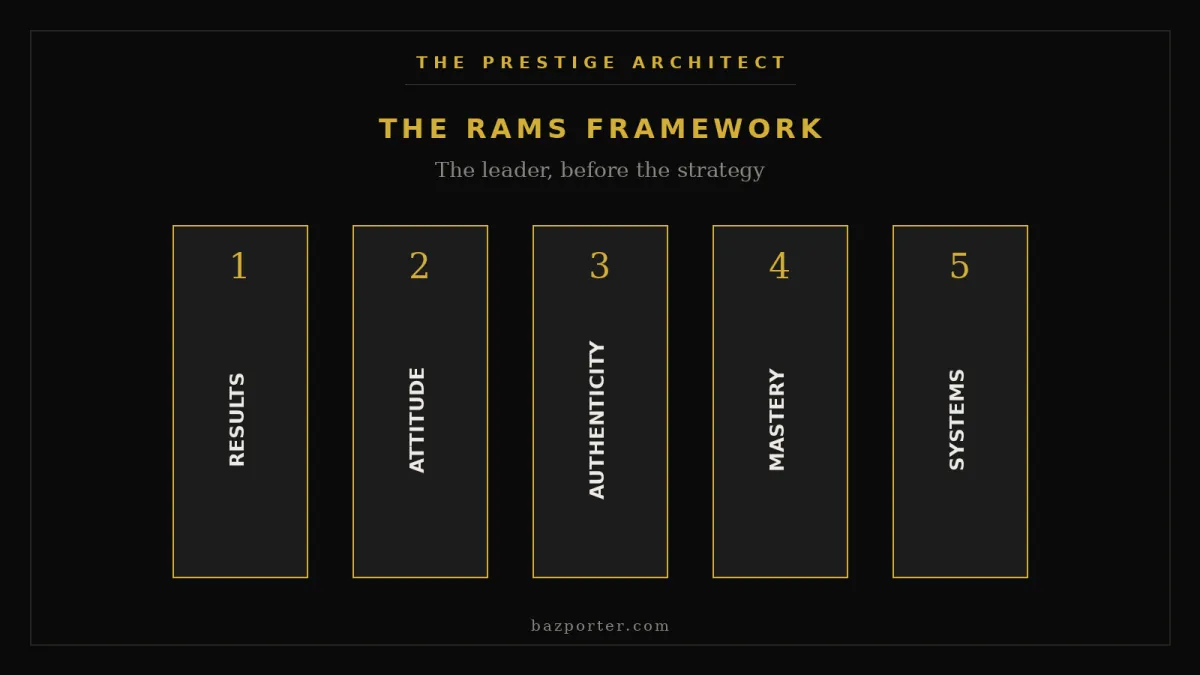
My framework, RAMS™, redesigns a life across five pillars. It is the operating system behind The Prestige Architect™. You do not run all five at once. You run them in order, in place.
Results: redefine the win
The old scoreboard still runs. It measures a life you no longer want. That is why hitting the target feels flat. Start here. Write down what a real win looks like now. Not the title. Not the number. The actual outcome you would trade for. When the measure changes, the day changes.
Attitude: read the restlessness as data
You have been treating the pull to leave as betrayal. It is not. It is information. Something outgrew its container. Stop arguing with the feeling. Ask it a question instead. What specifically do you want out of? Rarely the whole life. Usually one structure inside it.
Authenticity: close the gap
The distance between the life you built and the person you are now is the whole problem. That gap is not moral. It is structural. You made choices that fit an earlier you. Honor that. Then close the gap on purpose. Every redesign decision answers one question. Does this move me toward myself or away?
Mastery: you have done this before
You built this life once. From less than you have now. That is the proof you need. The skill that built it can rebuild it. You are not starting from zero. You are starting from competence. Redesign is not a leap of faith. It is a use of what you already own.
Systems: change one structure at a time
This is the pillar most people skip, and it is why they end up leaving. They try to change everything at once, fail, and conclude the life itself is the problem. It is not. The structures are. Redesign them in sequence. The calendar first. Then the roles you hold. Then the commitments you keep saying yes to out of habit. One structure a week. In place.
Here is the contrast most leaders live inside without naming it.
Collapsed: I have to leave to feel like myself again.
Sovereign: I can rebuild this life to fit the self I became.
Collapsed: The restlessness means I chose wrong.
Sovereign: The restlessness means I grew past an old choice.
Collapsed: Change means burning it down and starting over.
Sovereign: Change means editing the structures, one at a time.
Collapsed: I am trapped.
Sovereign: I am the architect. I can redesign the room I am standing in.
You do not have a life problem. You have a design that stopped fitting. The self did not break. The structure got old.
If you want the map for that redesign, start with the Fast Future Freedom Blueprint. It is the free entry audit that shows you which structure to change first.
A leader who redesigned in place
A founder came to me certain the answer was to sell the company. Fifteen years in. Successful by every external measure. And a daily, private urge to walk away from all of it.
We did not touch the sale. Not yet. We ran the redesign instead. Results first. The old win was revenue. The new win was two clear mornings a week with no meetings. Then systems. We cut one recurring commitment that had outlived its reason. Then roles. A title handed to someone who wanted it more.
Three months later the urge to sell was gone. Not suppressed. Gone. The company had not changed. The design had. The founder had outgrown a structure, not a life. Redesign in place gave back the thing the exit only promised.
The architecture of your return
You are not lost. You are between designs. The life you built was correct for who you were. It stopped fitting because you kept growing. That is not a reason to leave. It is a reason to redesign.
The return is not dramatic. It is a sequence. Redefine the win. Read the restlessness. Close the gap. Use your mastery. Change one structure. Then the next. You keep the life. You lose the misfit.
When you are ready to build the plan with structure instead of guesswork, apply through the Fast Future Freedom Blueprint. That is where the redesign gets a sequence and a name.
Questions leaders ask
How do I know if I should redesign my life or actually leave it?
Ask what you want out of. If the honest answer is one or two structures, not the whole life, redesign in place first. Most exit fantasies point at a single misfit wearing the mask of the whole thing. Test the smaller change before the irreversible one.
Is it too late to redesign my life at 45 or 55?
No. Redesign is not age dependent. It depends on whether you still have structures you can edit, and you always do. The calendar, the roles, the commitments are all in your hands. Later seasons often make redesign easier, because you have more mastery to work with.
What if I redesign and still want to leave?
Then you leave, but from clarity instead of panic. Redesign in place is not a trick to keep you stuck. It removes the noise so a real exit becomes a clean decision. Many people stay. Some go. Both choices are cleaner after the redesign.
Why does the urge to walk away keep coming back?
Because the mismatch is still there. The urge is a smoke alarm, not the fire. It returns until you change the structure setting it off. Silencing it does not work. Redesigning the source does.
Where do I start if everything feels like it needs to change?
Start with one structure, and make it the calendar. It is the fastest to edit and the quickest to feel. Reclaim two blocks of time this week. The relief you feel there tells you what to redesign next.
About the author
Written by Baz Porter®, founder of The Prestige Architect™ and creator of the RAMS™ method. Baz helps successful leaders in Silent Collapse™ redesign the life they built into one that fits who they became, without burning it down.