Psychological Flexibility: Lead From Values Not Fear
Written by Baz Porter®
Psychological flexibility is the quiet engine under every steady leader. It is the trained capacity to feel fear and still move toward what matters. Most executives were taught the opposite. Control the feeling. Push it down. Perform anyway. That method holds until it does not. Then the pressure leaks out as reactivity, avoidance, or the slow flatline I name Silent Collapse™. There is another way to lead. I set it out in full in the manifesto.
What this article covers
Key takeaways
Psychological flexibility is acting on your values while discomfort is still present.
Rigidity is not strength. It is fear wearing a suit.
Suppressing emotion raises the cost. It does not lower it.
Flexibility is a trained skill, not a trait you are born with.
You rebuild it across all five RAMS™ pillars, not with one hack.
What is psychological flexibility?
Psychological flexibility is the capacity to stay present, hold hard feelings, and still act on your values. It has three moving parts. You notice what you feel. You accept it without a fight. You choose the action that serves who you want to be. Fear does not vanish. It stops driving. For a leader, this is the line between a wise response and a fast reaction. Most executives run on reaction and call it control. The flexible leader does the harder thing. They stay in contact with the feeling and lead from values while it burns. Think of it as range. Rigidity has one gear. Flexibility has many.
The hidden pattern under executive rigidity
Here is the pattern I see in the room. The most rigid leaders are not the coldest. They are the most afraid. Rigidity is a defense. It keeps a painful feeling out of view. The research backs this. Kashdan and Rottenberg, in a landmark 2010 review in Clinical Psychology Review, framed psychological flexibility as a foundation of mental health (source). Steven Hayes built a whole method around it through Acceptance and Commitment Therapy, now studied by the American Psychological Association (source). The finding is clear. People who avoid inner discomfort pay more, not less. The avoided feeling does not leave. It runs the show from the dark. The cost shows up later. It shows up as a short fuse. It shows up as a closed door. It shows up as a body that will not switch off at night. The feeling was never handled. It was only delayed.
Rebuild psychological flexibility across the five RAMS™ pillars
You do not fix rigidity with willpower. You rebuild the system that produced it. RAMS™ works at the level of the nervous system, not the to-do list. Here is the rebuild, pillar by pillar.
Results
Rigid leaders chase certainty. They confuse control with results. Real results come from clean action under pressure. You measure the response, not the mood. You ask one question before you move. Does this serve the outcome, or does it only soothe my fear? Control is a feeling. Results are a fact. Do not trade the fact for the feeling.
Attitude
Attitude is your stance toward your own feeling. The old stance is war. Fight the fear. The new stance is room. You let the feeling be present and lead anyway. Acceptance is not defeat. It is the first honest move. Fear is data, not a verdict. You read it, then you decide.
Authenticity
Flexibility needs a true north. That north is your values, named out loud. When you know what you stand for, fear loses its vote. You stop performing a role. You act from what is real. This is where a leader stops hiding and starts leading.
Mastery
This is a skill, so you drill it. Notice the feeling. Name it in one word. Take the values-based action while it is still there. Repeat under real load. Mastery is not the absence of fear. It is fluency while afraid.
Systems
Willpower fails at scale. Systems hold. You build small structures that make the flexible move the default. A pause before a hard reply. A check-in with a named value before a big call. The system carries you when the day does not. You are not asking yourself to be brave on command. You are building a rail that makes the brave move ordinary.
Here is the shift in plain terms.
Collapsed: suppress the feeling, react fast, call it strength.
Sovereign: feel the feeling, act on values, call it leadership.
Collapsed: certainty is the goal, so rigidity grows.
Sovereign: clean action is the goal, so range grows.
Collapsed: the avoided emotion runs the room in secret.
Sovereign: the named emotion informs the choice in the open.
Baz Porter® does not motivate. He does not inspire. He architects the return from collapse.
If you feel the rigidity in your own leadership, name it. Then look at it with counsel, not judgment. The Silent Collapse Diagnostic™ is a 60 minute session with me, live, to map where the fear is running the show.
A short case from the room
A founder came to me sharp and certain. Every decision was fast. Every door was closed. His team read the certainty as control. It was fear. He could not sit with the chance of being wrong. So he ruled it out with speed. We built the flexible move. Feel the doubt. Name the value. Choose the slower, truer call. Within weeks his people spoke up again. His results did not drop. They rose. The rigidity was never strength. It was a wall around a feeling he would not hold. When he learned to hold it, the wall came down. What his team wanted all along was not certainty. It was contact.
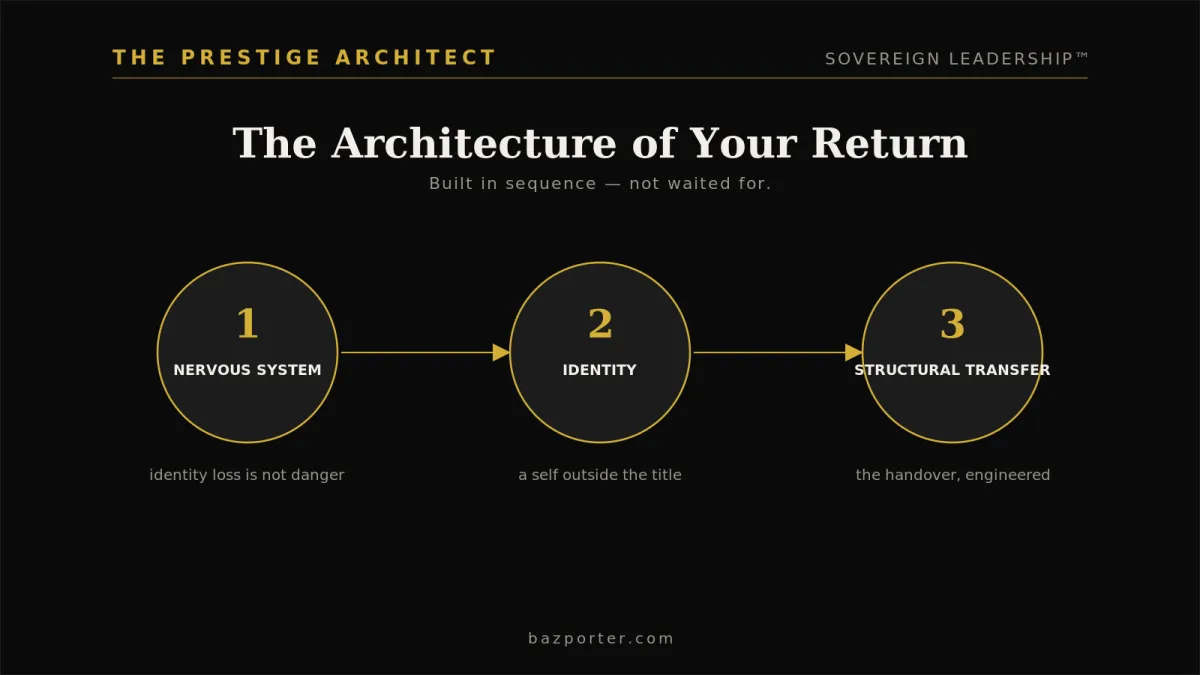
The architecture of your return
Your return is not a mood you find. It is a structure you build. Psychological flexibility is the load-bearing wall. You learn to feel and still lead. You learn to be wrong and still stand. This is the core of Sovereign Leadership™. Power without collapse. Success without self-betrayal. If you are ready to build it, start where every rebuild starts. Book the Silent Collapse Diagnostic™ and we map the first move together.
Questions leaders ask
Is psychological flexibility the same as resilience?
No. Resilience is bouncing back to where you were. Psychological flexibility is choosing values-based action while the stress is still present. Resilience is recovery. Flexibility is response. One returns you to baseline. The other moves you forward under load.
Does psychological flexibility mean I have to be soft?
No. It means you stop wasting energy fighting your own feelings. That energy goes into clear, hard decisions. Flexible leaders are often the most decisive in the room. They are not ruled by the fear they refuse to feel.
How do I build psychological flexibility as a leader?
You train three moves. Notice the feeling. Accept it without a fight. Act on your named value anyway. Do it under real pressure, in small reps. Over time the flexible response becomes the default, not the exception.
Is psychological flexibility the same as psychological safety?
No. Psychological safety is a team climate where people speak up. Psychological flexibility is an inner skill inside one person. Safety is about the group. Flexibility is about your own relationship with discomfort. You need both, but they are not the same thing.
Can rigid leadership be a sign of Silent Collapse™?
Yes, often. When a capable leader turns hard, fast, and closed, it is rarely strength. It is a defense against a feeling they will not hold. That quiet, high-functioning shutdown is what I call Silent Collapse™. The Diagnostic maps it.
About the author
Baz Porter® is the founder of Baz Porter LLC® and the architect of Sovereign Leadership Architecture™. He guides high-achieving leaders from Silent Collapse™ to Sovereign Leadership™. Power without collapse. Success without self-betrayal.