Performance-Based Self-Worth: Why Wins Never Land
Written by Baz Porter®
You hit the number. You closed the round. The board sent the note that says well done. And within a day, sometimes within an hour, the good feeling drains out and you are already scanning for the next proof. If that loop is familiar, you are living inside performance-based self-worth, and it is the quiet engine underneath most Silent Collapse™.
Performance-based self-worth is the belief that your value is rented, not owned. It is due again on the next result. High performers rarely notice it, because the strategy works. It got you here. It also never pays out the one thing it promises, which is the settled sense that you are, at last, enough.
This is not a motivation problem. It is a structural one. And structure is something you can redesign. That is the whole premise of the work I build my name on.
Contents
Key takeaways
Performance-based self-worth ties your inner value to measurable output. The value resets to zero after every win.
It is distinct from self-esteem. Self-esteem rises and falls with events. Self-worth is meant to hold steady underneath them.
The pattern is learned, often early, and it is reinforced by workplaces that reward overwork and constant availability.
The exit is not lower standards. It is a worth that is owned, not earned, so your standards stop being a survival test.
Redesign runs through five levers. Results, Attitude, Authenticity, Mastery, and Systems. That is the RAMS™ frame.
What performance-based self-worth actually is
Performance-based self-worth, also called contingent self-worth, is a mind structure where your sense of value depends on results, usefulness, or achievement. Win, and you matter. Slip, and your right to feel settled is revoked. The social psychologist Jennifer Crocker named this pattern in her research on the contingencies of self-worth. Her studies show that basing worth on outcomes creates a deep, predictable fragility. The source of your value sits outside your control. For a leader, that means every quarter is a referendum on whether you are allowed to exist in peace.
The hidden pattern most leaders miss
Here is the part that stays hidden. The achievement does relieve the pressure. For a moment, you feel worthy. Then the feeling fades, and the bar resets higher. Crocker and Connie Wolfe described this in Psychological Review in 2001. They mapped how worth staked on results produces short relief and long fragility. Success becomes a painkiller with a shrinking dose.
The pattern usually forms early. A young mind learns that approval arrives with output, and love feels conditional on being useful. That lesson runs quietly for decades. Harvard Business Review has documented this across its work on high performers. The traits that build a strong career are drive and relentless standards. On the line, those same traits curdle into overwork and self-erasure. Forbes reported the same in 2026. It named the self-destructive habits of high achievers. These get praised as commitment, until they quietly cost the leader everything.
So the wins keep coming, and the emptiness keeps returning, and you assume you simply have not achieved enough yet. You have. The problem was never the size of the win. It is where your worth is anchored.
The RAMS™ reframe: worth by design
You do not fix this by trying harder to feel worthy. You rebuild the base it stands on. Sovereign Leadership Architecture™ runs that rebuild across five load-bearing levers. Each one moves you from a rented worth to an owned one.
Results. You keep the standard. You change its meaning. A result becomes evidence of a system working, not a verdict on whether you deserve rest.
Attitude. You stop treating a flat feeling after a win as proof of failure. It is proof the anchor is misplaced, and that is information, not indictment.
Authenticity. You name the real driver out loud. The need to keep proving is not discipline. It is fear wearing a suit. Naming it takes its power.
Mastery. You build the skill of steady self-regard. It is trainable. It grows through repetition, the same way any executive capability does.
Systems. You engineer worth into your calendar and your rules, so your value stops depending on the next outcome. Design carries what willpower cannot.
Held together, the shift looks like this:
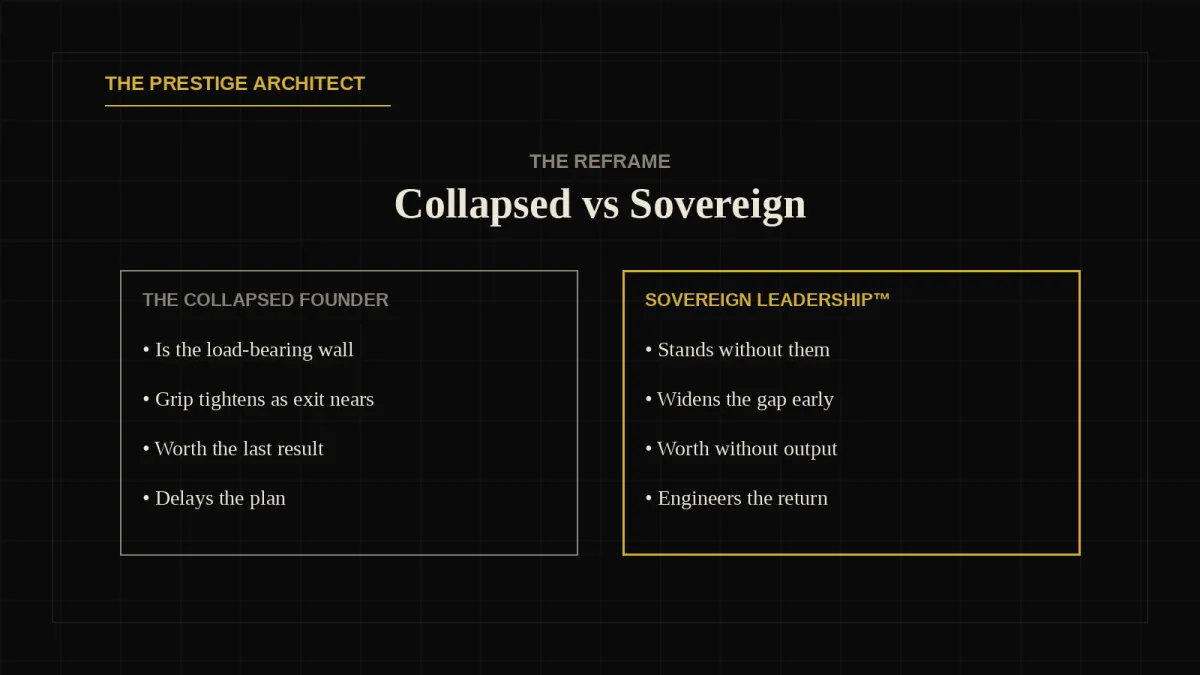
Collapsed: worth is due on the next result. Sovereign: worth is owned, and results are how you serve, not how you qualify.
Collapsed: rest must be earned. Sovereign: rest is a scheduled input, not a reward.
Collapsed: a slip threatens your identity. Sovereign: a slip is data inside a stable self.
Collapsed: praise is a fix you chase. Sovereign: praise is pleasant and optional.
Baz Porter does not motivate. He does not inspire. He architects. Worth built on the last win is a debt you can never clear. Worth built on design is yours.
If the loop above reads like your inner week, that is the exact pattern the Silent Collapse Diagnostic™ is built to surface. It is a sixty minute session, live, that shows you where your worth is anchored and what it is costing you.
A leader who rebuilt the base
A founder came to me after a record year. On paper, the case was closed. Revenue up, team growing, press warm. Inside, the person felt hollow the morning after every milestone, and terrified of the quarter ahead. We did not add a routine. We counseled toward the root. Their worth had been staked on output since childhood, and the company had become the newest proof. We moved the anchor. We built rules that treated rest as an input and results as service, not as a verdict. Six months on, the standards held. The dread did not. The wins finally started to land, because there was a settled self there to receive them.
The architecture of your return
Your return does not begin with doing less. It begins with owning your worth so the doing stops being a test. Sovereign Leadership™ is power without collapse, and success without self-betrayal. That second half is the whole point. When your value is owned, ambition becomes clean. You still build. You just stop bleeding for permission to.
The first move is to see the structure clearly. Apply for the Silent Collapse Diagnostic™. It runs sixty minutes, live. We map where your worth is anchored. We name what the current design costs you. Then we set the first rebuild step that holds.
Frequently asked questions
What is performance-based self-worth?
Performance-based self-worth is a mind structure where your sense of value depends on results, achievement, or usefulness. When you succeed, you feel worthy. When you slip, that worth is revoked. It is also called contingent self-worth. It is a leading driver of executive burnout, because the source of your value sits outside your control.
How is self-worth different from self-esteem?
Self-esteem is situational. It rises with a win and falls with a setback, because it is built on evaluation. Self-worth is deeper. It is the conviction that you have value independent of any single result. Leaders in Silent Collapse™ usually have plenty of the first and almost none of the second.
Why do my achievements stop feeling good so fast?
Because the win is relieving a pressure, not filling a need. Achievement briefly quiets the fear that you are not enough, then the relief fades and the bar resets higher. Research by Jennifer Crocker calls this the fragility of contingent worth. The dose keeps shrinking, so you chase the next result faster.
Is this the same as being ambitious?
No. Ambition is healthy. The problem is the anchor, not the drive. When worth is owned, you still hold high standards, but a slip no longer threatens your identity. You build because you choose to, not because you are trying to earn the right to feel settled.
How do I start decoupling my worth from my output?
Start by seeing the structure, not by lowering your standards. Name the driver, treat rest as a scheduled input, and redesign the rules that tie your value to the next result. The Silent Collapse Diagnostic™ is the fastest way to map where your worth is anchored and the first step that holds.
About the author
Baz Porter® is the founder of Baz Porter LLC® and The Prestige Architect™. A British Army veteran and international bestselling author, he hosts the Rise From The Ashes podcast on the C-Suite Network. He guides high-achieving leaders from Silent Collapse™ to Sovereign Leadership™. He uses the RAMS™ framework and Sovereign Leadership Architecture™. The aim is power without collapse, and success without self-betrayal.