When the Life You Built Stops Fitting You
You built a life that looks right on paper. The title. The house. The team who counts on you. And some quiet part of you no longer fits inside it. This is the Silent Collapse™ that high achievers never say out loud. Not a breakdown. A slow outgrowing. If this is you, read the manifesto first, then come back.
Written by Baz Porter®
On this page
Key takeaways
An outgrown life is not a failed life. It is a life you have moved past.
The restless pull to walk away is data, not weakness.
You do not have to blow it up to change it.
The move is RETURN, coming back to what you actually want.
The Fast Future Freedom Blueprint maps the next real step.
Why the life you built stopped fitting you
Here is the short answer. You outgrew the life you built. The person who chose this life is not the person living it now. That gap is what you feel as restlessness.
The life still works. The problem is that it works for who you used to be. You set these goals at thirty. You are living them at fifty. The plan did its job. You are just no longer the same author.
Most leaders misread this feeling. They call it burnout. They call it a bad quarter. They tell themselves to be grateful. And the pull stays. It does not leave, because it is not a mood. It is a message. The life you built stopped fitting you, and staying loyal to it is costing you yourself.
The hidden pattern under the restlessness
The pattern has a name. Psychologists call it identity foreclosure. You committed to a self early. You never reopened the question. The role hardened around you.
Research on career reinvention shows this clearly. In her work on working identity, Herminia Ibarra found that people do not think their way into a new self. They act their way in, through small experiments. The team at Harvard Business Review has tracked the same truth across decades of midlife reinvention. The self is not fixed. It is built, and it can be rebuilt.
The American Psychological Association frames midlife not as decline but as reassessment. The restlessness is the reassessment starting. Your mind is asking a real question. Is this still the right life for who I am now?
Here is what makes it feel like a crisis. You outgrew the life quietly, over years. But the awareness lands all at once. So a slow, healthy shift feels like a sudden rupture. It is not. You are just catching up to yourself.
The RAMS™ reframe
RAMS™ reframes an outgrown life across five pillars. It moves you from reaction to design.
Results. Stop measuring your life by the old scoreboard. The metrics that made sense at thirty do not fit now. Name the results you actually want at this age. Then measure against those.
Attitude. The restlessness is not the enemy. It is a signal that you are still alive to your own life. Treat it as information. A leader who feels nothing is in worse trouble than one who feels the pull.
Authenticity. This is the pillar under the whole feeling. The life stopped fitting because you changed and the life did not. Authenticity is the work of closing that gap. Not by torching what you built. By telling the truth about who is living inside it now.
Mastery. You already have the skill to build a life. You did it once. That capacity did not vanish. You can point it at a second design with the same command you used the first time.
Systems. A new self needs new structure. Not a grand leap. Small, repeatable experiments that let the next version of you show up on purpose.
The difference between collapse and return shows up in the daily posture:
Collapsed: waits for the feeling to pass. Sovereign: reads the feeling as a map.
Collapsed: thinks the only options are stay or explode. Sovereign: looks for the third door.
Collapsed: calls the restlessness a flaw. Sovereign: calls it a compass.
Collapsed: stays loyal to the old plan. Sovereign: stays loyal to the person.
The leaders I work with are not broken. They are early. They felt the shift before they had language for it. My job is to hand them the language, and then the architecture.
If you feel the pull and want the next real step, start with the Fast Future Freedom Blueprint. It is a free entry audit. It shows you where the gap is.
A leader who outgrew the plan
A founder came to me at forty-eight. Company profitable. Marriage steady. Kids nearly grown. And every morning he sat in the car for ten minutes before going in. He could not name why.
He thought he wanted to sell the company and vanish. That was the story on the surface. Under it was a simpler thing. He had outgrown the version of himself who started the company at thirty-one. The company was fine. The fit was gone.
We did not blow anything up. We ran small experiments. He handed off the parts of the role that belonged to his old self. He rebuilt his week around the work only he could do now. Within a season, the car ritual stopped. He did not leave the life. He grew back into it, redesigned.
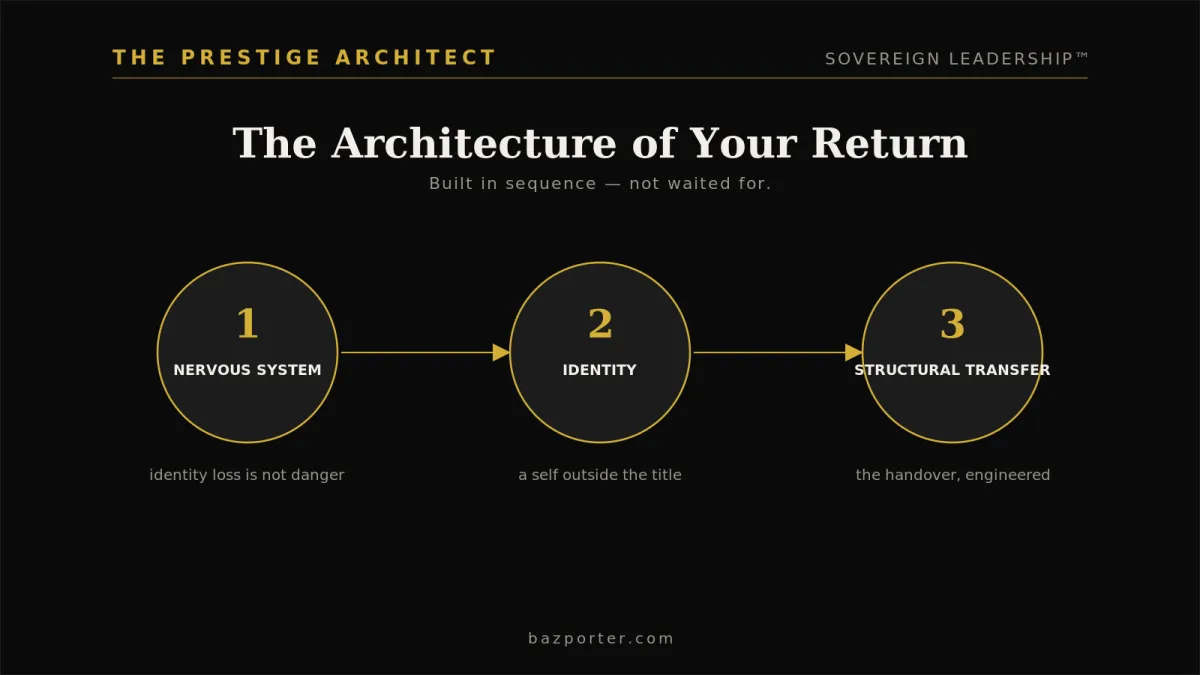
The architecture of your return
Return is not a teardown. It is coming home to what you actually want, with the structure to hold it.
The architecture has three moves. First, tell the truth about the gap between who you were and who you are. Second, keep what still fits and name what does not. Third, run small experiments toward the next design, in place, before you touch anything drastic.
You do not owe your old plan your whole life. You built it. You can build again. The restlessness is the start of that build, not the end of you.
When you are ready to map it with a guide, apply through the Fast Future Freedom Blueprint. It is where the return begins.
Questions leaders ask
Is it normal to want to walk away from a life you worked hard to build?
Yes. It is common among high achievers in their forties and fifties. The wish to walk away is usually not about the life itself. It is about the gap between who you were when you built it and who you are now. The feeling is a signal to redesign, not always to leave.
How do I know if I truly outgrew my life or I am just burned out?
Burnout eases with rest. An outgrown life does not. If time off helps and the pull returns the moment you go back, the issue is fit, not fatigue. Outgrowing feels like restlessness that rest cannot touch.
Do I have to quit everything to feel like myself again?
No. Most people do not need to detonate their life. They need to redesign it in place. Small experiments, honest edits, and new structure usually close the gap without a dramatic exit. Leaving is one option, rarely the only one.
Why does this restlessness feel so sudden when nothing has changed?
The change was slow but the awareness is sudden. You outgrew the life gradually over years. Then it surfaces all at once, so a healthy shift feels like a crisis. You are catching up to a change that already happened.
What is the first step to rebuilding a life I outgrew?
Start by naming the gap between who chose this life and who is living it. Then take a free entry audit like the Fast Future Freedom Blueprint to see where the fit broke. The first step is honesty, then a map.
Written by Baz Porter®, founder of Baz Porter® and creator of RAMS™. He helps successful leaders in Silent Collapse™ return to the life they actually want.