Only Valued for What You Do: The Usefulness Trap
You said it quietly, almost as a joke. If I were not useful, who would I even be. Nobody laughed, because it was not a joke. It was the floor of how you live.
You are the one people reach for. The dependable one. The fixer. Your value feels real only while you are producing. The moment you stop, a cold question arrives. Do they want me, or do they want what I do. This is Silent Collapse™, the quiet erosion that looks like success from the outside. I have watched it hollow out some of the most capable people I counsel. The way back is not a harder push. It is a return to a self that is more than its output.
Written by Baz Porter®
On this page
Key takeaways
The fear that you are only valued for what you do is called the usefulness trap.
It is learned, not true. You were rewarded for output, so output became your worth.
Being needed is not the same as being known. One can hide the other for years.
The fix is not to do less. It is to let your worth rest on something output cannot touch.
Return beats performance. You rebuild a self that is valued when the work stops.
The short answer
You fear you are only valued for what you do because you were trained to. Somewhere early, love arrived with a task attached. So you learned a rule. Be useful and you are safe. The rule worked. It built your career. It also built a quiet terror. If the usefulness ends, so do you. That is the usefulness trap. Your worth got welded to your output.
The fear is not weakness. It is an old survival strategy still running. The work is to unweld worth from output. Not to stop contributing. To stop needing the contribution to prove you exist.
The hidden pattern
Here is what most capable people miss. Your self-worth became conditional. It pays out only when you perform. Researchers call this a contingency of self-worth.
Jennifer Crocker and Connie Wolfe mapped this in Psychological Review in 2001. When worth is staked on a domain, every event in that domain becomes a verdict on the self. A win is relief, not joy. A pause feels like exposure. The stakes never fall, so the pressure never stops.
Michael Kernis took it further in Psychological Inquiry in 2003. He drew a line between fragile self-esteem and secure self-esteem. Fragile worth needs constant proof. Secure worth does not. The goal is not higher self-esteem. It is worth that stops depending on the next result.
Read those two findings together and the trap is clear. You did not fail. You built a sound structure on a conditional foundation. The structure is strong. The foundation moves. That is why the wins never land and the rest never comes.
The RAMS™ reframe
I counsel leaders through five pillars. They are called RAMS™: Results, Attitude, Authenticity, Mastery, and Systems. The usefulness trap distorts all five. Here is the return.
Results
Collapsed, results are your proof of life. Sovereign, results are the fruit, not the root. You still produce. You simply stop asking the work to tell you who you are.
Attitude
Collapsed, rest feels like risk. You believe the value stops when you stop. Sovereign, you hold a steadier view. Your worth is not on the clock. It does not clock out when you do.
Authenticity
This is the pillar that frees you. Collapsed, you show people your function. You lead with what you can do for them. Sovereign, you let people meet the person underneath the role. That is the whole move this week. You are more than useful. People can value that, but only if you let them see it.
Mastery
Collapsed, mastery is a shield. You get so good that no one can question you. Sovereign, mastery becomes a gift you give freely. It is not the wall you hide behind.
Systems
Collapsed, you are the system. Everything runs through your usefulness. Sovereign, you build structure that holds without you. Then your presence becomes a choice, not a ransom.
Here is the contrast, plainly.
Collapsed: worth is earned each day. Sovereign: worth is a fact you stop auditing.
Collapsed: being needed feels like being loved. Sovereign: being known feels like being loved.
Collapsed: rest is a threat. Sovereign: rest is where you meet yourself again.
Collapsed: you give usefulness. Sovereign: you give presence, and usefulness follows.
Collapsed: if I stop, I am no one. Sovereign: if I stop, I am still me.
Being needed kept you safe. It also kept you hidden. The return is letting people value the part of you that does nothing for them.
If any of this lands, start where it is quiet and free. The Silent Collapse Diagnostic™ shows you where your worth is still welded to output, in about ten minutes.
A case I counseled
A founder came to me at fifty one. The company was thriving. So was the fear. She told me she could not remember the last time someone wanted her company with no agenda. Every relationship had a job attached. She was the one who fixed, funded, and carried. Underneath it sat a thought she had never said aloud. If I were not useful, they would leave.
We did not add tasks. We ran one experiment. For two weeks, she let one person help her without repaying it. No favor returned. No value added back. It felt unbearable at first. She called it the longest two weeks of her life. Then something shifted. The person stayed. The sky held. She learned a thing output had hidden for thirty years. She was wanted, not just used. That is the return. It is not a feeling you force. It is a structure you let yourself test.
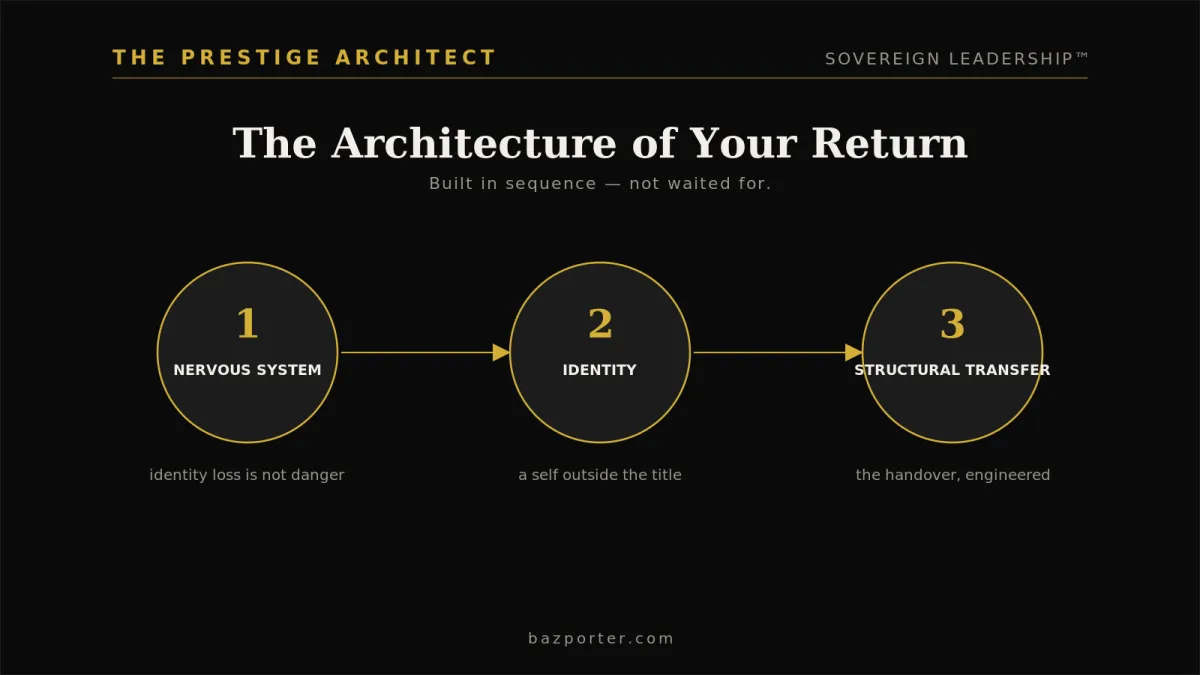
The architecture of your return
You do not fix the usefulness trap by trying harder to believe you matter. You build proof the old rule cannot argue with. You let your worth get tested in safety, and you watch it hold.
That is the work I do with the leaders I counsel inside the container. We find where worth is still staked on output. We rebuild the foundation under the structure you already built. You keep the results. You lose the ransom.
If you want the first step, take the Fast Future Freedom Blueprint. It is the free entry audit. It maps where your value feels conditional and names the first move back to a self that is more than useful.
Questions leaders ask
Why do I feel worthless when I am not being productive?
Because your worth got staked on output. When the output stops, the verdict feels negative. This is a contingency of self-worth, not a true reading of your value. The feeling is real. The conclusion is false. Worth that depends on performance is fragile by design, and it can be rebuilt on steadier ground.
Is wanting to be useful a bad thing?
No. Contribution is good and real. The trap is not usefulness. It is needing usefulness to prove you deserve to exist. You can give freely without staking your identity on the giving. The test is simple. Can you stop and still feel like yourself. If not, the worth is welded too tight.
How is being needed different from being loved?
Being needed is about your function. Being loved is about your person. They can look identical for years. The difference shows up when you stop producing. If the relationship thins, it was built on use. If it holds, it was built on you. Most load-bearing leaders have never run that test.
Can I rebuild my sense of worth without quitting my work?
Yes. You do not need to leave. You need to unweld worth from output while the work continues. That means letting your value get tested in safe places and watching it hold. The results stay. The dependence falls away. This is the return, and it happens inside your real life, not apart from it.
What is Silent Collapse and how do I know if I am in it?
Silent Collapse™ is the quiet erosion that hides behind success. You function at a high level while the inner self goes numb. A clear sign is this fear that you are only valued for what you do. The Silent Collapse Diagnostic™ gives you an honest read in about ten minutes, with no cost and no pitch.
About the author
Baz Porter® is The Prestige Architect™. I counsel accomplished leaders out of Silent Collapse™ and back to a self that is more than useful, using the RAMS™ framework. The work is a return, not a repair.