No One Carries You: The Uncarried Self
You carry everyone. No one carries you. You have noticed the quiet math. You are the one people call. You are rarely the one who calls.
This is not self-pity. It is an accurate ledger. You hold the team. You hold the family. You hold the business. The weight sits on you alone. Underneath the competence is a question you do not say out loud. Who holds me?
I name this state Silent Collapse™. It is the private cost of being the load-bearing wall for a built life. You can read the manifesto behind the return here.
Written by Baz Porter®, architect of sovereign leadership.
On this page
Key takeaways
Being uncarried is not a character flaw. It is a broken exchange.
You trained people to lean. They learned the lesson well.
Carrying everyone is a role. It is not your identity.
Reciprocity is a structure. You can rebuild it on purpose.
The return begins the day you let one weight be held.
The short answer
Why did carrying everyone leave no one carrying you? Because you built a system with one direction of flow. Support left you and rarely came back. People did not conspire. They adapted. You were strong, so they leaned. You never asked, so they never offered. The uncarried self is the result of a reciprocity gap, not a lack of love. The fix is structural. You rebuild the exchange, one honest request at a time, until care runs both ways again.
The hidden pattern
Here is the part most capable leaders miss. Relationships run on exchange. Sociologist Alvin Gouldner called it the norm of reciprocity (Gouldner, 1960, American Sociological Review). Healthy bonds rest on balanced give and take. When one person gives and gives, the balance does not just tilt. The bond itself weakens.
You became the permanent giver. That felt generous. It was also a slow erosion. People stopped seeing a person who had needs. They saw a resource. A resource does not get carried. It gets used.
The ache you feel is not weakness. It is data. It is your own system telling you the exchange has run one way for too long.
The RAMS™ reframe
My RAMS™ model reads this across five pillars. Here is the shift from the collapsed pattern to the sovereign one.
Results
Collapsed results look like output. You measure the day by how much you held. Sovereign results count differently. You ask what got built that no longer needs you. A load you can set down is a result. A dependency you quietly carry is a cost.
Attitude
The collapsed attitude says needing help is failing. So you never ask. The sovereign attitude is simpler. Needing is human. Asking is leadership. You model the thing you want your people to be able to do. Your silence taught them to lean. Your request can teach them to reach back.
Authenticity
Here is the raw truth. You are not only the strong one. You are a person who is tired, and that is real. Authenticity is letting someone see the tired. Not the whole weight at once. One honest sentence. The relationships that can hold that sentence are the real ones. The rest were leaning on a role.
Mastery
Mastery is not carrying more with less complaint. That is endurance. Mastery is designing the load so it does not all route through you. You learn to hand a weight cleanly. You learn to receive without flinching. Both are skills. Both can be practiced.
Systems
This is the heart of it. You do not have a willpower problem. You have a system problem. The flow goes out and does not return. Systems can be redesigned. You name who carries what. You ask for one thing back. You let the small asks land before the large ones. The structure does the work your stamina has been doing.
Collapsed versus sovereign, in plain terms:
Collapsed: you hold it all. Sovereign: the load is shared on purpose.
Collapsed: asking feels like failing. Sovereign: asking is a design choice.
Collapsed: people see a resource. Sovereign: people see a person.
Collapsed: care flows one way. Sovereign: care runs both ways.
Collapsed: you are needed. Sovereign: you are known.
You were never meant to be the only one standing. The strength is not in holding everything. The strength is in letting the structure hold its share.
If you want to see where the exchange broke, start here. Take the Silent Collapse Diagnostic™ here. It maps where your load runs one way and where it can run both.
A case from the room
A leader sat with me last spring. Call them the anchor of a company and a family at once. Fifty-one. Admired. Tired in a way sleep did not touch.
They said one line I remember. "If I stopped, I would find out how alone I am." That is the fear under the carrying.
We did not add a resilience trick. We looked at the exchange. Researcher Johannes Siegrist named the risk precisely. High effort met with low reward predicts breakdown (Siegrist, 1996, Journal of Occupational Health Psychology). They were spending everything and receiving almost nothing back.
So they ran one experiment. They asked a deputy to own a decision fully. They asked a sibling to handle one family call. Small. Deliberate. Both held. Nothing fell. The anchor felt a strange thing that week. Carried.
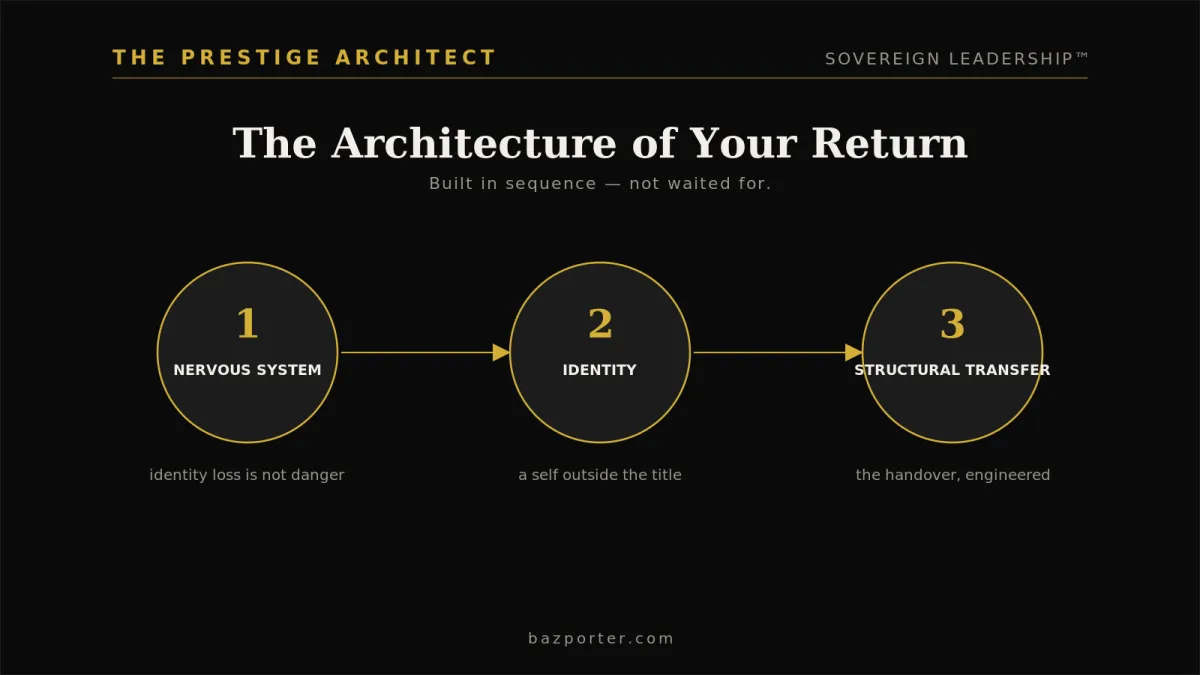
The architecture of your return
The return is not a grand gesture. It is a rebuilt exchange. You start where the gap is widest and the risk is lowest.
Name one weight you carry that someone else could hold. Hand it fully. Do not supervise it back onto your plate. Then ask for one thing. Let it be small enough that saying yes is easy for them and strange for you.
Watch what happens. The people who step up are your real structure. You stop being the only wall. You become a person inside a building that stands.
This is the work I counsel leaders through. When you are ready to design it, apply for the Fast Future Freedom Blueprint here.
Questions leaders ask me
Why do I feel like no one carries me?
Because the exchange in your relationships runs mostly one way. You give support and rarely request it. Over time people stop offering, not from coldness, but because you taught them you do not need it. The feeling is accurate. It points to a structure you can change.
Is it weak to want to be taken care of?
No. Wanting to be held is a basic human need, not a flaw in a strong person. Strength and need are not opposites. The leaders who last are the ones who let care run both ways. Receiving is a skill, and it keeps you standing.
How do I ask for help without feeling like a burden?
Start small. Ask for one specific thing that is easy to give. A single decision, a single task, a single call. Small requests let people say yes without strain. Each yes rebuilds the exchange and lowers the fear that asking makes you a weight.
What if I ask and no one shows up?
Then you have learned something important. Some bonds were leaning on your role, not on you. That is painful and clarifying. The people who do show up are your true structure. You build the next season of your life around them, not around the ones who only took.
Where do I start if I am the one everyone leans on?
Begin with the Silent Collapse Diagnostic™. It shows you where your load runs one way. From there you redesign the exchange on purpose. The return starts the day you let one weight be carried by someone else.
About the author
Baz Porter® is the architect of sovereign leadership and the creator of the RAMS™ model and the Silent Collapse Diagnostic™. He counsels established leaders moving out of Silent Collapse™ and back to a self that is more than useful.
He is the founder of Baz Porter LLC® and the architect of Sovereign Leadership Architecture™. He guides high-achieving leaders toward Sovereign Leadership™. He is an international bestselling author and the host of the Rise From The Ashes podcast on the C-Suite Network.