Moral Injury at Work: When Leaders Betray Themselves
Written by Baz Porter®
You made the call. The layoff. The compromise. The number over the person. You told yourself it was the job, and you were right. And still, something inside you went quiet. This is moral injury, and it is the wound underneath what most leaders name as burnout. It is the private cost of Silent Collapse™, the state I built the manifesto to name.
What Is Moral Injury At Work?
Moral injury is the damage you carry when your actions cross your own values. It is not weakness. It is not fatigue. It is the felt gap between what you believe is right and what your role required you to do. Senior leaders often carry it heaviest. You sit close to the levers. You feel responsible for the harm and constrained from stopping it. So you act, and the injury settles in.
Burnout is depletion. Moral injury is a violation. You can rest a tired body. You cannot rest away a decision that betrayed your conscience. That is why the vacation did not land. The exhaustion was never only in your calendar. It was in your integrity.
Key Takeaways
Moral injury is the wound of acting against your values, not simple tiredness.
Leaders carry it hardest because they hold the levers and the responsibility.
It shows up as guilt, then numbness, then a slow loss of meaning.
The return is structural. You rebuild the alignment between your role and your values.
The Short Answer
Moral injury at work is the lasting harm that follows a choice, an order, or a silence that violated your moral code. It is distinct from burnout. Burnout comes from load. Moral injury comes from a breach of conscience. In leaders it presents as guilt, shame, cynicism, and a quiet emotional flatness that rest does not touch. The way out is not more recovery time. It is a rebuild of how you decide, so your role stops asking you to abandon yourself. That rebuild is the work of Sovereign Leadership™.
The Hidden Pattern Beneath The Guilt
Here is the pattern I see in the room. The guilt comes first. Then anger at the system that forced the choice. Then shame, turned inward. Then, worst of all, numbness. You stop feeling the harm. Then you stop feeling much at all.
Clinical researchers named this sequence. Litz and colleagues defined moral injury as the lasting harm from acts that transgress deeply held moral beliefs (Litz et al., 2009, Clinical Psychology Review). The business world is catching up. Harvard Business Review reports that people are done being asked to make moral compromises at work (HBR, 2022). The high performer does not quit loudly. She goes silent inside, and calls it composure.
The RAMS™ Reframe
RAMS™ is my operating system. Results, Attitude, Authenticity, Mastery, Systems. It works at the level of the business and the level of the nervous system. Run moral injury through all five.
Results. You have hit the targets. The numbers say you won. Your body says otherwise. Real results include the cost you paid to get them. A win that hollows you out is a loss on a delay.
Attitude. You have framed the numbness as strength. It is not resolve. It is a signal. Your conscience is still working. The flatness is proof it has not gone dead.
Authenticity. This is the center of the wound. You acted against yourself and kept the mask on. Authenticity is not a mood. It is the alignment between what you value and what you do. Moral injury is that alignment torn.
Mastery. Mastery is not doing more. It is deciding cleaner. A leader with mastery names the values before the pressure, so the hard call does not require self-abandonment.
Systems. You cannot willpower your way out of a values breach. You need a decision architecture that holds your line under load. That is a system, not a mood.
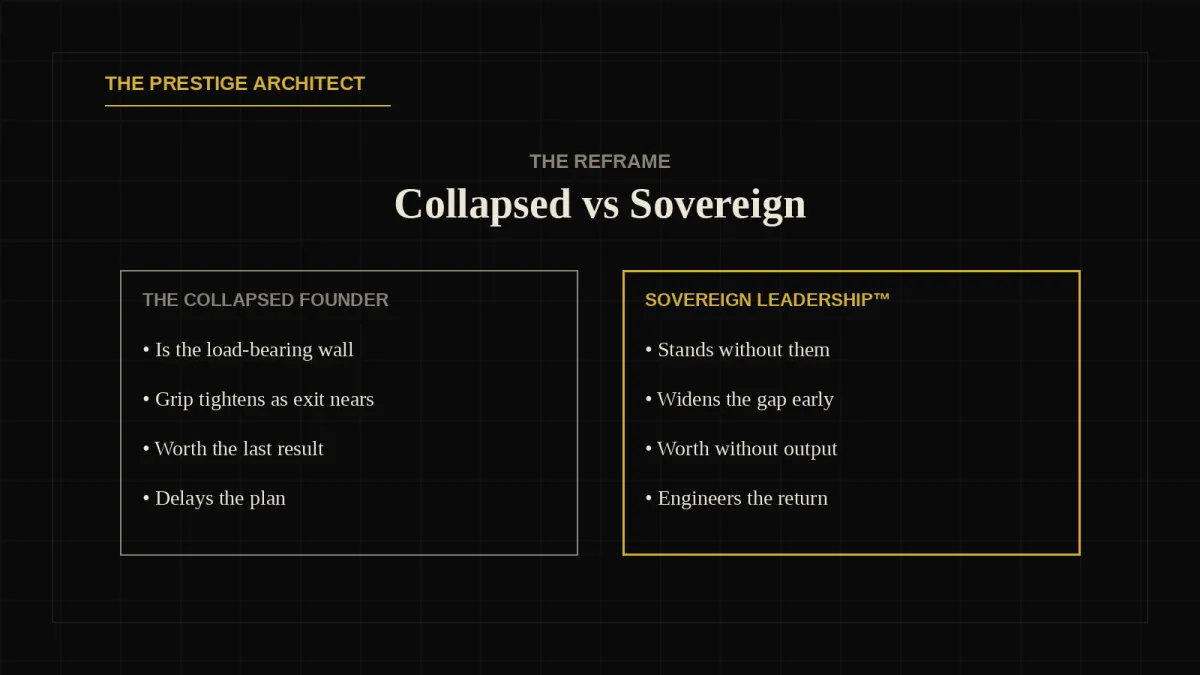
Collapsed Versus Sovereign
Collapsed: You bury the choice and call the numbness professionalism. Sovereign: You name the breach and rebuild the line you crossed.
Collapsed: You blame yourself alone. Sovereign: You see the system that forced the choice and redesign your place in it.
Collapsed: You chase more rest for a wound rest cannot reach. Sovereign: You repair the alignment between your role and your values.
Collapsed: You lead from guilt. Sovereign: You lead from a code you no longer betray.
Baz Porter does not motivate. He does not inspire. He architects the return of leaders who look successful and feel erased.
If the numbness is familiar, name it before it deepens. The Silent Collapse Diagnostic™ is sixty minutes, live with me, to locate the exact breach and the first repair.
A Case From The Room
A founder sat across from me. Forty-nine. Nine figures in exits. She had cut a team to hit a board number she did not believe in. The metrics recovered. She did not. She described it as burnout. It was not. It was moral injury.
We did not add rest. We rebuilt her decision architecture. We named her non-negotiables before the next pressure arrived. We separated the choices the system forced from the ones she owned. The guilt did not vanish. It became information. Within weeks the flatness lifted, because she stopped asking recovery to fix a breach of conscience.
She had spent a year treating the wrong wound. She kept booking the spa week. She kept clearing the calendar. Nothing held, because the injury was in her conscience, not her schedule. Once she repaired the alignment, her drive returned clean. She led the next hard quarter without abandoning herself once. That is the difference between recovery and repair.
The Architecture Of Your Return
You do not heal moral injury with a holiday. You rebuild the way you decide. You draw the line your role kept asking you to cross. You build the system that holds it when the pressure returns. That is the architecture of the return, and it is the whole of Sovereign Leadership Architecture™.
Start where the wound is clearest. Apply for the Silent Collapse Diagnostic™. Sixty minutes, live with me. We find the breach, and we design the first repair.
Frequently Asked Questions
What is moral injury at work?
Moral injury at work is the lasting harm you carry after an action, order, or silence that violated your own values. It is distinct from stress or fatigue. It arises when your role asks you to do something you believe is wrong, or to witness harm you cannot prevent.
How is moral injury different from burnout?
Burnout comes from excessive load and depletes your energy. Moral injury comes from a breach of conscience and damages your sense of self. Rest can ease burnout. Rest cannot repair a decision that crossed your values. The two often occur together, which is why leaders confuse them.
Why do leaders experience moral injury more than others?
Leaders sit close to the levers of harm and hold direct responsibility for the outcomes. They enforce policies they privately question and execute choices framed as optimization. That proximity to power, paired with limited freedom to refuse, deepens the injury rather than easing it.
What are the signs of moral injury in high achievers?
The signs move in a sequence. Guilt, then anger, then shame turned inward, then emotional numbness. High achievers often read the numbness as composure and keep performing. The flatness that rest does not fix is the clearest signal.
Can moral injury be repaired?
Yes. Repair is structural, not merely emotional. You name the values that were crossed, rebuild your decision architecture so your role stops requiring self-abandonment, and restore the alignment between what you believe and what you do. That rebuild is the work of the return.
About The Author
Baz Porter® is the founder of Baz Porter LLC® and The Prestige Architect™. A British Army veteran and international bestselling author, he hosts the Rise From The Ashes podcast on the C-Suite Network. He architects the return of high-achieving leaders from Silent Collapse™ to Sovereign Leadership™. Power without collapse. Success without self-betrayal.