Why You Keep Changing Your Ideal Client
You have rewritten your ideal client four times this year. Each version felt right for a week. Then a new idea arrived, and you started the whole thing over. This is not a marketing gap. It is Silent Collapse™, the quiet erosion that reaches high-achieving founders when the work stops matching the person doing it. Every rewrite resets your offer. It resets your message. It resets your nerve. You are not losing faith in the business. You are losing faith in yourself. There is a cleaner way to read this pattern, and it begins with the manifesto.
Written by Baz Porter®
Contents
Key Takeaways
Changing your ideal client is a symptom, not a strategy. The churn hides a deeper reset.
Every new buyer starts your offer, your message, and your confidence back at zero.
The cause is not indecision. It is that no single buyer is protected long enough to become real.
Commitment to one buyer is what makes the work compound. Focus is architected, not found.
The Silent Collapse Diagnostic™ names the real buyer under the noise, in one hour.
Why You Keep Changing Your Ideal Client
Here is the plain answer. You keep changing your ideal client because no single buyer is ever protected long enough to become real.
A new idea is louder than an old commitment. So the target moves, and everything downstream resets with it. Focus is not a feeling you wait for. It is a structure you build.
Read that again. The problem is not that you cannot decide. You decide often. You decide well. The problem is that each decision gets overwritten before it can bear weight. You name a buyer on Monday. You build a page for them by Wednesday. On Friday a sharper idea arrives, and the buyer changes. Now the page is wrong. The offer is wrong. So you rebuild from zero. Again.
This is the engine behind "ideas everywhere, nothing finished." It is not laziness. It is not a talent gap. It is an unprotected target. And an unprotected target cannot hold a business on top of it.
The Hidden Pattern
There is real science under this. Sheena Iyengar and Mark Lepper studied what happens when people face too many options. In their 2000 study in the Journal of Personality and Social Psychology, shoppers offered twenty-four choices were far less likely to commit than shoppers offered six (Iyengar & Lepper, 2000). More options did not free them. More options froze them.
You are living that finding every week. Your market is not six buyers. It is every buyer you can imagine. So commitment stalls, and the target keeps sliding.
There is a second mechanism, and it is the way out. Arie Kruglanski and colleagues call it goal shielding. When you commit hard to one goal, your mind actively suppresses the competing ones (Shah, Friedman & Kruglanski, 2002). The alternatives go quiet. The chosen path gets clear. Without that commitment, every rival idea stays loud, and none of them can be built. Commitment is not a mood. It is a filter your brain runs once you choose.
The RAMS™ Reframe
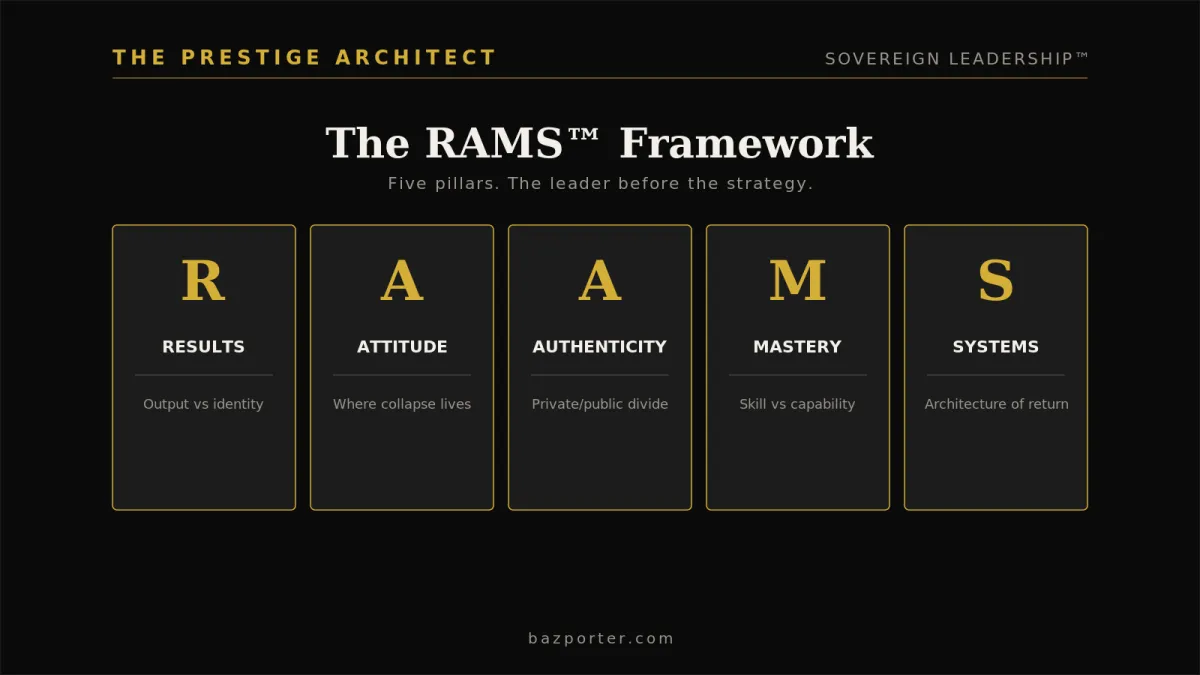
RAMS™ is the operating system I use to end this churn. It has five pillars. We read your pattern through all five.
Results. Name the result one buyer needs, not the many results a crowd keeps asking for. A single, specific outcome is something you can finish. Ten possible outcomes is a list you rebuild every week.
Attitude. Stop treating the reset as proof you cannot do this. The reset is data, not a verdict. Each rewrite is telling you the target was never protected. That is a design flaw, not a character flaw.
Authenticity. The buyer you keep abandoning is often the one closest to your own story. You skip past them because they feel too obvious. Obvious is not small. Obvious is where your authority already lives.
Mastery. Mastery comes from depth on one buyer, over time. You cannot master a target that changes monthly. Depth is what turns a service into an offer people trust.
Systems. Protect the target with a system, not with willpower. Write the buyer down. Date it. Hold it for ninety days, no rewrites. The system shields the choice so your work can finally compound.
Here is the contrast, stated plainly.
Collapsed: The buyer changes when a new idea arrives. Nothing finishes. Every week starts at zero.
Sovereign: The buyer is chosen, written, and protected. New ideas wait their turn. The work stacks.
Collapsed: Confidence rises and falls with the latest concept.
Sovereign: Confidence comes from depth on one commitment held over time.
Collapsed: You are the only thing holding it together, by force, every single week.
Sovereign: The structure holds it, so you are free to build on top of it.
"Baz Porter does not motivate. He does not inspire. He architects. That is why the work holds."
If you cannot tell whether this is your pattern, read it directly. The Silent Collapse Diagnostic™ shows you, in one hour, the buyer you keep circling and the reset that keeps costing you.
A Case In Point
A founder came to me with a familiar story. Four ideal clients in six months. Four home pages. Four offers, none of them live. They were not short on ideas. They were short on one protected target.
We did one thing first. We named a single buyer and dated the commitment. Ninety days, no rewrites, no matter what new idea arrived. The relief was immediate, and so was the resistance. A shinier buyer appeared in week two. We held.
By week nine the offer was finished. Not perfect. Finished. For the first time in a year, the work had compounded instead of resetting. The founder said the quiet part out loud: "I thought I had an idea problem. I had a commitment problem." That is almost always the truth under the churn.
The Architecture of Your Return
You do not need another idea. You have too many already. You need one buyer, protected, long enough to build on. That is not a mindset trick. It is architecture, and it can be designed.
This is the return. Not a new self. The self that was already there, before the resets convinced you otherwise. Sovereign Leadership™ starts the moment you protect one choice and let it hold weight.
When you are ready to name the real buyer and stop rebuilding from zero, apply for the Silent Collapse Diagnostic™. One hour. We find the target under the noise, and the reset that keeps taking it from you.
Frequently Asked Questions
Why do I keep changing my ideal client?
Because no single buyer is protected long enough to become real. A new idea overwrites the last target before it can bear weight. The churn is a commitment gap, not an indecision problem. When you shield one choice, the work stops resetting.
Is changing my ideal client a sign my business is failing?
No. It is a sign the target was never protected. That is a design flaw you can correct, not proof you cannot do this. The reset is data telling you where the structure is missing. Read it as information, not as a verdict on you.
How long should I commit to one ideal client before switching?
Commit for ninety days with no rewrites. Write the buyer down and date it. Ninety days is long enough for the work to compound and for real signal to arrive. Switching before then means you are reading noise, not results.
What is the difference between focus and just picking a niche?
A niche is a label. Focus is a protected structure. Picking a niche once does nothing if a new idea can overwrite it next week. Focus is the system that shields the choice so your offer, message, and confidence can finally stack.
How does the Silent Collapse Diagnostic™ help with this?
It names the real buyer under the noise in one hour. It shows you the reset pattern that keeps costing you, and where the target keeps slipping. You leave with one protected commitment, not ten open tabs. That is the start of the return.
Baz Porter® is the founder of Baz Porter LLC and The Prestige Architect™. He guides high-achieving people from Silent Collapse™ to Sovereign Leadership™. Power without performance. Peace without retreat.