Internal Locus of Control: Own Your Response
Written by Baz Porter®
You run the company. You do not run your own inner weather. That gap has a name. It is Silent Collapse™, the private erosion under a public win. Most leaders trace their unease to the market, the board, or the quarter. The real variable sits closer. It is where you locate the source of your outcomes. Rebuild that one setting and the whole system steadies. This is the work behind the Sovereign Manifesto.
On this page
Key takeaways
An internal locus of control is the trained belief that your response, not your circumstance, drives your outcomes.
It is built, not inherited. You install it through repeated, deliberate choice.
An external locus of control quietly powers Silent Collapse™. You feel run by forces outside you.
The target is a moderate internal locus, not a total one. You own your response, not every result.
Sovereign Leadership™ is built here. You author the inside first, and the outside follows.
What is an internal locus of control in leadership?
An internal locus of control is the orientation that your own actions, choices, and responses shape what happens to you. A leader with an internal locus of control owns the response to a hard quarter. They do not hand the whole result to the market. The idea is simple. Your locus of control is the source-point you assign to outcomes. Sovereign Leadership™ treats it as a built capacity, not a personality type. You strengthen it by catching the reflex to explain results away, then choosing the response you control. Aim for a moderate internal locus. You own your reaction and your standards. You do not pretend to own the weather.
The hidden pattern
The concept is not new. In 1966, psychologist Julian B. Rotter defined internal versus external control of reinforcement (Rotter, Psychological Monographs, 1966). His finding held for six decades. People who locate control inside themselves act, learn, and recover faster. People who locate it outside tend to wait.
Here is what most leaders miss. A moderate internal locus predicts stronger career outcomes and steadier stress management (BetterUp). Yet an extreme internal locus turns on its owner. It becomes self-blame for events no one could steer, and a need to control everything, including people. Research on locus of control in leader relationships shows the same tension between drive and over-reach (National Library of Medicine). The pattern is not "own everything." It is "own your response, release the rest." That precision is the line between command and collapse. Locus of control is also a choice you can practice, caught one excuse at a time (MindTools). The leaders who last treat it as a daily discipline, not a mood.
The RAMS™ reframe
I do not motivate. I architect. RAMS™ is the operating system I use to rebuild a leader from the inside. It has five pillars: Results, Attitude, Authenticity, Mastery, and Systems. Locus of control runs through all five.
Results. An external locus reads a miss as fate. An internal locus reads it as data. You ask one question. What was mine to move? Then you move it. Results follow ownership, not worry.
Attitude. Your stance is not your mood. It is a chosen posture toward events. You train it like a muscle. A setback stops being a verdict on you. It becomes an input you use.
Authenticity. An external locus outsources your standards to the room. You perform for approval and lose your own line. An internal locus sets the standard from the inside. Your yes and your no become yours again.
Mastery. Skill compounds only when you believe practice pays. That belief is an internal locus in action. Without it, you stop training and start waiting for luck to arrive.
Systems. A locus is not willpower. It is a system of small, repeated responses. You build cues, defaults, and reviews that make ownership the path of least resistance. The system holds the standard when your energy dips.
Here is the same leader, before and after the rebuild.
Collapsed: reacts to the quarter. Sovereign: responds to the part they control.
Collapsed: waits for conditions to change. Sovereign: changes their own input first.
Collapsed: reads criticism as a ruling. Sovereign: reads it as information.
Collapsed: self-worth rides on the result. Sovereign: self-worth rides on the standard held.
Collapsed: owns everything and burns out. Sovereign: owns the response and rests.
Power without collapse is not control of the world. It is command of your own response.
If you cannot tell where your locus sits right now, start there. The Silent Collapse Diagnostic™ is 60 minutes, one to one with me, to map it.
A leader who rebuilt it
A founder came to me after a funding round fell through. She read it as proof she was not enough. Every outcome lived outside her. The board's mood. The investor's silence. The market cycle. She was capable and exhausted at the same time.
We did not add drive. She had plenty. We rebuilt the locus instead. Each morning she named one event and split it in two. The part she controlled sat on one side. The part she did not sat on the other. She acted only on the first. Within weeks the panic dropped. The pipeline did not change overnight. Her relationship to it did. She stopped waiting to be rescued and started leading again.
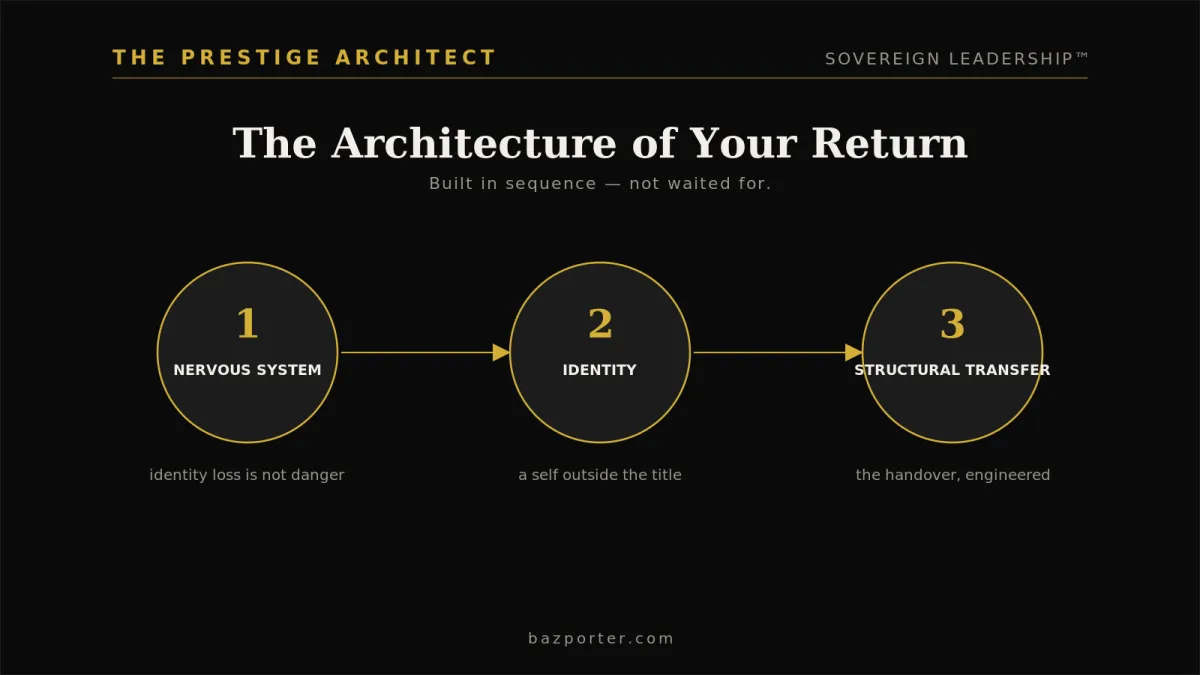
The architecture of your return
An internal locus of control is not a slogan. It is a build. You install it with three moves, repeated daily. Name the event. Split what is yours from what is not. Act on your part and release the rest. Do that long enough and it stops being effort. It becomes who you are under pressure. The circumstance keeps changing. Your source-point stops moving with it.
This is the foundation of Sovereign Leadership™. You author the inside first, then the outside follows. If you are ready to rebuild it with counsel and not theory, apply for the Silent Collapse Diagnostic™.
Questions leaders ask
What is the difference between an internal and external locus of control?
An internal locus of control means you believe your actions drive your outcomes. An external locus means you credit outcomes to luck, fate, or other people. Most leaders carry a mix of both. The aim is to weight it toward the internal without tipping into self-blame.
Can you change your locus of control as an adult?
Yes. Locus of control is a learned expectancy, not a fixed trait. You shift it by catching the reflex to explain outcomes away, then choosing the response you control. Repetition rewires the default over weeks and months.
Is a strong internal locus of control always good for leaders?
No. A moderate internal locus predicts the best outcomes. An extreme one leads to over-control, difficulty taking direction, and self-blame for events no one could steer. Own your response, not every result.
How does locus of control relate to burnout?
An external locus feeds burnout because you feel run by forces outside you. You work harder without a sense of traction. Rebuilding an internal locus restores the felt link between effort and result, which lowers chronic stress.
How do I start building an internal locus of control today?
Pick one event from your day. Split it into the part you controlled and the part you did not. Act on the first and release the second. Do this daily. The habit installs the orientation faster than any single insight.
About the author
Baz Porter® is the founder of Baz Porter LLC® and The Prestige Architect™. A British Army veteran and international bestselling author, he architects the return from Silent Collapse™ to Sovereign Leadership™: power without collapse, success without self-betrayal. He is the host of the Rise From The Ashes podcast.