In Charge on Paper, in Control of Nothing
You run the meetings. You approve the plans. Your name sits at the top of the chart. On paper, you are in charge of everything. Then you watch what actually happens. You control almost none of it.
People agree in the room and do the old thing. Work moves without you and around you. You hold the outcome for calls you cannot command. You feel in charge. You are in command of nothing. This is a real state, and it has a name: Silent Collapse™. You are not failing. Your control was never where you thought it was. The way back is a return to authority that lives in who you are, not the seat you sit in.
Written by Baz Porter®, The Sovereign Leadership Architect.
On this page
- Key takeaways
- Why you feel in charge of everything and in control of nothing
- The hidden pattern under the illusion of control
- The RAMS™ return across five pillars
- The first move you can make this week
- What this looks like in a real room
- The architecture of your return
- Questions leaders ask
Key takeaways
- Being in charge is a position. Being in control is a result.
- Routing everything through you feels like control. It is the opposite.
- The harder you grip, the less actually holds.
- Real control is what stands when you step out of the room.
- The first move is small, and you can start it this week.
Why you feel in charge of everything and in control of nothing
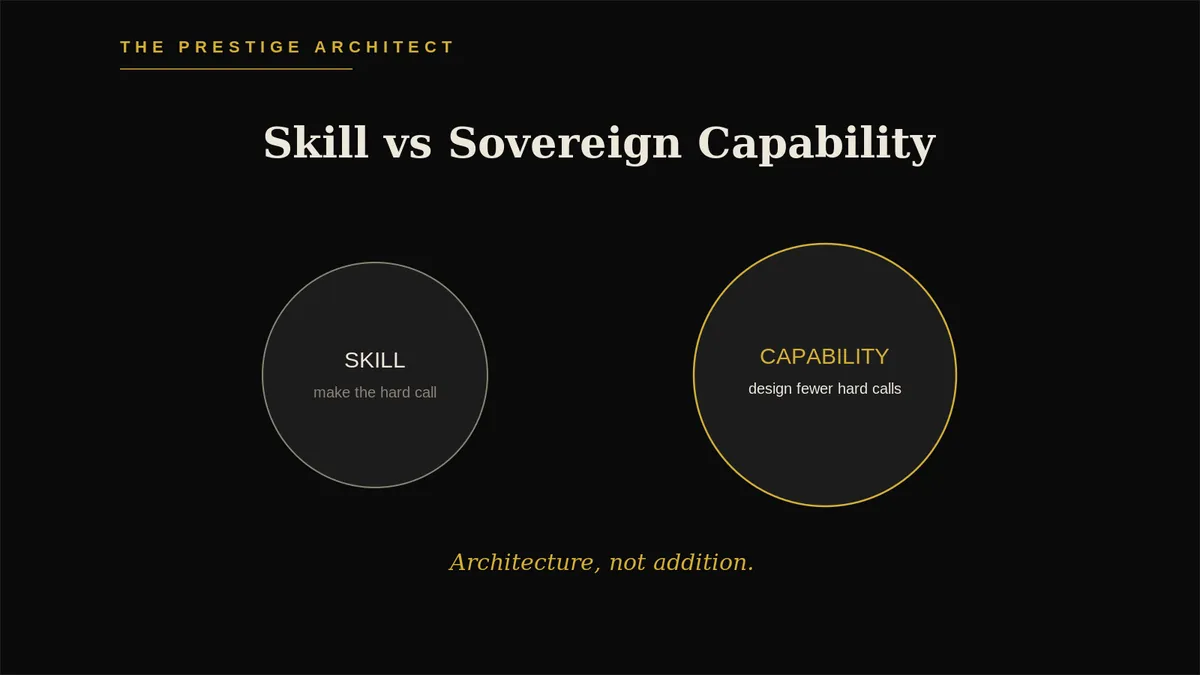
You feel in charge because the signals of charge are everywhere. The title. The chart. The meetings you run. The decisions that cross your desk. You confused those signals with control. They are not the same thing. Being in charge is a position. Being in control is an outcome you can produce and hold.
Here is the hard part. The things that make you feel in charge are the same things that drain your control. Every decision you pull toward you trains the room to wait for you. Every task you touch teaches people to stop owning it. You become the center of the motion. You stop being the source of the result. People in Silent Collapse™ feel this as a strange exhaustion. They are busy at the center and powerless at the edge. The work of Baz Porter®, The Sovereign Leadership Architect, rebuilds control at its real source, through the RAMS™ framework. Control returns when you stop mistaking motion for power.
The hidden pattern under the illusion of control
Psychologists have a name for this. They call it the illusion of control. It is the tendency to believe you are steering an outcome when you are only standing close to it. Being at the center of activity feels like causing the result. Often you are only near it. Research on social power explains why the gap stays hidden.
Power at work comes in two forms. One is positional. It comes from the title and the chart. The other is personal. It comes from who you are, what you know, and how people feel you. Studies on supervisor social power show that personal power raises real commitment, while positional power earns compliance in the room and disengagement after (supervisor social power and employee commitment study). The long-standing guidance on leading without authority says the same. You produce real movement by trading in trust and value, not by holding the seat (Harvard Business Review).
So the pattern is simple and cruel. Positional control is loud and empty. It makes people comply while you watch. It makes nothing hold when you leave. You feel in charge because compliance looks like control from the center. It is not. The seat produces motion. Only trust produces control.
There is a second cost. The harder you grip, the faster control leaks. Each thing you pull back teaches the team that ownership lives with you. So they stop owning. So more routes to you. So you grip harder. The loop tightens. The chart still says you are in charge. The control has already left the building.
The RAMS™ return across five pillars
RAMS™ is the framework beneath real control. Results, Attitude, Authenticity, Mastery, Systems. Here is the return, pillar by pillar, led by Results.
Results. Stop counting activity. Count outcomes that hold without you. Name one result you own and let it stand on its own weight. Control is measured by what survives your absence, not by how much passes through your hands.
Attitude. Drop the belief that gripping tighter is leadership. The grip is fear wearing a suit. People feel it and pull back. Lead from steadiness instead. Steadiness is the posture of someone who does not need to hold everything to feel safe.
Authenticity. This is the center. People give real control to a leader they can feel is real. A borrowed, performing self earns only compliance. Say the true thing plainly. Let people meet the actual you. That is what they follow when you are not in the room.
Mastery. Deepen the one thing only you can do. Expertise is control the title cannot fake. When you are the clearest mind in the room, people bring you the hard call by choice. That is pull, not push.
Systems. Build agreements and structures that hold without your presence. Control that needs you in the room is supervision. Design the follow-through so it carries itself. A system you do not have to watch is the only control that scales.
Here is the contrast, felt from the inside.
- Collapsed: everything routes through you, and you call that being in control.
- Sovereign: the work holds without you, and that is control.
- Collapsed: you grip harder when things slip.
- Sovereign: you build the thing that does not slip.
- Collapsed: your power ends at the door of the room.
- Sovereign: your power walks out of the room inside other people.
Control is not everything passing through your hands. It is what still stands after you take your hands off.
If you want to see where your control actually leaked, start here. The Fast Future Freedom Blueprint™ is a free 60-minute identity audit. It shows you the exact place you traded real control for the feeling of it.
The first move you can make this week
Pick one thing that routes through you by habit. A sign-off. A check. A decision people bring you that they could own. This week, hand it fully to one person. Give them the outcome, not the task. Tell them you will not take it back.
Then watch yourself. Watch the urge to check in. Watch the fear that it will slip. Sit with it. Do not grab the thing back. What you feel is not a warning. It is withdrawal from the illusion. If the work holds without you, you just learned where real control lives. Repeat it with one thing a week. Control grows the way trust does, quietly and then all at once.
What this looks like in a real room
The leaders I sit with who feel this almost always share one history. They rose by being the one who caught everything. Nothing dropped on their watch. They were the safe pair of hands. The organization rewarded it with a bigger seat. So they learned one lesson deep in the body. Control means I hold it myself.
Then the scope grew past what any one person can hold. The old habit kept running. They reached for more, touched more, checked more. The team read it as distrust and stepped back. More fell to the center. The leader felt busier and less in control at the same time. It is a loop, and it is common. It is not a flaw in them. It is a stage almost no one is warned about.
The architecture of your return
You can begin the return on your own. Pick one thing that routes through you. Hand it over fully. Keep your hands off. Watch what the work does without you. That first move is real, and it is yours.
Here is the limit of doing it alone. You cannot see the belief you are standing inside. The place where you first fused control with holding it yourself usually sits below your own view. It lives at the level of identity, not habit. That is the part a 60-minute audit is built to find. Bring the one thing you cannot let go of, and the question underneath it. Who am I if I am not the one holding everything?
Apply for the Fast Future Freedom Blueprint™. One hour. No charge. You leave with the map of where your control returns.
Questions leaders ask
Why do I feel in charge but have no real control?
Because the signs of being in charge are not control. The title, the meetings, and the decisions on your desk are position, not power. They make people comply while you watch. Real control is the result that holds when you step away, and that comes from trust, not from the seat.
What is the difference between being in charge and being in control?
Being in charge is a position you are given. Being in control is an outcome you can produce and hold. Charge earns short-term compliance in the room. Control earns commitment that holds when you are not there. One is the seat. The other is who you are in it.
Why do I feel more out of control the more I try to control everything?
Because every task you pull back teaches people to stop owning it. Ownership moves to you, so more routes to you, so you grip harder. The loop tightens and real control leaks out. Gripping is the behavior that drains the thing it is trying to protect.
How do I get real control back as a leader?
Start by handing one thing fully to one person and keeping your hands off it. Trade in trust, clarity, and expertise instead of rank. Build agreements that hold without you in the room. The deeper rebuild happens at the level of identity, which is the work of the Fast Future Freedom Blueprint.
About the author
Baz Porter® is The Sovereign Leadership Architect. He rebuilds the identity beneath high performance, so leaders decide, lead, and live from a self that is genuinely their own. He works with accomplished people who look strong on the outside and feel unseen on the inside. His work begins underneath the visible problem, at the level of state of being. Learn more about Baz Porter®.