Hyper-Independence: Why You Can't Ask for Help
Written by Baz Porter®
You run the company. You carry the team. You solve what no one else can solve. And you do it alone, because asking for help feels like a small death. This is hyper-independence, and in high achievers it is rarely strength. It is a wound wearing a suit. It is one of the quiet engines of Silent Collapse™, the private erosion that hides behind a public win. If you have read the manifesto, you already know the shape of this. Power without collapse is the whole point.
Here is the part no one says out loud. The world rewards you for it. They call you dependable. They call you a rock. And every time they do, the door closes a little more.
In this article
Key takeaways
Hyper-independence is compulsive self-reliance. It is the refusal to need anyone.
In leaders it reads as strength. Underneath, it is a protection the nervous system built.
The cost is hidden: chronic isolation, thin trust, and a team that cannot reach you.
It is a pattern, not a personality. Named clearly, it can be rebuilt.
The RAMS™ reframe moves you from armored to sovereign, one pillar at a time.
What is hyper-independence in leaders?
Hyper-independence is compulsive self-reliance. It is the refusal to need anyone, ever. In leaders it looks like strength. You carry every load. You ask for nothing. You trust no one with the real weight. Underneath, it is a defense. The nervous system learned that needing people was not safe, so it shut the door and called that door discipline. Silent Collapse™ often lives right here. The wins keep landing. The isolation keeps growing. This is not a flaw in your character. It is a pattern you can name and rebuild.
The hidden pattern
Most leaders think self-reliance is a virtue they earned. The evidence says it is often a scar they adapted around. The psychiatrist John Bowlby, who built attachment theory, named this exact state decades ago. He called it compulsive self-reliance: a defensive style that forms when a person learns early that depending on others brings disappointment or harm (Bowlby, Attachment and Loss, 1980). The mind solves the danger by refusing the need.
So the pattern is not weakness. It is a survival move that outlived the threat. The child who could not lean on anyone becomes the executive who cannot delegate. The research is blunt about the price. Harvard Business Review has documented for years that leaders who will not delegate cap their own growth and burn out their teams. Forbes has reported the same on executive isolation: the higher you climb, the fewer people you let close, and the loneliness compounds. You are not imagining the distance. You built it.
The RAMS™ reframe
The Sovereign Leadership Architecture™ does not ask you to become soft. It asks you to become whole. The RAMS™ framework moves through five pillars. Each one turns a defense into a design.
Results. Collapsed, you measure yourself by how much you carry alone. Sovereign, you measure yourself by what the system produces without you in the room. The first is a ceiling. The second is a legacy.
Attitude. Collapsed, needing help feels like exposure. Sovereign, needing help is data. It tells you where the architecture is thin.
Authenticity. Collapsed, you perform the rock so no one sees the cost. Sovereign, you let the right people see the whole of you. That is not weakness. That is command with the mask off.
Mastery. Collapsed, you master tasks. Sovereign, you master trust, which is the one asset that scales past your own two hands.
Systems. Collapsed, you are the system, so the system stops when you stop. Sovereign, you build a container that holds without you, so you can rest without the whole thing shaking.
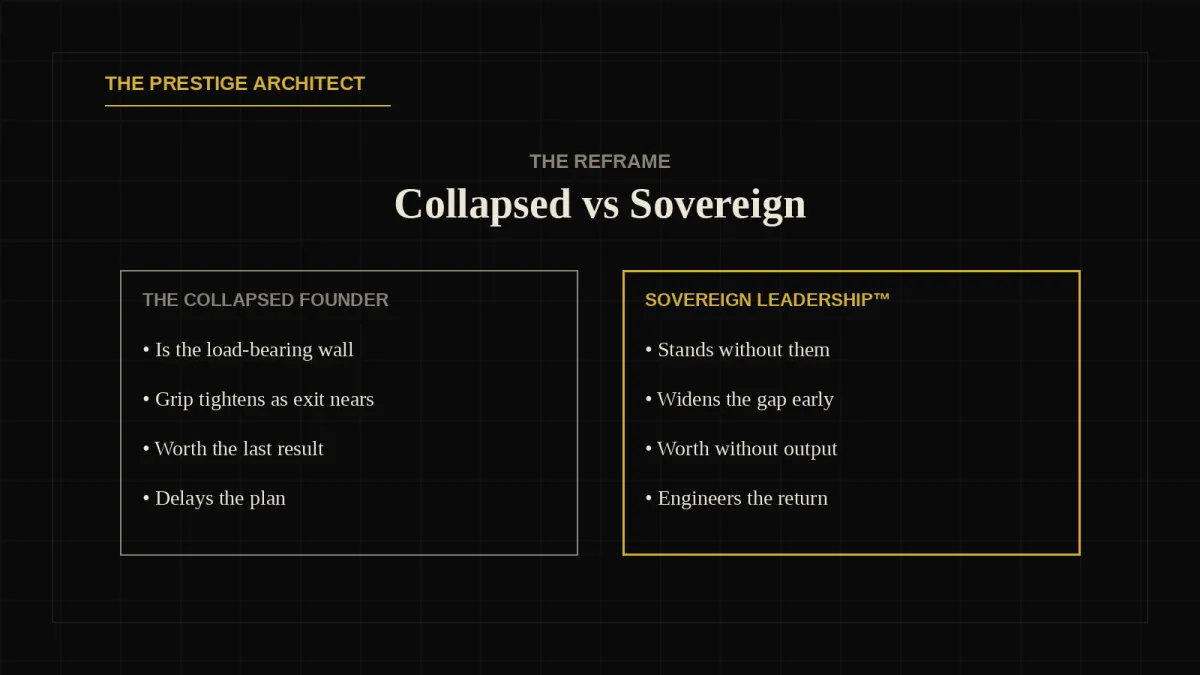
Here is the shift, side by side.
Collapsed: I do it alone so it gets done right. Sovereign: I build so it gets done without me.
Collapsed: Asking for help is a risk. Sovereign: Asking for help is a lever.
Collapsed: My value is what I carry. Sovereign: My value is what I architect.
Collapsed: Trust no one with the weight. Sovereign: Train the right people to hold it.
Baz Porter® does not motivate. He does not inspire. He architects. The work is not to try harder. The work is to build a self that no longer has to.
If you recognize yourself in this, the next step is a clear read, not a pep talk. The Silent Collapse Diagnostic™ is one hour, live, to name exactly where the armor is costing you.
A leader who could not ask
I counseled a founder who had scaled a company to eight figures and could not take a real day off. Every process ran through them. They told me they trusted their team. Their calendar told a different story. Every decision, large or small, waited for their yes.
We traced it back. Early in life, the one time they leaned on someone, that person let them fall. The lesson locked: hold it all, or lose it all. The company was not the problem. The old rule was. We rebuilt the rule. Within a quarter, they had handed off a full layer of decisions and slept through the night for the first time in years. The business did not shrink. It grew, because they finally stopped being the bottleneck.
The architecture of your return
You cannot think your way out of a pattern this old. You have to build your way out. That is what the return is: a deliberate rebuild of how you hold power, so success stops costing you the person underneath it.
Start with the truth on the table. Apply for the Silent Collapse Diagnostic™. In one hour we map where hyper-independence is running your leadership, what it is protecting, and the first move to loosen its grip. You do not have to carry all of it. You never did.
Frequently asked questions
Is hyper-independence a trauma response?
Often, yes. It tends to form when depending on someone early in life led to disappointment, neglect, or harm. The nervous system learns that needing people is not safe and adapts by refusing help. It is a survival pattern, not a fixed trait, which is why it can be rebuilt.
How is hyper-independence different from being self-sufficient?
Healthy self-sufficiency is a choice. You can carry a load and you can also set it down and ask for help. Hyper-independence removes the choice. Asking feels unsafe, so you never do it, even when the cost is your health, your team, or your relationships.
Why do successful leaders struggle with hyper-independence most?
Because the world rewards it. High achievers get praised for carrying everything alone, so the pattern is reinforced by the very success it produces. The praise hides the price until the isolation and exhaustion surface as Silent Collapse™.
Can hyper-independence hurt my company?
Yes. When every decision routes through you, the business cannot scale past your capacity and your team cannot grow. You become the bottleneck and the single point of failure. Building trust and delegation is not soft. It is how the organization survives you.
How do I start to change hyper-independence?
Begin by naming the old rule that says needing people is dangerous. Then run a clear diagnostic on where the pattern is costing you most. The Silent Collapse Diagnostic™ is a focused hour, live, to map that and set the first concrete move toward a sovereign rebuild.
About the author
Baz Porter® is the founder of Baz Porter LLC® and the architect of Sovereign Leadership Architecture™. He guides high-achieving leaders from Silent Collapse™ to Sovereign Leadership™: power without collapse, success without self-betrayal. He is an international bestselling author and the host of the Rise From The Ashes podcast on the C-Suite Network.