Reclaim Your Career: Going Back to Work Post-Burnout
You're preparing to go back to work. Your calendar is rebuilt. Your inbox is cleaned. Your wardrobe is ready. Your body still reads the environment as a threat.
That's the split no one names. You look operational. You don't feel safe. You can brief a board, close a deal, and still freeze when a simple Slack message lands. You tell yourself rest should have fixed it. It didn't.
This is not a re-entry problem. It's an architecture failure. The old system produced the collapse. If you return to work inside the same system, you don't return. You repeat.
Table of Contents
The Return to a Fractured Self
You've built the image. You've kept the title. You've preserved the appearance of control. Underneath it, something has gone cold.
You wake before the alarm and scan for threat. You open the laptop with dread, not purpose. You answer messages with precision and feel nothing after sending them. You have everything you said you wanted. You still feel vacant.
This is the executive version of collapse. It hides inside competence. It survives on praise, obligation, and momentum. It keeps the machine moving while the operator disappears.
Some people label this imposter syndrome and go looking for confidence tactics. That misses the structural issue, though practical reading on how to overcome imposter syndrome and build brand can help you recognize how performance identity gets reinforced in public. The deeper problem is that your role fused with your worth.
Your return to work will expose that fusion fast. The meetings will look familiar. Your internal response won't. The part of you that once drove everything now resists contact.
That's why professional identity must be rebuilt, not polished. Start by examining how your role consumed your self-concept through professional identity development. If your title has become your nervous system's life support, going back to work will feel like walking back into the site of injury.
The Hidden Pattern Behind Your Return
Going back to work after burnout requires nervous-system command and operational redesign. It does not require more grit. It does not require a better planner.
Most return advice fails because it treats re-entry like logistics. That diagnosis is wrong. The challenge is that returning professionals are often managing a health-and-performance transition, not just a logistical one. Guidance that advises people to take it easy fails to explain how to rebuild capacity when energy, cognition, and confidence are all reduced at once, as discussed in this return-to-work health-and-performance discussion.

This is Silent Collapse™. High output masks internal system failure. The person looks functional. The operating state is not.
Your old engine ran too hot
A high-performing leader often mistakes chronic activation for excellence. That's conditioning, not strength. The system learns that urgency equals value, overextension equals commitment, and self-erasure equals leadership.
That pattern works until it doesn't. Then the same traits that built the career start degrading the operator. Attention narrows. Recovery weakens. Decisions become reactive. Ordinary work begins to feel hostile.
Operational truth: If your body reads work as danger, discipline won't fix the return.
Research on employees returning after exhaustion-related leave identified three recurring dimensions in the experience: struggling to adapt sustainably to change, being supported or hindered by context, and being part of a larger societal system, as reported in this qualitative study on return-to-work after exhaustion. That finding matters because symptom improvement alone doesn't secure a stable return. Context decides whether recovery holds.
The office isn't the real battlefield
The modern language of going back to work has also shifted. By 2024, roughly 70% of companies had formal return-to-office policies requiring some in-office time, 93% of business leaders said employees should be in the office at least part of the week, and the most common expectation was three days per week in the office, according to this return-to-office benchmark summary. That data confirms a broad institutional push toward hybrid work. It does not prove that bodies and brains are ready for the load being reintroduced.
Your return fails when you interpret attendance as readiness. It isn't. Presence is not capacity. Compliance is not recovery.
If executive overcontrol, vigilance, and cognitive strain have become your default state, study your patterns through the lens of executive dysregulation. Going back to work succeeds only when the system beneath the role stops firing like it's under attack.
RAMS Reframe The Internal Architecture
The RAMS Framework™ starts with the two pillars leaders resist most. Results and Attitude expose the private contract driving the collapse. That contract usually sounds clean in public and brutal in private. Produce, prove, repeat.
Results are no longer proof of self
You were trained to let output answer identity. Strong quarter. Strong self. Public praise. Temporary relief. Silence. Then the cycle starts again.
That contract is efficient and corrosive. It turns every metric into a referendum on your worth. It also makes going back to work dangerous, because your first instinct will be to restore credibility through performance volume.
That is relapse behavior.
Use this diagnosis. If your first return plan includes proving you're still elite, you're still fused to the old operating state.
Watch for urgency theater: You volunteer too early, answer too fast, and overprepare routine work.
Watch for identity panic: A delayed response or reduced load feels like personal diminishment.
Watch for image management: You protect the appearance of resilience instead of the conditions required for stability.
You do not need bigger results. You need a cleaner relationship with results.
Attitude is your internal operating system
Attitude is not positivity. It is not confidence talk. It is your internal operating system. It decides what you perceive, what you tolerate, and what you obey under pressure.
In a collapsed state, attitude becomes militarized against the self. Rest feels suspect. Needs feel weak. Boundaries feel dangerous. The operator becomes both commander and captive.
For many leaders, that pattern also overlaps with rumination. If your mind runs endless internal simulations after every decision, review this practical piece on coping with overthinking and anxiety. Overthinking is not depth. It is often a threat loop wearing intellectual clothing.
Collapsed vs Sovereign Leadership operating states
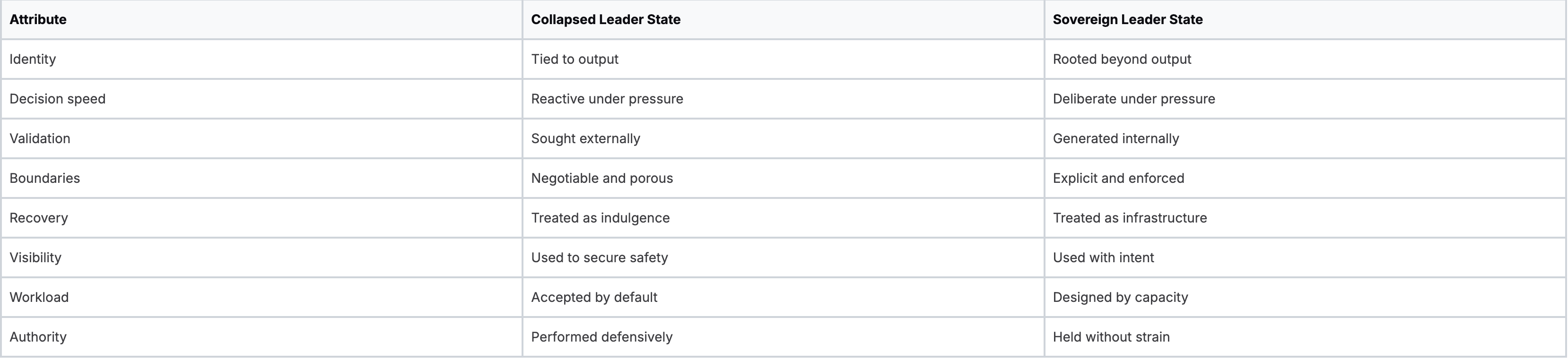
This is the shift from collapse to Sovereign Leadership™. The external job can stay similar. The internal command structure cannot.
Two direct corrections
Separate output from identity.
Write down what remains true if performance dips. Title is not self. Revenue is not self. Praise is not self.Audit your automatic beliefs.
Notice any rule that equates exhaustion with virtue. That rule is hostile to recovery.Stop using productivity to regulate emotion.
Task completion can numb panic for a few minutes. It cannot restore capacity.Rebuild your internal command language.
Replace self-threat with instruction. Replace “I'm behind” with “The system needs redesign.”
Your internal architecture determines whether any return plan survives contact with real work. That's why nervous-system design is not separate from leadership. It is leadership. Build that foundation through nervous system architecture.
RAMS Reframe The External Architecture
Internal insight without external redesign is cosmetic. Leaders fail here because they try to return with better intentions inside the same structure that depleted them.
Mastery and Systems complete the RAMS Framework™. These pillars convert self-awareness into enforceable design.
Mastery means command, not accumulation
Most leaders misuse mastery. They treat it like collecting more techniques, more certifications, or more communication polish. That's accumulation. It isn't command.
Mastery means you can hold performance without forfeiting regulation. It means you know what load you can absorb, what conditions degrade you, and what sequence restores function. It also means you stop treating every request as equal.
A strong return plan is staged. A practical return-to-work plan works best when formalized as a structured process that clarifies who receives the employee, what pace is expected, and what accommodations are possible, according to this guidance on staged return after burnout. That is not emotional comfort. That is operational design.

Systems decide whether your return holds
Systems are where your real loyalty shows. If your calendar, communication rules, and meeting load still reward self-abandonment, your return plan is fiction.
Run a systems audit across four zones.
Time systems
Identify where your day gets pre-spent before deep work begins. Protect recovery windows. Reduce unnecessary switching.Communication systems
Set response standards. Define what deserves immediate reply and what doesn't. Most urgency is manufactured by weak norms.Decision systems
Document what you alone must decide. Delegate the rest. If everything routes through you, the structure is immature.Boundary systems Translate personal limits into visible protocols. Here, many leaders fail. They announce a boundary once and then violate it themselves. Use concrete rules and review them often. If this is weak, rebuild it through how to set boundaries at work.
Command principle: A boundary that isn't attached to a system will collapse under pressure.
The external architecture also shapes role design. Returning workers are often steered toward part-time, temporary, or lower-visibility paths as “easier” options. That can help some people re-enter. It can also institutionalize a diminished role if accepted without strategy. Treat every structural concession as a design choice, not a default.
Your non-negotiables for going back to work
Define the pace: State what volume you can sustain now, not what you handled at your peak depletion.
Define accommodations: Reduced hours, altered duties, extra breaks, or work-from-home options are design levers, not signs of weakness.
Define escalation paths: Decide who handles issues before they flood your attention.
Define review points: Re-entry needs checkpoints. It does not need blind optimism.
A return without architecture is not a return. It is a scheduled relapse.
If you need a sharper diagnosis before you redesign the structure, Take the Silent Collapse Diagnostic.
A Phased Protocol for Sovereign Re-Entry
Monday, 8:07 a.m. You reopen your laptop, accept every meeting, answer every message fast, and prove you are back. By Thursday, your sleep is broken, your concentration is gone, and the old pattern is already rebuilding itself. That is not a difficult transition. That is a failed re-entry design.
A sovereign return requires phased control. Your job is not to resume your old output. Your job is to rebuild operating capacity without handing command back to the conditions that broke it.

Phase one pre-return reconnaissance
Run a systems audit before day one. Review role scope, decision density, reporting lines, meeting load, and hidden expectations. Identify what changed while you were out. Define what must change before you return.
Ask direct questions and get written answers.
What outcomes matter now
What work can be phased in later
Who owns support and escalation
What conditions overload this role
If you are returning after parental leave or another major identity shift, use planning tools that force operational clarity. The Acheloa Wellness parental leave plan is useful for this reason. It turns vague goodwill into assigned responsibilities, visible logistics, and defined support.
Phase two the negotiation
Negotiate structure. Do not negotiate from guilt.
State the conditions required for stable performance. Use precise language. Tie every request to sustained output, cleaner accountability, and lower failure risk.
Use language like this:
“I will return strongest with a phased workload, clear priorities, and explicit ownership boundaries.”
Use language like this:
“My target is stable output. The role has to support that target from the start.”
Set four terms. Set title. Set scope. Set flexibility. Set review cadence. If pay is part of the discussion, connect it to role design and accountable outcomes.
A study on retirement and reemployment found that many people return to work after stepping away, and many expect work patterns to change again later. Use that reality correctly. Treat re-entry as an adjustable command structure, not a permanent declaration.
Phase three initial integration
The first month establishes the pattern your environment will normalize. If you perform at crisis speed to reassure other people, the system will adopt crisis speed as your baseline.
Set hard operating rules early.
Cap meeting density: Protect concentration blocks and decompression time.
Limit performance theater: Stop attending low-value forums to signal commitment.
Track nervous system indicators: Headaches, insomnia, irritability, dread, and cognitive drag are operational warnings.
Escalate friction immediately: Adjust load before symptoms become incapacity.
Researchers studying return to work after exhaustion found that success depends on adaptation between the person and the workplace, including workload redesign and manager support, not symptom improvement alone. Build your return around that standard. If the structure stays unchanged, the relapse risk stays active.
If you need a sharper baseline before you set your re-entry plan, use the Burnout Breakthrough Assessment.
Phase four sustained command
Sovereignty requires maintenance. Review the system every week. Measure load, decision quality, recovery, irritability, and resentment. Those indicators reveal whether your architecture is holding.
Ask five questions.
What drained me unnecessarily
What restored me reliably
Where did I override my own limits
Which demands were real
What gets redesigned next week
Stop rewarding survival. Reward clean operation. A stable return often looks less dramatic than your old overextension pattern. That is not reduced capability. That is command.
Frequently Asked Questions
Why do I feel dread about going back to work when I used to love my role
Dread is a system memory. Your nervous system is detecting conditions that previously drove depletion, overexposure, or collapse. Stop treating that signal as a character flaw. Audit the operating environment first.
How do I know if I'm ready to return
Readiness requires structure. Build a staged plan. Define accommodations. Set expectations. Mark clear boundaries.
If those conditions are missing, you are not returning to work. You are re-entering the same failure pattern with fresh language.
What if my employer wants the old version of me back
Reject reenactment. State your conditions in plain terms and attach them to workload, communication, availability, and authority.
An employer asking for your old output without structural change is asking for your old breakdown.
Why do small tasks feel harder than they used to
Prolonged exhaustion reduces cognitive load tolerance. Task switching costs more. Ambiguity hits harder. Low-grade threat drains processing power.
This is an operational issue, not proof of reduced intelligence or ambition.
Should I take a reduced role just to get back in
Choose reduced scope only if it strengthens your long-term position. Temporary constraint can protect capacity. It can also strip authority, mute visibility, and stall trajectory.
Evaluate the role for decision rights, reporting lines, future scope, and political influence before you accept it.
What if I can't tell whether this is burnout or something deeper
Stop guessing. Use a sharper diagnostic. Start with the Burnout Breakthrough Assessment. Name the pattern before you redesign the system.
British military veteran. Two-time international bestselling author. Founder of The Prestige Architect™. Host of Rise From The Ashes podcast on C-Suite Network. Based in Boulder, Colorado.
Baz Porter advises executives, founders, and senior leaders whose external success has been built on internal overrun. Going back to work is rarely a motivation problem. It is a command problem. Capacity fails when the person returns but the architecture stays broken.
Use the material in this article. Apply it without dilution. If your return still feels unstable, study the Sovereign Leadership Resource Hub. The core problem is not whether you can work again. The core problem is whether you can build a system your nervous system can trust.