Founder Succession Anxiety: Why You Can't Let Go
You built it. You can name every system inside it. And the thought of handing it over tightens something in your chest you do not have language for. This is founder succession anxiety, and it is the early grammar of Silent Collapse™. The exit is not an org-chart problem. It is an identity problem wearing an org-chart costume. Before you read the playbooks, read The Manifesto.
Table of Contents
Key Takeaways
Succession is an identity rebuild, not a paperwork exercise. The resistance you feel is structural, not logistical.
Founder-led handovers fail at two to three times the rate of non-founder transitions. The cause is rarely strategy. It is the founder who steps back but keeps deciding.
The fear of letting go is data. It marks the exact place where your self-worth fused to the company.
Sovereign Leadership™ separates who you are from what you run — so the business can outlive the role without ending the person.
The Definitive Answer
Founder succession anxiety is the nervous-system response to dissolving a fused identity, not a sign you chose the wrong successor. You cannot let go because the role and the self have become one structure. The work is to rebuild that structure so the person stands on a foundation the company does not own. That is architecture, not willpower.
The Hidden Pattern Under the Fear
Most founders treat the exit as a logistics problem. Find the successor. Document the systems. Set the date. Then the date arrives and the body refuses. The calendar says ready. The chest says no.
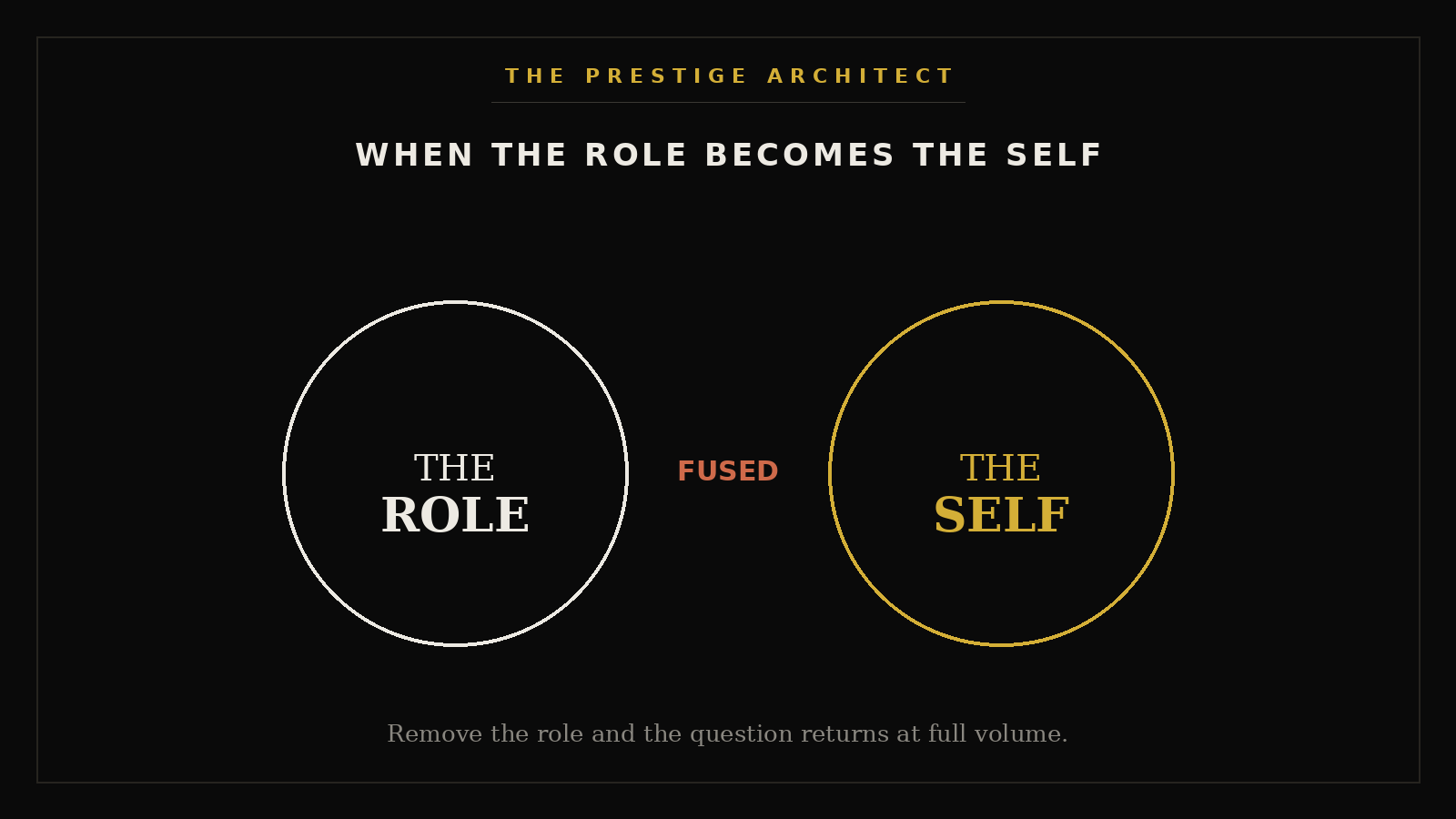
Here is what is actually happening. For years the company was the answer to a quieter question: who am I when I am not producing? The role buried that question under output. Remove the role and the question returns at full volume. Harvard Business Review's 2026 analysis of founder transitions found that handovers led by founders carry a failure risk two to three times greater than non-founder transitions, and that the dominant failure mode is role ambiguity — the founder who formally steps back but functionally keeps leading (HBR, "Leading After the Founder," 2026). That is not a discipline failure. It is an identity that has nowhere else to live.
When the role becomes the self
Researchers call the severance a discontinuous loss of job-related identity — a sudden cut from the social role that organized an entire existence. A peer-reviewed study of owner-CEOs moving through voluntary transition documented the destabilized sense of self before, during, and after the handover (Frontiers in Psychology, 2015). The work on work-related identity loss describes the same terrain: leaders who reframe the exit as a chapter rather than an ending recover their footing; leaders who cannot, grieve a loss with no funeral (Conroy & O'Leary-Kelly, Academy of Management Review).
The founder who cannot let go is not failing at strategy. They are grieving a death no one scheduled.
This is the spine of Silent Collapse™ — the gap between a life that looks complete and a self that feels evacuated. If the pattern is familiar, the language for it is here: Sovereign Leadership Resource Hub.
The RAMS™ Reframe: Architecture, Not Advice
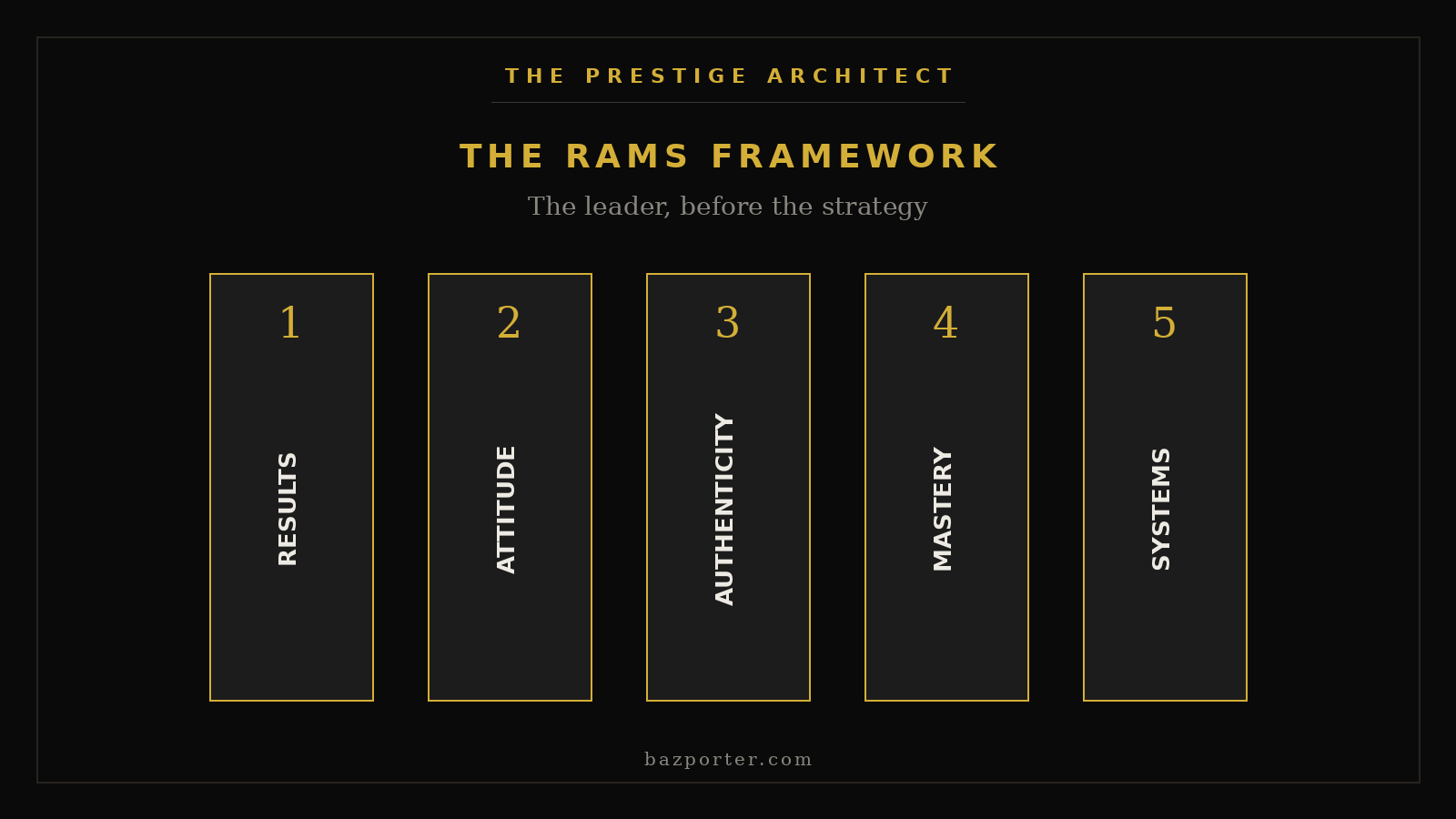
The RAMS Framework™ runs the handover at the level where it actually breaks — the leader, before the strategy. Five pillars: Results, Attitude, Authenticity, Mastery, Systems. Each one names a place the founder fuses to the role, and the rebuild that frees it.
Results — output versus identity
You measured yourself in output for decades. Revenue. Headcount. The thing you shipped. Succession removes the scoreboard. Operational rule: name three sources of worth that do not require the company to exist. Write them down before the handover date, not after.
Attitude — where the collapse lives
Attitude is the internal operating system. It is where the sentence "if I let go, it falls apart" runs on a loop. That sentence is not a forecast. It is a tether. The company does not need you to hold it. You need it to hold you. Command decision: separate the two out loud, in front of one person you trust.
Authenticity — the private and public divide
In public, you are the confident founder planning a clean exit. In private, you wake at 4 a.m. rehearsing reasons to stay. That divide is the engine of Silent Collapse™. Closing it is not weakness. It is the only move that lets the handover hold.
Mastery — skill versus sovereign capability
You are a master operator. That is the trap. Mastery of the role is not the same as the capability to exist without it. One is a skill. The other is sovereignty. Sovereign Leadership™ is the second one — capability that does not depend on a title to be real.
Systems — the architecture of the handover
The handover does not need more documentation. It needs a structure that makes the founder's daily decisions unnecessary, in sequence, on a clock. Decision rights transfer first. Then visibility. Then presence. The founder who stays "available for questions" has built no system at all.
DimensionThe Collapsed FounderSovereign Leadership™ The exitA loss to surviveA structure to build Self-worthFused to outputAnchored off the role Decision rightsQuietly retainedTransferred on a clock The 4 a.m. voiceReasons to stayEvidence it can stand The successorA threat to the legacyThe proof of it
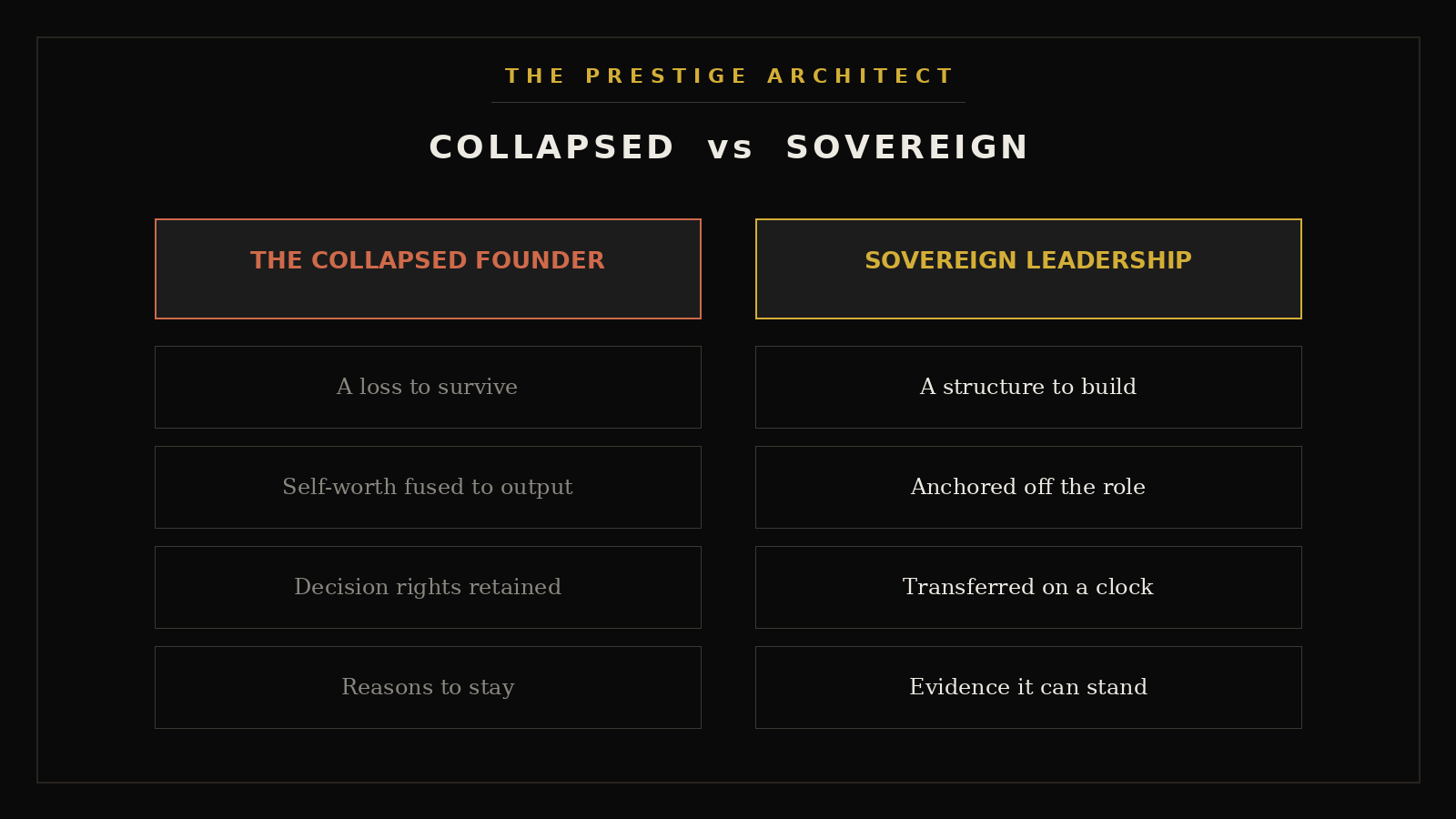
If the table reads like a mirror, start with the diagnostic built for exactly this: Take the Silent Collapse Diagnostic.
A Case Vignette: The Founder Who Stepped Back Twice
One founder ran a nine-figure company for nineteen years. They named a successor, announced the date, and stepped back. Within ninety days they were back in the building, "just to stabilize." The successor lost authority. The board lost confidence. The founder lost sleep.
We did not redo the org chart. We rebuilt the foundation under the founder first — three anchors of worth off the company, a clean transfer of decision rights in sequence, and one trusted witness to the private fear. The second step-back held. The business did not need the founder to survive. The founder, for the first time, did not need the business to feel real.
The Architecture of Your Return
Letting go is not a feeling you wait for. It is a structure you build under the part of you that the role was holding up. Nervous-system sovereignty comes first: the body learns it is safe to exist without the title. Then the handover holds, because there is a person on the other side of it.
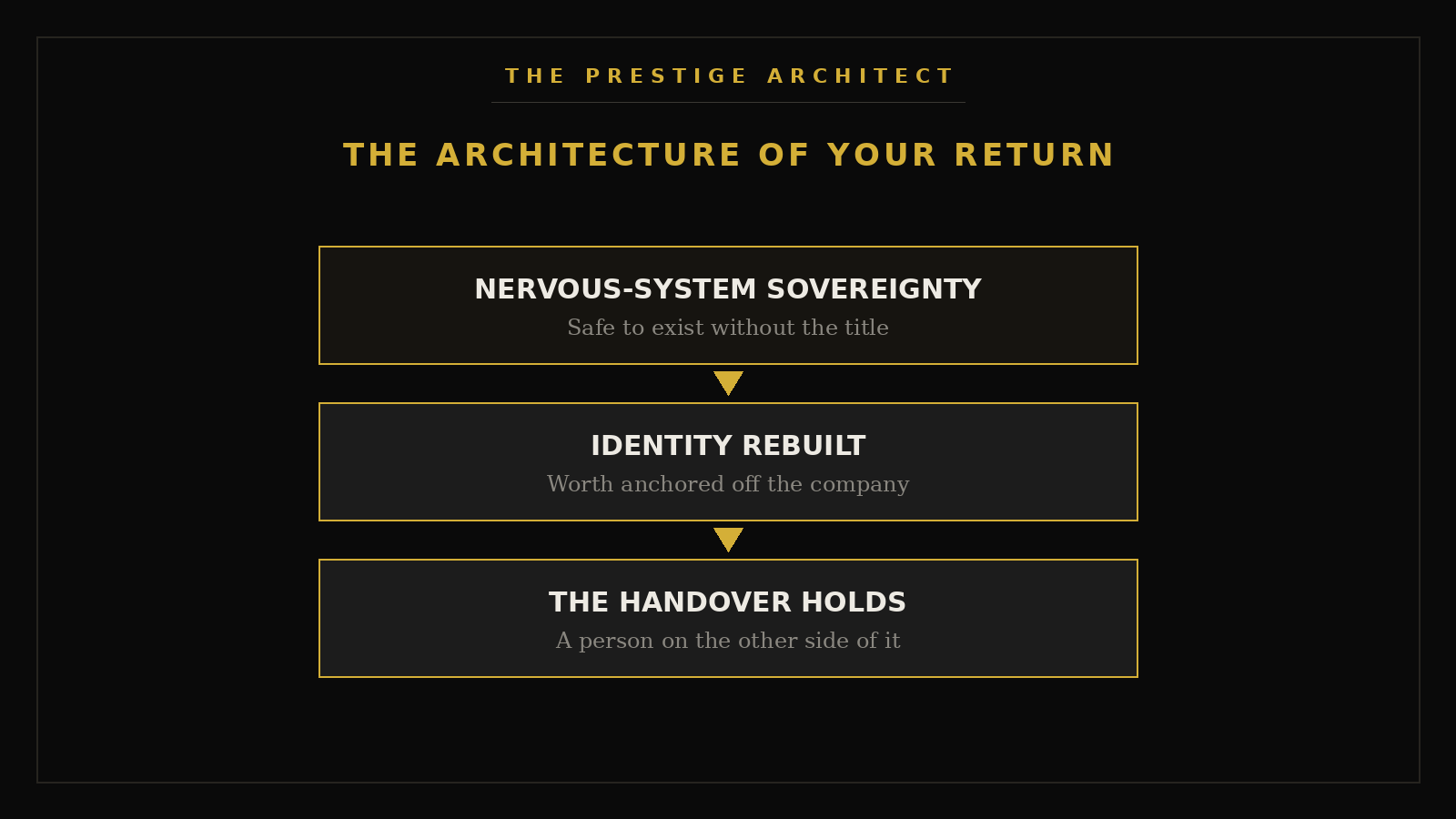
This is not inspiration. It is architecture — the leader rebuilt before the strategy is touched. The company you built deserves to outlive your need to run it. So does the person who built it.
When you are ready to rebuild the foundation before the exit, not after the collapse: Apply to Work With Baz.
Frequently Asked Questions
Why do I feel anxious about succession when I planned it carefully?
Because the plan addressed the company and not the self. Founder succession anxiety is a nervous-system response to dissolving a fused identity. Good planning on the org chart does nothing for the part of you that became the role. That part needs its own architecture.
Is it normal to want to step back into the business after handing it over?
It is common and it is the primary failure mode. Research on founder transitions identifies the founder who formally steps back but keeps deciding as the dominant cause of failed handovers. The pull back is real. It is also the signal that the foundation under you was never rebuilt.
How is this different from ordinary retirement planning?
Retirement planning organizes money and time. This organizes identity. The discontinuous loss of a job-related self is a documented psychological event, not a scheduling detail. Sovereign Leadership™ treats the person as the first system to rebuild, not the last.
What is the first step if I recognize myself in this?
Name three sources of worth that exist with the company removed. If that sentence is hard to finish, that is the diagnosis, not a failure. The Silent Collapse Diagnostic maps where the fusion lives so the rebuild has a starting point.
British military veteran. Two-time international bestselling author. Founder, The Prestige Architect®. Host, Rise From The Ashes podcast, C-Suite Network. Boulder, Colorado.