Why Founders Can't Let Go: The Exit Is an Identity Problem
You built it. You cannot leave it.
The board raises your exit. Your chest tightens. You change the subject.
This is not a strategy gap. It is a quieter failure — Silent Collapse™, the private erosion underneath public success. You run a company worth more than you once imagined. And the thought of handing it over reads as erasure.
You tell yourself the timing is wrong. The successor is not ready. The numbers need one more year. None of that is the real reason. The real reason is simpler and harder: you do not know who you are without the title. I have sat with founders at this exact edge. Start with Read The Manifesto.
Table of Contents
Key Takeaways
Founder succession anxiety is an identity problem, not an org-chart problem. The company and the self have fused.
The data is stark. Harvard Business Review (January 2026) found founder-CEO handovers fail or stall at two to three times the rate of non-founder transitions.
The fear of exit is Silent Collapse™ in a business mask. The nervous system reads role loss as a threat to survival.
Sovereignty is built, not willed. You rebuild the self that exists outside the role — then the exit becomes structural, not terrifying.
The Short Answer
Founders cannot let go because the company and the self have fused into one identity. Succession is not a transfer of power. It is a transfer of identity — and an unregulated nervous system reads identity loss as death. The founder who cannot exit is not weak. The founder is undefended at the one place no operating plan ever covered: who they are without the company.
The Hidden Pattern: Why Letting Go Feels Like Dying
Most founders treat the exit as a logistics problem. Valuation. Successor. Timeline. The logistics are not the wound. The wound is fusion.
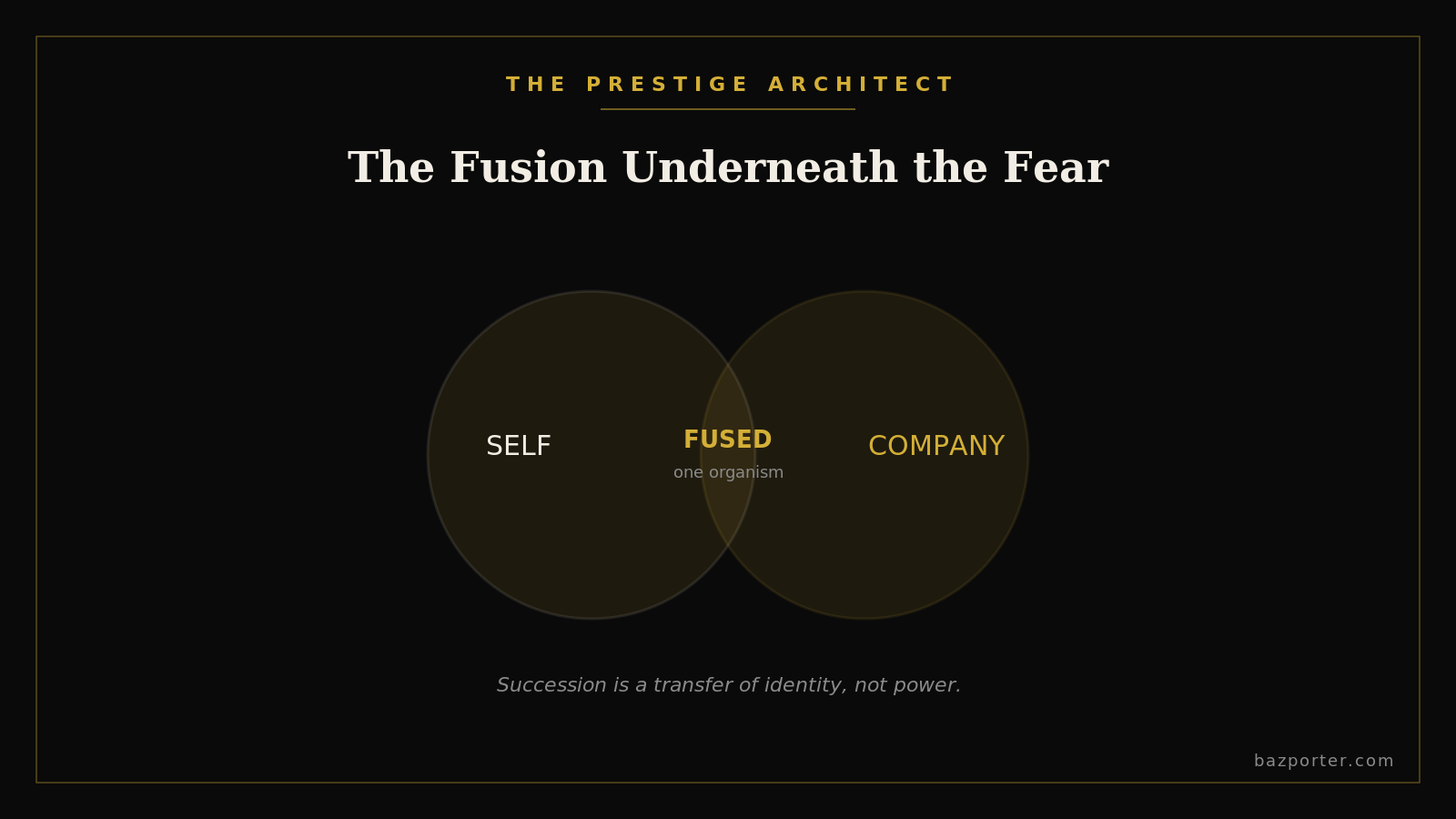
For years, the company was the answer to one question: who am I. Every introduction starts with the title. Every waking decision routes through the business. The self and the venture grew into one organism. Ask that organism to split, and the body responds the way it responds to amputation.
This is not a metaphor for drama. Work-identity research in the Academy of Management Review describes role exit as a form of work-related identity loss — processed through the same machinery as grief, not strategy. The leader does not need a better plan. The leader needs a self that survives the loss.
Harvard Business Review's January 2026 study, Leading After the Founder, puts numbers on it: founder-led handovers carry two to three times the failure risk of non-founder transitions. The cause is rarely the successor. The cause is the founder who cannot fully leave — quibbling over settled details, reinserting into decisions, undercutting the very person hired to lead.
Founders do not sabotage succession because they doubt the successor. They sabotage it because their own survival is wired to the chair.
That self-sabotage is Silent Collapse™ operating in plain sight. The outside sees indecision. The inside is a nervous system defending against erasure. Name it, and the pattern stops being a character flaw and starts being an engineering problem. If you want the full diagnosis of how this erosion runs, the Sovereign Leadership Resource Hub maps it end to end.
The RAMS™ Reframe: Exiting Without Collapse
The RAMS Framework™ treats the leader before the strategy. Five pillars — Results, Attitude, Authenticity, Mastery, Systems — run at the level of the nervous system and the business at once. Apply them to the exit and the fear stops driving.
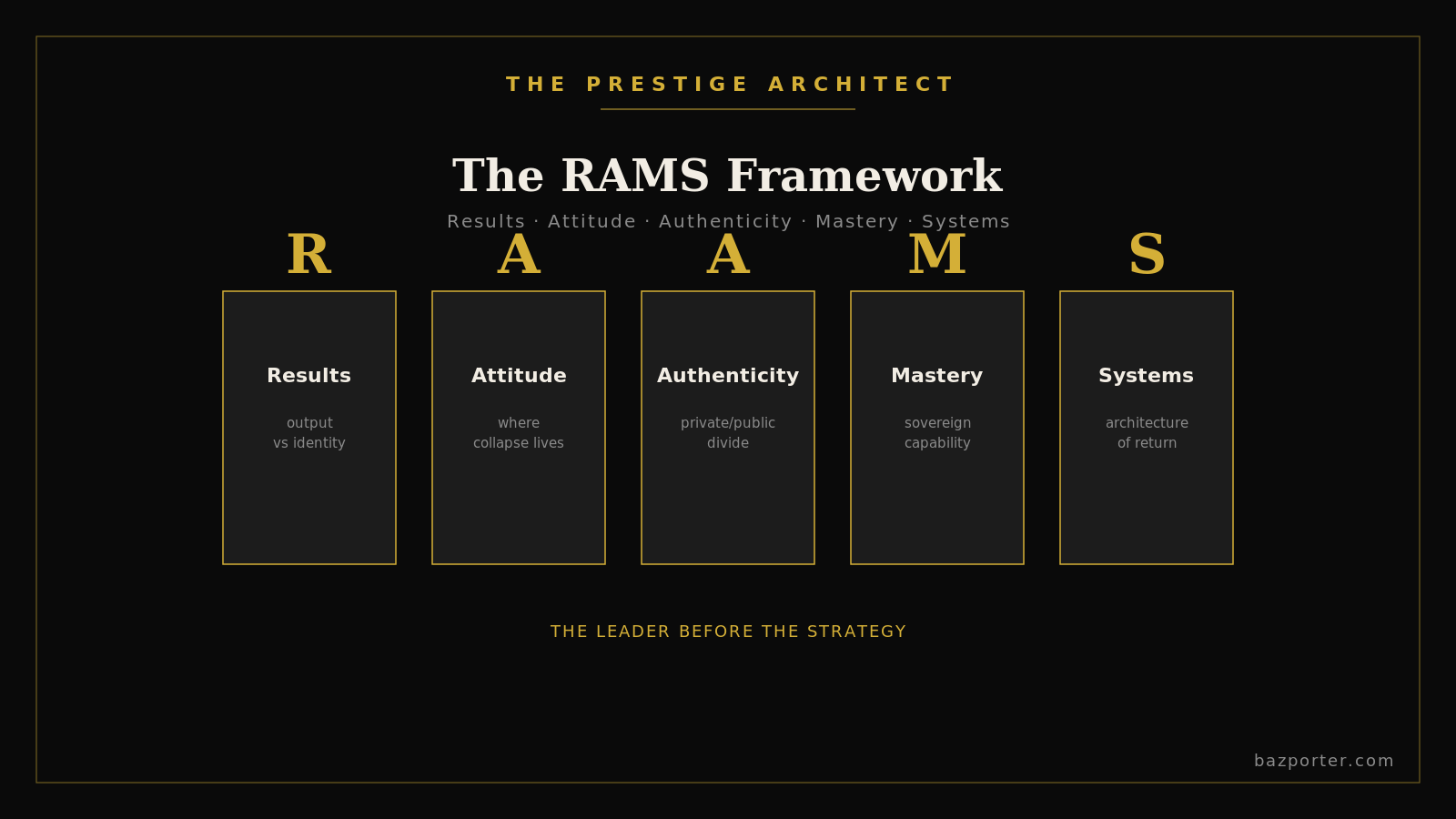
Results: The Output–Identity Gap
You measured worth by output for decades. Revenue. Headcount. The exit removes the scoreboard. The gap that opens is not financial. It is the distance between what you produced and who you are.
Operational rule: separate the metric from the meaning before the handover, not after.
Command decision: define one source of worth that does not depend on the company existing.
Attitude: Where the Collapse Lives
Attitude is the internal operating system. This is where the collapse hides. The voice says: if I leave, it falls apart. That voice is not insight. It is a threat response dressed as judgment. Regulate the response and the timeline clears on its own.
Authenticity: The Private–Public Divide
In public you signal a clean transition. In private you delay it. That divide is the engine of Silent Collapse™. The wider the gap between the performed founder and the lived one, the more the exit feels impossible. Closing the divide is the work. The performance costs more than the truth.
Mastery: Skill Versus Sovereign Capability
You have operator skill in volume. Skill built the company. Skill does not carry you through the loss of the role. Sovereign capability does — the capacity to stay regulated while the identity you knew dissolves. That is a different muscle. It is trainable.
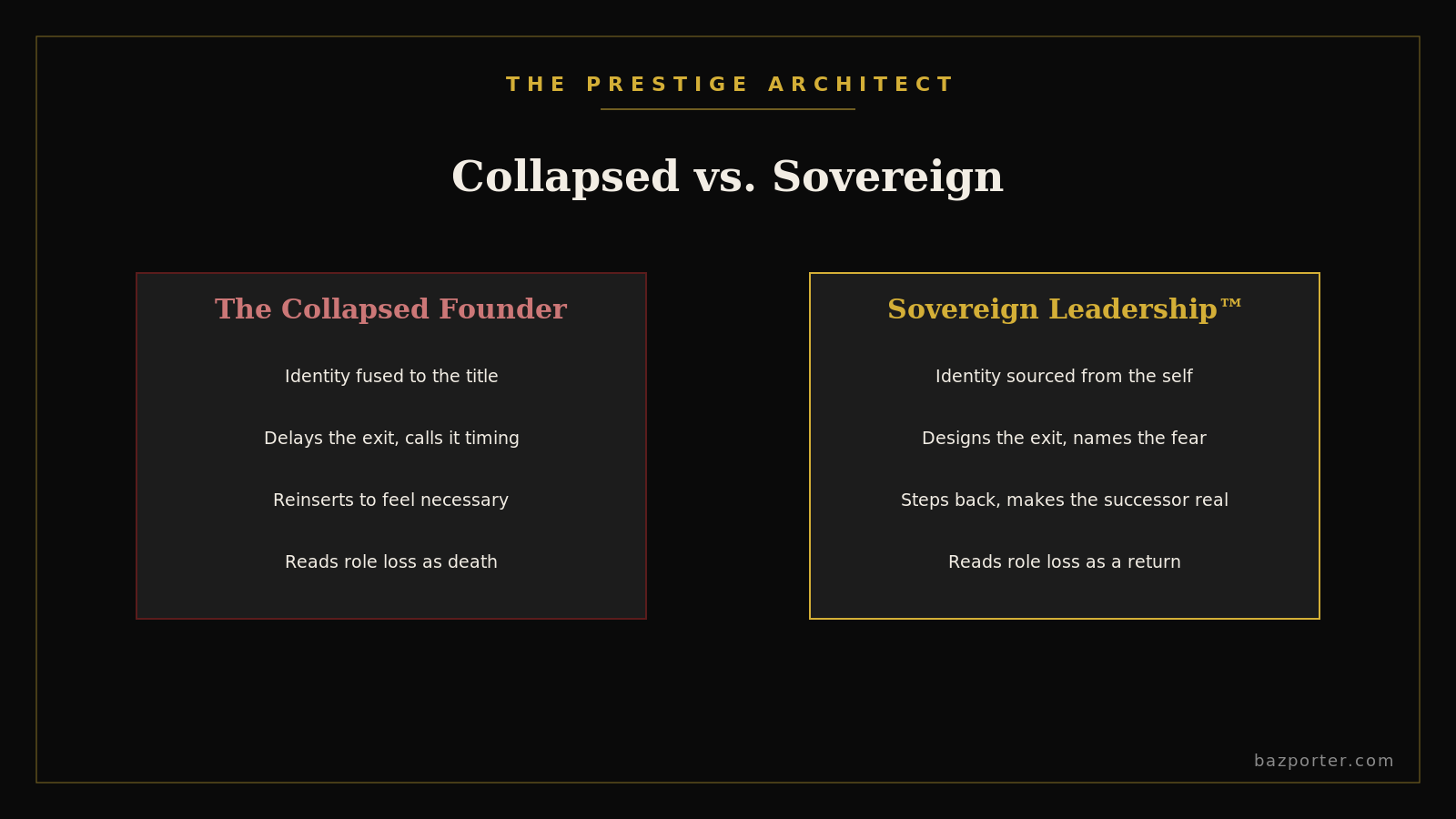
The Collapsed FounderSovereign Leadership™Identity fused to the titleIdentity sourced from the selfDelays the exit, calls it timingDesigns the exit, names the fearReinserts to feel necessarySteps back to make the successor realReads role loss as deathReads role loss as a return
Systems: The Architecture of the Return
The calendar is not the problem. The architecture is. A founder who cannot leave has built a system with one point of failure: themselves. Sovereignty rebuilds the structure so the company runs without the founder's nervous system as load-bearing.
The exit you fear is the proof your architecture worked — a company that no longer needs you is the only success worth building.
Before you touch the org chart, find out how deep the erosion runs. Take the Silent Collapse Diagnostic.
A Founder Who Exited Without Collapse
One client ran a firm for nineteen years. Eight figures. The board wanted a transition. Every plan stalled at the same place — him. He framed it as protecting culture. The truth was the chair held his identity together.
We did not start with the succession plan. We started with the self. We separated his worth from his output. We regulated the threat response that fired every time he imagined leaving. Then we rebuilt the company's decision architecture so it did not route through him. The handover closed in seven months. He described the day he left as the first full breath in a decade.
The Architecture of Your Return
You do not need motivation to let go. You need a structure that makes letting go survivable. That structure has an order. First the nervous system, so the threat response stops steering. Then the self, rebuilt outside the role. Then the company, re-engineered to run without you as the single point of failure.
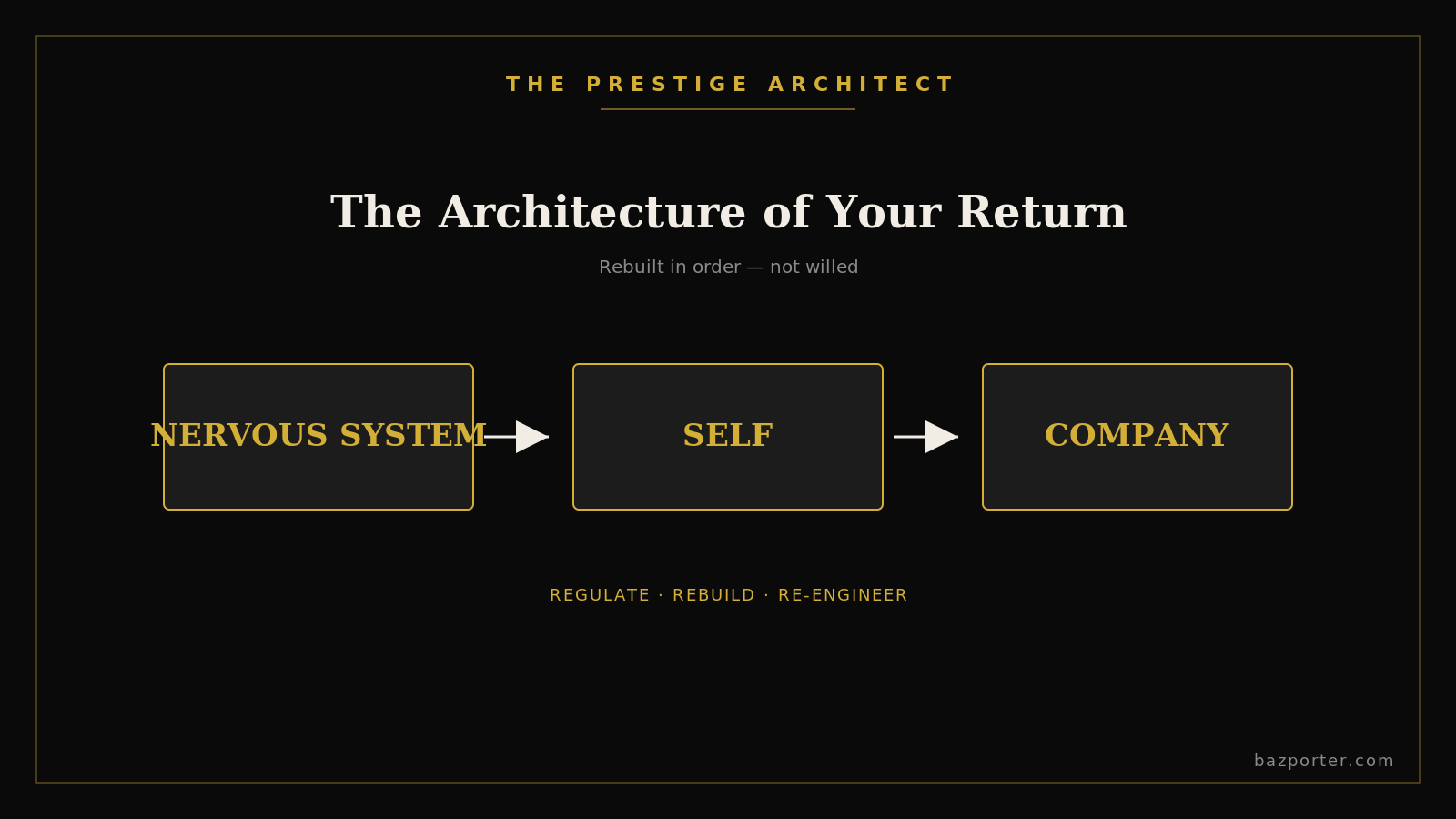
This is not inspiration. It is architecture. The founders who exit clean are not braver. They built the self and the system that made the exit structural. The return is to the person who existed before the title — fuller, not smaller.
Succession is not the end of the founder. It is the first time the founder gets to be a person again.
If you are at this edge, the work is precise and it is mine. Apply to Work With Baz.
Frequently Asked Questions
Why can't I let go of my company even though I want to?
Because the company and your sense of self have fused. Wanting to leave is a thought. The resistance lives lower, in a nervous system that reads role loss as a threat to survival. The fix is not more willpower. It is rebuilding a self that exists outside the role first.
Is founder succession anxiety a real condition or just stress?
It is identity loss, processed like grief. Peer-reviewed work-identity research treats role exit as a genuine loss, not ordinary stress. Naming it as Silent Collapse™ turns a vague dread into a problem you can engineer.
Why do founder transitions fail so often?
Harvard Business Review's 2026 research found founder handovers fail at two to three times the rate of non-founder transitions. The usual cause is the founder reinserting into decisions and undercutting the successor — a survival response, not a leadership flaw.
How do I exit without feeling like I am disappearing?
Build the architecture in order: regulate the threat response, rebuild your identity outside the company, then re-engineer the business so it runs without you as the load-bearing part. The exit then reads as a return, not an erasure.
What is the first step if I am stuck at the edge of my exit?
Diagnose the erosion before you touch the org chart. The Silent Collapse Diagnostic shows how far the fusion has gone. From there the rebuild has a sequence, and the sequence is what removes the fear.
British military veteran. Two-time international bestselling author. Founder, The Prestige Architect®. Host, Rise From The Ashes podcast, C-Suite Network. Boulder, Colorado.