The Founder's Exit Is an Identity Problem, Not an Org Chart
You built the company. Now it owns you. The handover date is set, and your chest tightens every time someone says it out loud. This is Silent Collapse™ — the quiet erosion that hides behind a successful exit. Not in the deal terms. In the body of the person who signed them. Most founders read this tension as a deal problem. It is not. It is an identity problem wearing a deal's clothing. The org chart is ready. The nervous system is not. Read The Manifesto.
Table of Contents
Key Takeaways
Succession fails on identity, not org design. The skills transfer cleanly. The self does not.
The founder who "can't let go" is not difficult. That founder is grieving a role that paid them in meaning.
A clean exit is architecture, not willpower. You build a self that outlives the title before the title ends.
Tim Cook's planned 2026 handover models the visible version. The invisible version happens in private, in the body.
Why Founders Can't Let Go: The Short Answer
Founders can't let go because the company became their identity, and an exit reads to the nervous system as a loss, not a win. Succession planning anxiety is rarely about competence or control. It is the felt threat of disappearing when the title does. The fix is structural — build a self that exists outside the role before the role ends.
The Hidden Pattern: The Title Was Scaffolding
The pattern hides in plain sight. On September 1, 2026, Tim Cook hands Apple to John Ternus and becomes executive chairman. The press frames it as orderly. Watch what the language protects: he stays in the building.
Research on leader role transitions finds that failure during a handover is rarely a skills gap. It tracks to unresolved identity shifts. A 2026 systematic review in the Journal of Organizational Behavior documents this directly: the stronger the old leader identity, the more destabilizing its loss feels. Harvard Business Review's work on leading after the founder names the same fault line — the incoming leader cannot lead while the outgoing one keeps leading.
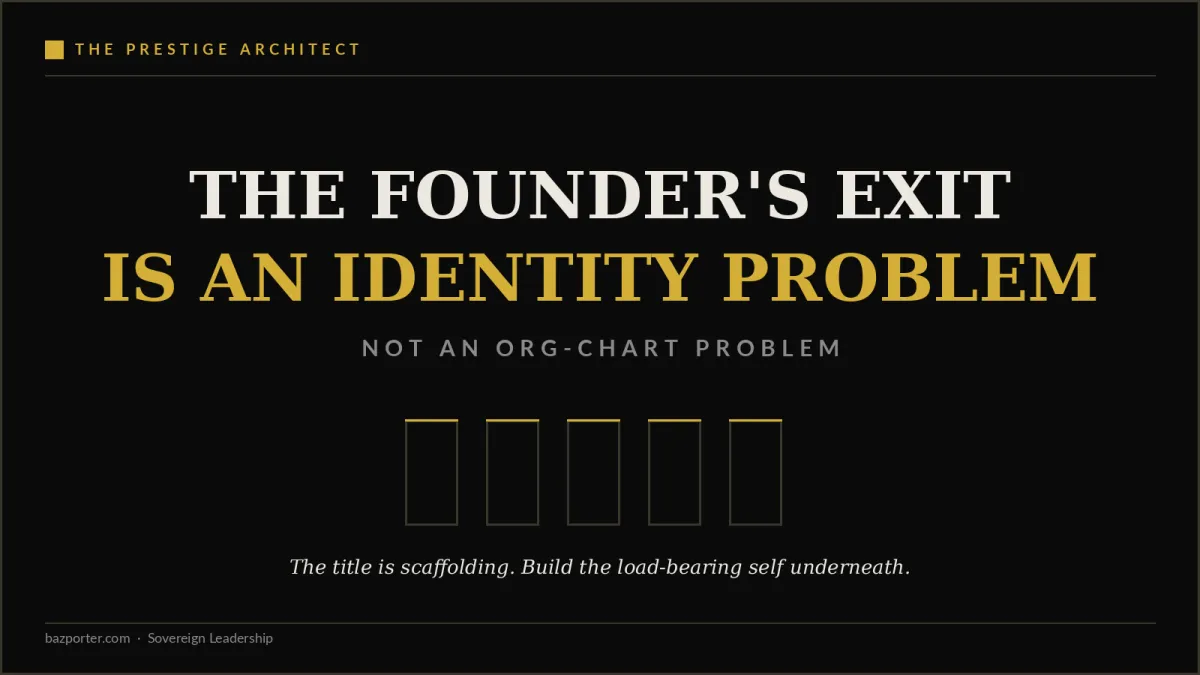
A title is scaffolding. You climb it for years. Then you forget it was ever scaffolding and start treating it as the building. Remove it and the structure sways — not because the work was weak, but because nothing load-bearing was built underneath. That sway is Silent Collapse™. It does not announce itself. It surfaces as insomnia before board meetings, irritation at the successor, a refusal to name a date.
This is the exact terrain the Sovereign Leadership Resource Hub maps for leaders standing at the edge of a transition.
The RAMS™ Reframe of a Founder Exit
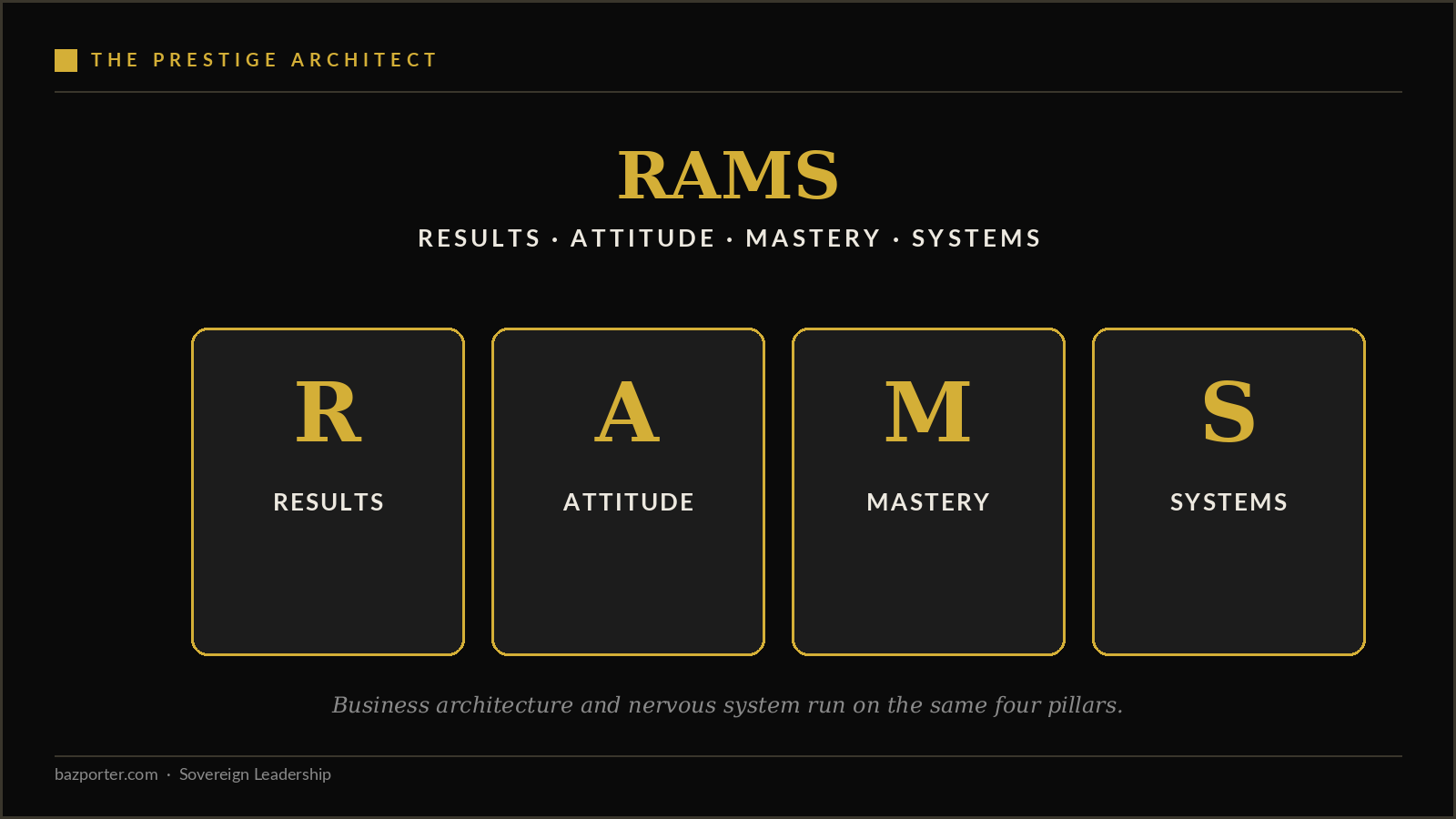
The return runs on four pillars. RAMS™ — Results, Attitude, Mastery, Systems. It operates at two levels at once: the business and the nervous system. When one is dysregulated, both are compromised. A founder exit stresses all four. Sovereign Leadership™ is what the architecture produces on the other side.
Results: The Output–Identity Gap
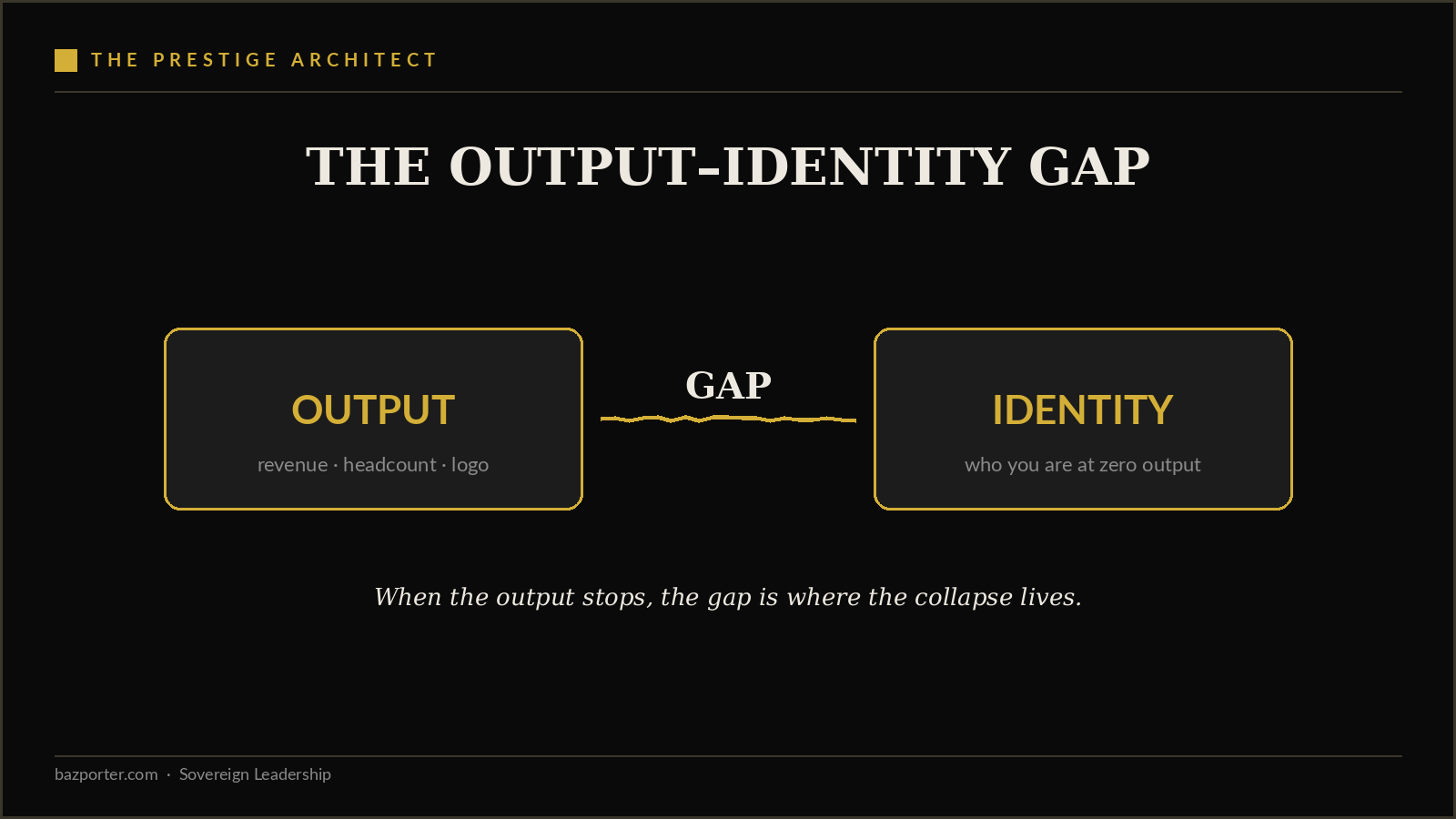
For thirty years your worth was legible. Revenue. Headcount. The logo on the building. Results were the receipt for your existence. The exit removes the receipt. The output stops, and a gap opens where identity used to sit.
Operational rule: open a second ledger now — who you are when you produce nothing.
The trap: founders who skip this confuse the company's value with their own.
Attitude: Where the Collapse Lives
Attitude is the operating system, not a mood. It is the story running under the decision. The founder who can't let go runs one line of code: "If I leave, I vanish."
Command decision: rewrite the line before the date, not after.
Why it matters: collapse lives here, in the unexamined system, long before it reaches the calendar.
Mastery: Skill vs Sovereign Capability
You mastered the company. That is skill. Mastery in the sovereign sense is different — the capability to stay regulated while the identity reorganizes. Skill built the exit. Sovereign capability survives it.
Succession is not a competence problem. It is an identity problem wearing a competence problem's clothing.
Systems: The Architecture of the Return
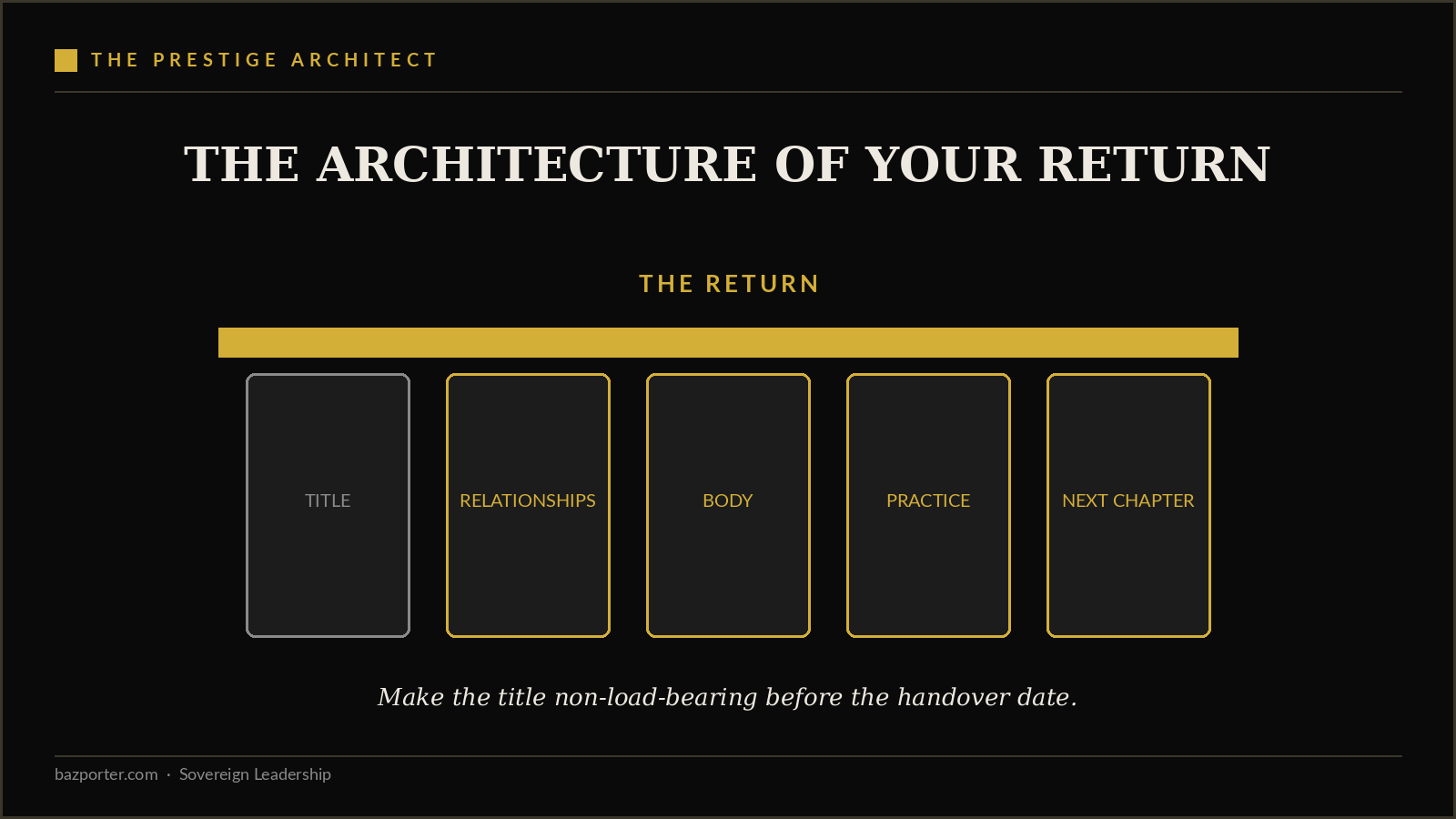
Systems is where willpower ends and architecture begins. You do not think your way out of identity loss. You build your way out — a self with more than one load-bearing column. Relationships. A trained body. A practice. A next chapter already under construction.
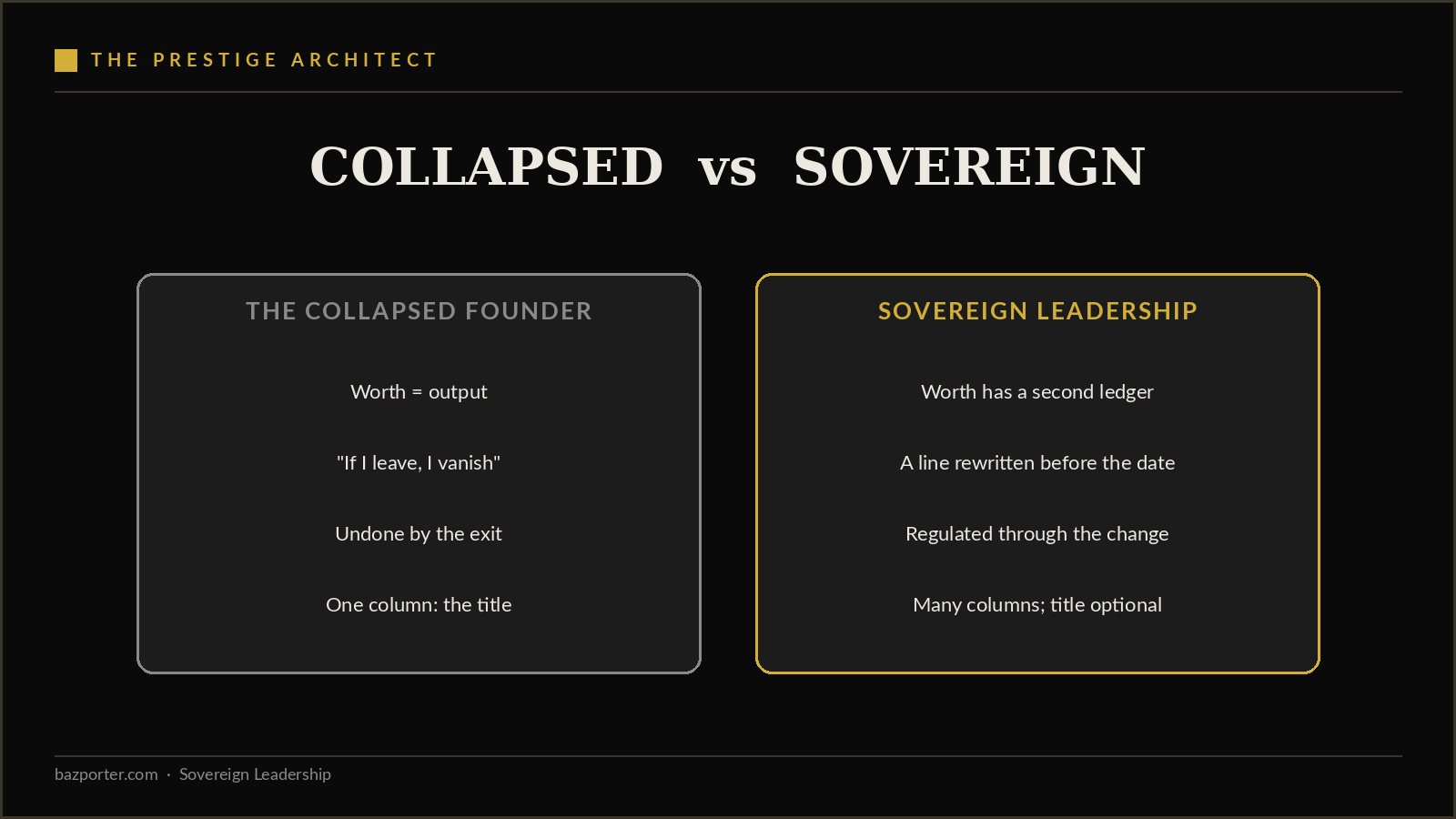
Collapsed Founder vs Sovereign Leadership™
Results — Collapsed: worth equals output, and the receipt stops at handover. Sovereign Leadership™: worth has a second ledger that output cannot erase.
Attitude — Collapsed: runs "if I leave, I vanish" on a loop. Sovereign Leadership™: runs a rewritten line installed before the date.
Mastery — Collapsed: skilled at the company, undone by the exit. Sovereign Leadership™: regulated while the identity reorganizes.
Systems — Collapsed: one load-bearing column, the title. Sovereign Leadership™: multiple columns, the title is non-load-bearing.
Before you set the handover date, find out where the collapse already lives. Take the Silent Collapse Diagnostic.
Case Vignette: The Chairman Who Couldn't Leave the Building
A founder — call him the Chairman — sold his firm at sixty-one. Clean deal. Strong number. Six weeks later he was at the office every day, redlining decisions that were no longer his. His successor was failing in slow motion, starved of authority. We did not work on the calendar. We built the second ledger first. Three months in, he named what the role had carried for him: proof he mattered. Once the proof had another home — a board seat that taught, a body he trained, a grandson he saw daily — the office grip released. The successor stepped into real authority. Systems first. The feeling followed the architecture, not the reverse.
The Architecture of Your Return
The clean exit is not an act of letting go. It is the result of having built something to stand on. You do not white-knuckle your way out of a title. You make the title non-load-bearing in advance. That is engineering, not inspiration.
Founders who exit well start eighteen to twenty-four months early — the same window research assigns to identity reconstruction. They build the self in parallel with the deal. When the date arrives, there is no cliff. There is a bridge. The nervous system, not the org chart, is the truest measure of whether you are ready.
If you are inside this and want the architecture built with you, Apply to Work With Baz.
Frequently Asked Questions
Why do successful founders struggle to let go of their company?
Because the company stopped being something they own and became something they are. When self-worth is fused to the role, an exit registers as erasure, not achievement. The struggle is identity loss, not stubbornness.
Is succession planning anxiety normal?
It is near-universal among founder-led leaders, and it is a signal, not a flaw. The anxiety marks the gap between a self that was built on output and a self that has nothing else load-bearing underneath it. Named early, it becomes the starting point for the architecture of a clean exit.
How early should a founder start preparing emotionally for an exit?
Eighteen to twenty-four months before the handover date. Research on identity reconstruction assigns roughly that window to the work of building a self outside the role. Starting at the deal table is too late; the architecture has to run in parallel with the transaction.
What is the difference between an exit problem and an identity problem?
An exit problem lives in the deal — valuation, terms, the org chart. An identity problem lives in the nervous system of the person leaving. You can solve the exit perfectly and still collapse, because the deal was never the thing holding you together.
Can a founder stay involved after handover without harming the successor?
Yes — once the founder's worth no longer depends on being the decision-maker. The damage comes from a leader who steps back in title while still leading in fact. When the title is non-load-bearing, an advisory role supports the successor instead of starving them of authority.
British military veteran. Two-time international bestselling author. Founder, The Prestige Architect®. Host, Rise From The Ashes podcast, C-Suite Network. Boulder, Colorado.