When a Founder Can't Let Go: The Exit Is an Identity Problem
When a Founder Can't Let Go: The Exit Is an Identity Problem
You built the company. Now you cannot leave it. That is not loyalty. That is a symptom. I name it Silent Collapse™ — the quiet erosion hiding behind a clean succession plan. You tell the board you are preparing the handover. Privately, every exit date slides. The truth is simple and hard. The exit is not an org-chart problem. It is an identity problem. If you have felt this, start with The Manifesto.
Table of Contents
Key Takeaways
The fusion, not the firm. A founder who cannot let go is not protecting the company. The founder is protecting a self.
Anxiety is data. Succession anxiety is identity foreclosure, not weak planning.
The numbers are real. Founder-CEO handovers fail at far higher rates than non-founder transitions.
The return is built. You rebuild who you are outside the title first. Then the handover holds.
The Definitive Answer
A founder who can't let go is fused to the role at the level of identity. The exit reads to the body as a threat to the self, so the nervous system stalls it. The fix is architectural. You build a self that stands without the title, and the succession stops sliding.
The Hidden Pattern: Identity Fusion
Most exit plans treat the founder as a logistics problem. Wrong layer. The founder is a nervous-system problem. Over years, the brain stops filing the company as a thing you own. It files the company as a thing you are. The title becomes a load-bearing wall in the structure of the self. Remove it, and the whole house feels like it falls.
This is why the board's timeline keeps moving. The body is doing its job. It guards the self against a perceived threat. Harvard Business Review found in 2026 that founder transitions carry a sharply higher risk of failure or downturn than transitions led by non-founder CEOs. The data names the wound. It does not heal it.
Why the Title Becomes the Self
Psychology has a precise term for this. Identity foreclosure is a premature, unexamined commitment to a role handed to you by circumstance. You became "the founder" before you ever asked who you are without the work. The role filled the space where a self was supposed to form. That is the engine of Silent Collapse™ — a life that looks complete and feels hollow at the core.
The founder who cannot let go is not failing at succession. The founder is succeeding at self-protection — at the cost of the company's future.
If you want the full map of this pattern, the Sovereign Leadership Resource Hub holds it.
The RAMS™ Reframe of the Exit
The exit is not handled with a date. It is handled with architecture. RAMS Framework™ runs at two levels at once — the business and the nervous system. They share one structure. When one is dysregulated, both are. Here is the founder transition through all four pillars.
PillarThe Collapsed FounderSovereign Leadership™ ResultsOutput is proof of worthOutput is a tool, not a self Attitude"If I leave, it dies""It is built to outlive me" MasteryHolds every decisionBuilds people who decide SystemsThe founder is the systemThe system runs without the founder
Results: The Output–Identity Gap
You measure your worth in output. The company performs, so you must matter. Strip the output and the question returns. Who am I without the next result? The gap between what you produce and who you are is the fracture line.
The trap: every win raises the cost of leaving.
The shift: worth is decoupled from production.
Operational rule: if your calendar is the only proof you exist, the exit will threaten your existence.
Attitude: Where the Collapse Lives
Attitude is the internal operating system. This is where Sovereign Leadership™ is won or lost. The collapsed founder runs one belief on a loop. "If I leave, it dies." That belief is not strategy. It is fear wearing a suit.
Command decision: name the belief out loud to one person this week. Fear that is spoken loses its grip.
Mastery: Skill vs. Sovereign Capability
Skill is doing the work yourself. Sovereign capability is building people who do not need you. The founder who can't let go has mistaken indispensability for mastery. Real mastery makes itself unnecessary.
Hoarded authority keeps the founder central and the company fragile.
Distributed authority makes the founder optional and the company durable.
Systems: The Architecture of the Return
This is the pillar that ends the stall. When the founder is the system, the founder cannot leave. When the system runs without the founder, the exit becomes safe. You are not removing yourself. You are building the structure that lets you stand outside it. The Prestige Architect® exists for this one move.
Before you redesign the architecture, find out how deep the fusion runs. Take the Silent Collapse Diagnostic.
A Case Vignette: The Founder Who Stayed Too Long
One client built a firm across eighteen years. The board approved a handover. Three exit dates passed. He blamed the successor each time. The real problem sat in his body, not the org chart. We did not fix the timeline. We rebuilt the system. We mapped every decision that ran through him and moved each one to a named owner with a written standard. As the system stopped needing him, his anxiety dropped. The fourth date held. He left whole, not hollow. The firm did not falter. It grew.
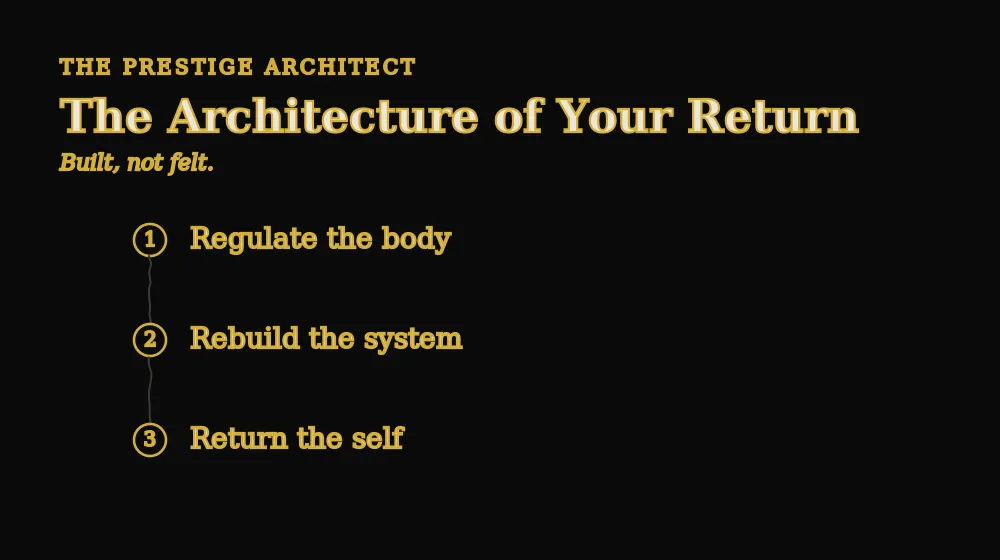
The Architecture of Your Return
The return is not inspiration. It is nervous-system sovereignty. A regulated body does not read the exit as death. It reads it as design. You build that body the same way you built the company — with structure, repetition, and standards. First the self stands alone. Then the title comes off without the fall.
Most founders skip this layer. They draft a new timeline and call it progress. The body files it as the same threat and stalls again. The order matters. Regulate the nervous system, then rewrite the org chart. Do it in reverse and the exit keeps sliding for another year.
This is precision work, and it is not done in a weekend. If you lead at scale and the exit keeps sliding, Apply to Work With Baz.
Frequently Asked Questions
Why can't I let go of the company I built?
Because the company stopped being something you own and became something you are. The brain encodes the founder role as identity. Leaving reads as a threat to the self, so the nervous system stalls the exit. The work is rebuilding a self that stands without the title.
Is succession anxiety normal or a warning sign?
It is both. Some unease is human. Anxiety that moves every exit date is a signal. It points to identity fusion, not a planning gap. Treat it as data about the self, not a flaw in the plan.
How do I plan an exit without losing my identity?
Build the self before you build the timeline. Move every decision that runs through you to a named owner with a written standard. As the system stops needing you, the exit stops threatening you. The date holds because the identity no longer depends on the role.
What is Silent Collapse in a founder transition?
Silent Collapse is a life that looks complete and feels hollow underneath. In a transition, it shows up as a founder who guards the title to guard the self. The success is real. The emptiness is also real. Both are true at once.
About the Author
British military veteran. Two-time international bestselling author. Founder, The Prestige Architect®. Host, Rise From The Ashes podcast, C-Suite Network. Boulder, Colorado.