How to Finish One Project Before Starting Another
You open the laptop. Six ideas are already shouting. None of last week's work is done. This is Silent Collapse™, the quiet erosion that hits capable people who start everything and land nothing. It is not a willpower problem. It is a design problem. The Baz Porter® manifesto names the real move. Not more effort. A return to a system that finishes.
Written by Baz Porter®
What this covers
Key takeaways
Ideas everywhere and nothing finished is a work-in-progress problem, not a discipline flaw.
Every open project taxes the next one. Unfinished work leaves a residue on your attention.
The answer is a limit. Finish one thing before you start the next.
A work-in-progress limit turns scattered effort into shipped results.
Build the constraint once. It holds every week with no new effort from you.
How to finish one project before starting another
Here is the short answer.
To finish one project before starting another, set a work-in-progress limit of one. Give the active project a real finish line. Park every new idea in a single list, off your desk. You start the next thing only when the current thing ships. The constraint does the discipline for you.
Read that again. The power is in the limit, not in trying harder. You already try hard. That was never the gap. The gap is that nothing tells you to stop opening new work. So you open all of it. And a mind holding ten open loops finishes none of them well.
A work-in-progress limit is one rule. Only one project may be active at a time. Everything else waits in line. This is how factories, hospitals, and strong teams move work. It is also how a founder stops rebuilding from zero every week.
The hidden pattern
There is a cost you cannot see. It has a name. Attention residue.
Sophie Leroy studied what happens when people switch tasks before finishing. In her 2009 paper in Organizational Behavior and Human Decision Processes, she found that part of your attention stays stuck on the unfinished task. You move to the next thing. A piece of your mind does not. That leftover is residue, and it drags down the work in front of you (Leroy, 2009).
Now count your open loops. The half-built funnel. The course you paused. The rebrand you keep touching. Each one leaves residue. So the real cost of ten open projects is not ten slots of time. It is a mind that never runs clean.
The research on task switching backs this up. The American Psychological Association reports that shifting between tasks can cost as much as forty percent of productive time (APA on multitasking). You are not slow. You are switching. The switching is eating the day.
This is why the answer is a limit and not a longer to-do list. A limit closes loops. Closed loops clear residue. A clear mind finishes.
The RAMS™ rebuild
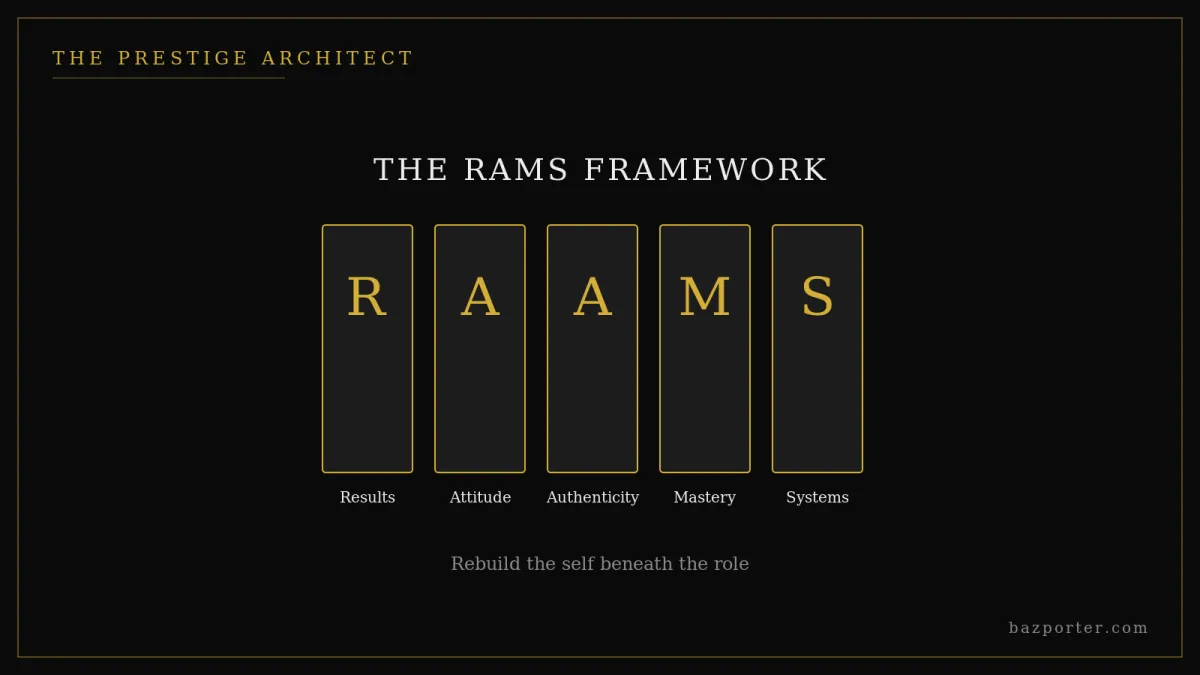
RAMS™ is the operating system I use to rebuild a founder from the inside out. Results, Attitude, Authenticity, Mastery, Systems. Here is how each pillar carries the work-in-progress limit.
Results
Define done before you start. Write the finish line in one sentence. A project with no finish line cannot be finished. So it stays open, and it becomes residue. Name the result first. Then the limit has something to protect.
Attitude
Starting feels like progress. It is not. A new tab of energy hides an old fear. If you never finish, you never get judged. Notice the pull to open something new. Name it as avoidance. Then close the loop you already own.
Authenticity
Here is the quiet truth. Every restart is a small vote against yourself. You are not proving you have ideas. You are proving, again, that you cannot land one. That story is the wound under the scatter. The limit is how you rewrite it, one finished thing at a time.
Mastery
Depth lives on the far side of finished. You only master a thing by carrying it to done. A dozen starts teach you nothing. One completed build teaches you everything. The limit is not a cage. It is the only door to mastery.
Systems
Make the limit a system, not a mood. One active project. One parking list for the rest. One weekly check to move the next item in only when the last one ships. Build it once. It runs on its own. This is how you stop rebuilding from zero.
Here is the contrast in plain terms.
Collapsed: many projects open, none finished, energy spread thin, weekly restart from nothing.
Sovereign: one project active, a clear finish line, ideas parked in one list, a system that moves work to done.
Collapsed: you carry the whole plan in your head and it leaks all day.
Sovereign: the system holds the plan, and your mind is free to build.
"Baz Porter does not motivate. He does not inspire. He architects. He builds the system that holds a leader steady when effort alone runs out."
If your work is a pile of open loops, start with one honest look. The Silent Collapse Diagnostic™ shows you exactly where the leaks are and which loop to close first.
One founder's turn
A founder came to me with nine live projects. Two courses. A podcast relaunch. A rebrand. A funnel. More. Each one was eighty percent done. None was live. Her income had gone flat. Her faith in herself had gone flatter.
We did one thing. We set a work-in-progress limit of one. We picked the funnel, because it fed cash. We wrote a finish line she could see. Everything else went into a single parked list. She was not allowed to touch it.
Ten days later the funnel shipped. First time in months something crossed the line. Then the next item moved in. Then it shipped too. Nothing about her changed. The design around her did. That is the return. Not a new her. The real one, finally free to finish.
The architecture of your return
You do not need more discipline. You need a container that finishes. That is architecture, and it is built, not felt.
Three parts hold it. One active project with a named finish line. One parking list that catches every new idea so it stops scattering. One weekly review that moves the next item in only when the current one ships. That is the whole machine. Simple on purpose, because a system you cannot run is not a system.
Build it once and the scatter ends. Not because you tried harder. Because the design will not let you start what you have not finished. This is the return the manifesto points to. Power without the daily rebuild.
If you want the leaks mapped before you build, begin here. The Silent Collapse Diagnostic™ is the first step. It names the pattern under the scatter and the one loop to close first.
Questions leaders ask
What is a work-in-progress limit for a founder?
It is a rule that caps how many projects can be active at once. For most founders the right cap is one. Every other idea waits in a parking list. You start the next project only when the active one ships. The limit protects your attention so work reaches done.
How do I stop starting new projects?
You do not rely on willpower. You build a catch. Keep one list where every new idea goes the moment it arrives. The idea is safe, so your mind lets it go. Then you return to the one project you already own. The list holds the future. You finish the present.
Why can't I finish what I start?
Usually it is not a flaw in you. It is too much open work at once. Each unfinished task leaves attention residue that drags the next one. It can also be avoidance, because unfinished work is never judged. A work-in-progress limit removes both traps by forcing one loop closed before another opens.
How many projects should I run at once?
One, if you want speed to done. A single active project clears attention residue and shortens the time to ship. Two is the ceiling only when one is truly blocked and waiting on someone else. Beyond that, cycle times stretch and finishing stalls. Fewer active projects finish faster.
What is attention residue?
Attention residue is the part of your mind that stays stuck on a task after you switch away from it. Sophie Leroy named it in 2009. When you leave a project unfinished and jump to the next, the residue lowers your performance on the new task. Closing the loop clears it.
About the author
Baz Porter® is the founder of Baz Porter LLC® and The Prestige Architect™. He is a British Army veteran, an international bestselling author, and the host of the Rise From The Ashes podcast on the C-Suite Network. He guides high-achieving leaders from Silent Collapse™ to Sovereign Leadership™. Power without performance. Peace without retreat.