
Feeling Unmotivated at Work? Reignite Your Drive with Quick Wins
That post-lunch haze can feel like a brick wall hitting your focus. You can reignite your drive in under five minutes by weaving in targeted micro-actions that snap you out of the slump.
Spark Engagement When Feeling Unmotivated At Work
Key Takeaways
Micro wins restore confidence with a burst of progress.
Two-minute energy resets boost circulation and clarity.
Quick boundary checks shield you from meeting overload.
Simple breathing or movement lifts your mood instantly.
Definitive Answer Block
When motivation dips, hit pause and deliver a tiny win like crossing off one task or stretching for two minutes. That small spark creates momentum you can ride through the rest of your afternoon.

Afternoon Slump Reversal
I watched a project manager break free from back-to-back Zoom fatigue by simply admitting she was drained. She grabbed a notepad, jotted one clear task, stood up for a quick two-minute shoulder roll, and gave herself a mini celebration. Her energy bounced back in minutes, and she sailed through her remaining to-dos.
Here’s a quick rundown of bite-sized resets you can try right now:
Quick Motivation Boost Approaches

Pick one of these mini resets the moment you sense your focus fading.
Make These Moves Now
Want to set yourself up for smoother afternoons? Start by building small rituals into your morning. Dive into our 5-Day Morning Ritual guide for the full blueprint.
“Interrupting your slump with a tiny action can shift your whole afternoon,” says leadership architect Baz Porter. That simple insight is why modest moves deliver outsized results.
Flash Focus Routine
Two-Minute Desk Stretch: Roll shoulders and open your chest.
Single-Task Micro Win: Knock out one email or quick note.
60-Second Breathing Reset: Inhale, hold, exhale—repeat.
Boundary Quick-Check: Confirm your next break window.
Sip and Step: Grab water, then stroll around your workspace.
Give these five a whirl next time motivation wavers. You’ll feel focus and confidence flick back on.
Plan For Continued Lift
Turn these micro-actions into habits so they happen automatically.
Schedule two energy resets: one mid-morning, one mid-afternoon.
Jot down tiny wins in a one-minute journal entry.
Tweak your approach based on energy highs and lows.
Pair stretches with deep breaths for a double boost.
Set timers or calendar alerts to keep yourself honest, and watch your afternoons transform.
The Hidden Pattern
Neuroscience reveals that when dopamine dips, your prefrontal cortex goes on hiatus, your brain’s “focus engine” sputters like a car running low on fuel. Recognizing this neural stall is your first move. Think of motivation as a muscle: when it’s underfed, it refuses to lift any weight.
Understanding Causes Of Low Motivation
Energy can leak out of your workday in ways you barely notice.
Before chasing quick fixes, take a step back and diagnose what really drains you.
Patterns hide in both your environment and your inner dialogue, and spotting them is the first act of self-rescue.
Jenna’s morning starts with a bulletproof to-do list.
An hour later, she’s trapped in back-to-back video calls.
By mid-morning, it feels like running on a treadmill without a finish line.
That flattened momentum is a classic hurdle for high performers.
Common Organizational Triggers
When your workplace is misaligned, even the best intentions crumble. Vague objectives keep you guessing. Endless meetings eat into your focus. And radio-silent feedback leaves you stalled.
Unclear Goals
No north star means you wander, and your energy drips away.Lack of Recognition
Small wins feel hollow when nobody notices them.Meeting Overload
Deep work vanishes under a flood of calendar invites.Feedback Deficit
No input equals no growth, and rising frustration.
Imagine being handed a project without clear KPIs. You spend half your week just trying to figure out if you’re on the right track, draining both time and enthusiasm.
Personal Mindset Patterns
Sometimes the blocker lives in your own head. Perfectionism inflates tasks into mountains. Self-doubt whispers that your best will never be enough. Overthinking becomes a hall of mirrors. And comparing yourself to peers steals the shine from your wins.
Perfectionism Trap
Waiting for flawless conditions stalls every start.Doubt Spiral
Negative self-talk erodes confidence and momentum.Analysis Paralysis
Too much planning masks the fear of action.Comparison Habit
Benchmarks against others turn victories into losses.
Tens of micro-decisions fizzle when perfectionism strikes, and doubt breeds more hesitation—feeding the very cycle you want to break.

"Spotting the real drains on your motivation is your first move toward reclaiming purpose," says leadership expert Baz Porter.
In the most recent global engagement cycle, Gallup found only 21% of employees worldwide were actively engaged. That chronic disengagement carries an eye-watering price tag, about $438 billion in lost productivity.
Read the full research on Gallup’s 2025 Global Workplace Report.
Notice how these drains overlap and compound. When unclear goals spark self-doubt, your internal habits ramp up, and momentum grinds to a halt.
For ways to break these loops, explore our guide on overcoming burnout at work.
At this point, you’ve mapped out what drains your motivation. Recognizing these triggers isn’t the finish line, it’s the foundation.
With clarity on where you lose steam, you can design precise steps to restore energy, sharpen purpose, and rebuild leadership confidence.
These patterns explain why motivation dips on your busiest days. Organizational gaps and inner critics form a draining cycle. Breaking free starts with diagnosing each trigger.
Identifying both the visible and hidden drains on your motivation strengthens you to take control and pave a clear path back to engagement.
This awareness is your starting point for change and purpose.
The RAMS Reframe
Now that you’ve diagnosed the slump, it’s time to apply the RAMS framework, Results, Attitude, Mastery, Systems, to rewire your drive. This reframe bridges insight and action, giving you a reproducible path out of the haze.
Creating Short Term Wins And Boundaries

When motivation dips, even the smallest victories feel huge. Take Priya, a marketing lead who noticed her energy ebbing by mid-afternoon. By zeroing in on tiny successes and protecting her focus, she carved out two solid hours for deep work every day.
Mapping Energy Highs And Lows
RAMS Method – Systems
Priya kept a simple log of her alertness, rating her focus on a 1–5 scale every hour. Over a week, patterns emerged: she was sharpest at 9 AM and again around 2 PM, while email threads at noon dragged her down.
Record your energy score hourly
Jot down what you were doing (meeting, solo work, brainstorming)
Highlight two consistent windows when your mind feels most alive
With that map in hand, you reserve creative tasks for your peak periods. And when you hit a slump? You switch gears before burnout sets in.
Setting Realistic Micro Goals
RAMS Method – Mastery
Big deliverables can feel paralyzing. Instead, break work into 30-minute sprints. Maybe you draft one slide, review five emails, or revise a paragraph. Each sprint ends with a quick check-in and a small celebration.
“I literally treat ticking off a sprint like a mini win,” Priya laughs.
When you see progress, confidence builds, and so does momentum.
Communicating Firm Boundaries
RAMS Method – Authenticity
Focus only thrives when you guard it. Priya now answers email at 10 AM and 4 PM. She blocks two 60-minute slots for calls, and she protects them fiercely.

Share your rhythm with colleagues so your limits don’t come as a surprise. If a last-minute call pops up, you can politely reschedule.
Learn more about crafting these kinds of limits in How to Set Boundaries at Work.
Stacking Small Wins
RAMS Method – Results
A visual tracker keeps wins front and center. Priya swears by her Kanban board, columns for To Do, In Progress, and Done. Shifting a task feels as satisfying as scoring a point in a game.
Pick one task you can finish in under 30 minutes
Complete it and move the card immediately
Jot one line in your journal about how it felt
Set the next sprint based on your energy map
Reward yourself with a short break or stretch
Soon enough, that sluggish afternoon flips into a chain of wins. Each check-off lights up the next.
Embedding Micro Celebrations
RAMS Method – Attitude
You don’t need confetti or cake. Two minutes of fresh air, a cup of tea, or a few deep breaths can mark a milestone just as well. These little rituals signal to your brain: “We’re winning.”
“My slump evaporated when I started giving myself credit for every finish,” Priya admits.
Over time, your mind learns to expect that boost, and focus becomes effortless.
Maintaining Momentum
RAMS Method – Systems & Results
Consistency is the secret sauce. At week’s end, Priya blocks out fifteen minutes for a “Quick Wins Check-In.” She lists her top three successes and notes any boundary that slipped.
Schedule a recurring “Weekly Quick Wins” slot
Review your journal entries and board progress
Adjust micro goals and boundary times as needed
Invite a peer for accountability and fresh ideas
This simple review keeps her system tuned and her motivation humming.
Real World Example Recap
Priya’s mix of targeted sprints and clear limits boosted her weekly output by 30%. She locked in two daily hours of uninterrupted work, trimmed needless email checks, and celebrated every small victory. Those concrete wins made her focus non-negotiable, even when priorities shifted.
Use Priya’s approach as your template. Start by mapping your energy, setting tiny goals, and guarding your time. Watch how quickly small shifts can reignite your drive.
Aligning Tasks With Values And Meaning
Often a dip in motivation isn’t about fatigue, it’s about losing sight of why you do what you do. When your to-do list drifts away from what truly matters, even small tasks can feel like a slog. In this section, you’ll discover how to tether everyday work to your deepest drivers.
You’ll start by running a values audit that uncovers your core professional principles. Then you’ll build a meaning matrix, rating projects on both alignment and energy return. Together, these tools point you toward activities that light you up, and away from those that drag you down.
Key Steps In Values Audit
Kick things off by writing down your top three professional values. Think innovation, service quality, collaboration, whatever sparks passion for you. Next, scan your current tasks and rate each one on a 1–5 scale based on how well it supports each value.
Clearly list your core values
Assign an alignment score (1 = low, 5 = high)
Highlight tasks scoring 4 or 5 as priority work
Flag anything below 3 for delegation or elimination
This quick audit reveals which activities fuel your energy and which quietly sap it. Once you can see the difference, you’ll know exactly where to invest your time.
Constructing Your Meaning Matrix
With values in hand, map your projects on two axes: value alignment (horizontal) and energy impact (vertical). This visual snapshot makes it easy to spot your sweet spot.

Projects in the top-right quadrant are your gold mine—high alignment and high energy. Lean into those. Anything in the bottom-left? It’s crying out for a rethink or removal.
Building Psychological Safety And Clarity
A team that feels safe to speak up is a motivated team. In fact, psychological safety can boost collective drive by 72%, while clear goals increase engagement by 78%. Nearly 93% of employees say tailored development programs would amplify their involvement even more. Discover workforce hopes and fears
“When people see how their tasks link to larger goals, they reclaim ownership over their work.”
— Baz Porter, Author & Architect
That insight captures why safety and clarity go hand in hand: they transform tasks into shared purpose.
Engineer’s Story Of Purpose In Action
Maya, a maintenance engineer, felt stuck in routine checklists. Instead of viewing maintenance as mere compliance, she saw an opportunity: improving user experience. By adding a quick usability test to each cycle, Maya shifted her focus.
The result? A 28% drop in glitches and a 15% rise in team morale. Her meaning matrix guided her toward tweaks that energized every workday and delivered measurable wins.
Audit routine tasks for innovation potential
Score each task by user-impact metrics
Introduce one small change to amplify purpose
Crafting Your Purpose Infusion Plan
Now it’s time to weave these insights into your weekly rhythm. Try these tactics to lock in motivation:
Carve out a weekly values audit slot in your calendar
Refresh your meaning matrix as new projects emerge
Reserve morning hours for top-quadrant tasks
Share your focus areas with your team for accountability
Celebrate each high-impact win, however small
Embedding purpose like this primes you to greet each day fully engaged. For a deeper dive, see our guide to professional values
Tracking Progress And Adjustments
Purpose isn’t a one-and-done exercise, it evolves. Schedule a monthly reflection to ask:
Which tasks fueled my energy this past month?
Where did my boundaries slip, and how can I reinforce them?
What new learning opportunities would deepen my engagement?
Tweak your values audit and meaning matrix based on these answers. Share your reflections with a mentor or trusted colleague, an outside perspective often uncovers blind spots and champions your successes. Over time, these small course-corrections keep your motivation robust and your work deeply meaningful.
This ongoing practice turns mere tasks into fulfilling contributions.
Sustaining Motivation With The RAMS Method
When the applause dies down, your inner toolkit is what keeps you moving forward. The RAMS Method breaks motivation into four pillars that anchor sustainable momentum.
Studies show that 67% of workers feel a tight job market revs up their engagement, while 61% point to job insecurity as their main driver. Those numbers remind us just how fragile external praise can be. Discover more insights about external motivators.
Rather than chasing every new initiative, this framework balances bold goals with the right mindset, targeted skill-building, and daily rituals that stick.
Below is an infographic illustrating a simple three-phase process: audit tasks, map their value, then align each action with your core values.
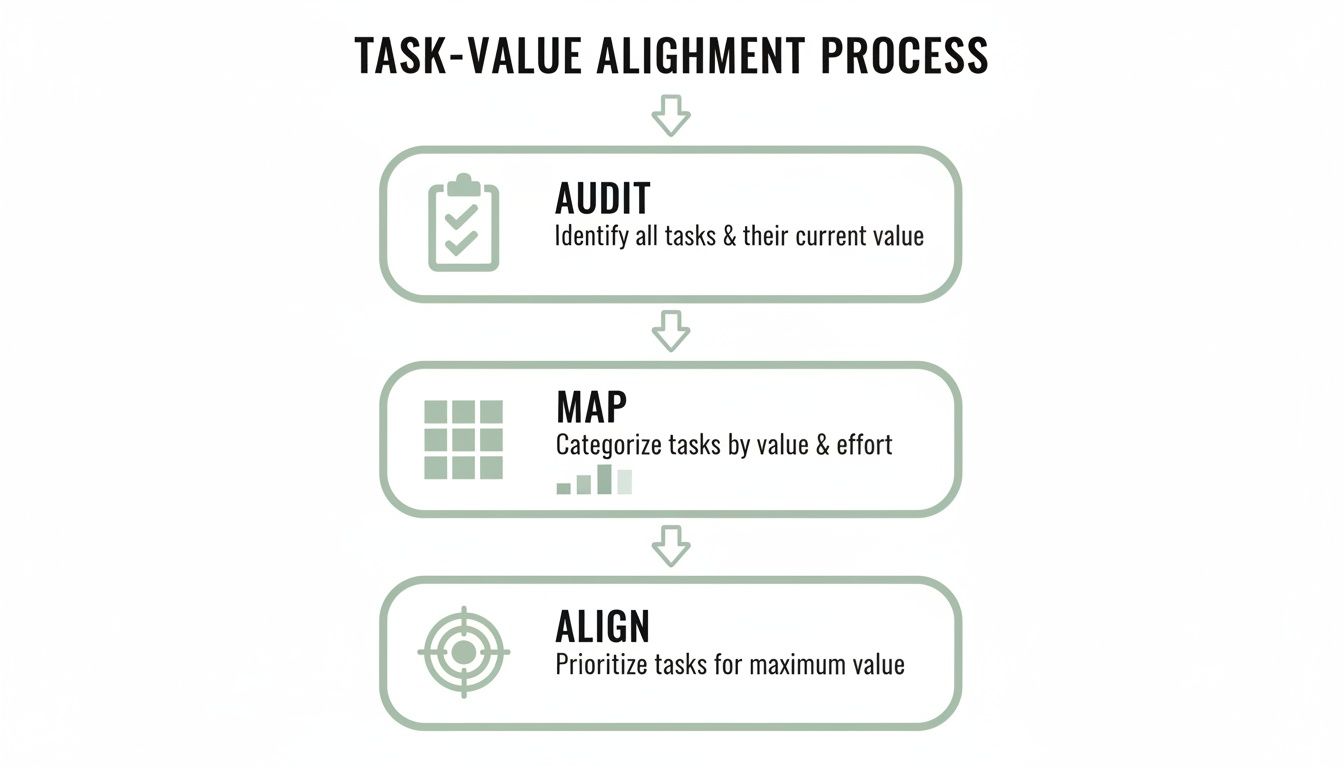
This flow highlights:
Audit Your Tasks
Map Their Importance
Align Actions With Core Values
Defining Clear Results For Drive
Carla, a sales director, dialed in on her targets and ended the quarter 25% above quota—without burning out.
Choose one concrete performance goal each week for razor-sharp focus
Track progress on a visible dashboard to celebrate every win
Pause after each milestone to acknowledge your achievement
Cultivating A Growth Attitude
Your mindset shapes how challenges land. By embracing a growth focus, setbacks become chances to evolve.
“Shifting from fixed results to growth perspective keeps motivation resilient,” says Baz Porter.
Try a daily affirmation or ask yourself, “What lesson is buried here?” to turn friction into forward motion.
Honing Skills For Mastery
Mastery isn’t accidental. Carve out dedicated practice slots to build expertise and avoid overwhelm.
Block a weekly session for a specific skill drill
Pair up with a peer for honest feedback and fresh insights
Measure progress with simple metrics like speed or accuracy
Designing Daily Support Systems
Systems automate your best habits and protect your focus. Carla swears by calendar blocks, gentle reminders, and accountability check-ins.

This table shows why internal routines outlast fleeting incentives.
Harnessing Results, Attitude, Mastery, and Systems together transforms short-lived bursts into deep, continuous energy.
Explore how the RAMS approach is reshaping coaching models in our guide on the RAMS coaching revolution methods
By weaving these four pillars into your day, you create a reliable engine for drive—one that hums along even when external rewards fade.
Sales Director Case Study
Carla was already a top performer but felt drained chasing quarter-end bonuses. She applied each RAMS pillar to her sales role:
Clarified her weekly revenue goals and checked progress each afternoon
Reframed every objection as an opportunity to learn
Ran daily product-demo practice sessions for sharper delivery
Built a morning ritual with planning and peer check-ins
Automated follow-up reminders via calendar integrations
Within two quarters, she beat her targets by 25% and cut overtime by 40%. Carla’s story proves that aligning metrics, mindset, skills, and structure can reignite your drive.
Strategies To Embed RAMS Daily
Start each morning by listing your top three goals and slotting them into prime focus windows
Take a midday pause for a quick reframing exercise to stay positive
Dedicate a short session to skill drills or peer coaching
End your day with a “quick wins” journal entry and tomorrow’s plan
Use simple automations to nudge you toward every critical task
These habits build a self-reinforcing loop that reduces dependence on shaky motivators.
Best Practices To Maintain RAMS
Review and adjust your systems weekly to match your energy patterns
Celebrate both headline wins and small progress markers
Share your framework with a mentor or peer for added accountability
Log lessons learned and refine your metrics as goals evolve
Treat RAMS as a living blueprint. Weekly check-ins keep your approach fresh, and monthly skill challenges stoke mastery.
When motivation dips, revisit the RAMS pillars, re-audit, reframe, refine, and reinforce, to bring your drive back into focus.
The RAMS Method isn’t a quick fix; it’s a sustainable solution for when work feels like a grind. Start applying these pillars today and watch consistent practice fortify your engagement against fatigue and uncertainty.
Imagine looking back six months from now at sharper focus, unshakable energy, and results that truly resonate. With RAMS, every task becomes both a goal and a step on your growth path.
If doubt ever creeps in again, cycle through RAMS one more time. That audit, that mindset shift, that skill drill, that system tweak, they’ll always guide you back to deep, lasting motivation.
Embrace RAMS to transform fleeting motivation into a perpetual source of professional energy and ongoing sustainable momentum.
The Return: Consolidating Your Progress And Next Steps
By this stage, you’ve uncovered quick wins, dug into root causes, realigned with your purpose, and explored the RAMS method. It’s time to weave these discoveries into your everyday routine. Below is a concise consolidation plan complete with journaling prompts, an accountability checklist, and reflection questions to anchor your efforts, and help you return to your own rhythm.
Journaling Prompts For Micro Wins
Reflect on one task you completed today and note how it boosted your mood.
Observe any energy spikes or dips, and jot down the triggers behind them.
Capture how a RAMS pillar shaped your focus or mindset.
Accountability Checklist
Block out two nonnegotiable slots in your calendar for deep work.
Share your schedule with a trusted colleague or mentor for quick check-ins.
Close each day by updating your Kanban board or task list.
“Seeing your progress in writing cements it in your mind and builds confidence,”
says leadership architect Baz Porter.
Reflection Questions To Maintain Alignment
Which projects this week resonated most with your core values?
Where did your boundaries falter, and what adjustments will you make?
Which one new habit can you introduce to keep your motivation steady?
To sustain this momentum, carve out a weekly 15-minute review session. During this slot, revisit your journal entries, tick off items on your checklist, and answer your reflection prompts. Turning these actions into habits is how small wins become lasting shifts.
Take Nina’s example: each Friday she worked through these prompts. She discovered that 80% of her high-energy tasks reflected her values. With that insight, she crafted a weekend plan that truly refreshed her for Monday.
If you want more tailored strategies to keep your drive alive and return fully to your own sovereignty, consider booking a brief diagnostic call with Baz Porter.
Try this consolidation now.
FAQs On Feeling Unmotivated At Work
How Can I Maintain Momentum After An Initial Quick Win
Once you’ve celebrated that first victory, carve out a follow-up micro-task within 24 hours. Capture the energy in a one-minute check-in journal, note exactly what felt invigorating. Then, plan your next small win using the same conditions that lit you up.
• Write down the environment, timing, and task elements that fueled your enthusiasm
• Pinpoint one replicable habit (time of day, tool, or setting)
• Slot the next micro-task into your calendar right away
What If I Face Setbacks After Setting Boundaries
Head back to your boundary script and read it aloud. Tweak any phrasing that feels stiff or unclear. When someone pushes back, treat it as golden feedback. Then, calmly remind them how focused work windows boost both quality and speed.
• Identify where your wording triggers resistance
• Reframe limits as productivity boosters
• Practice your script until it sounds natural
How Do I Stay Aligned With My Values Over Time
Block a monthly “values audit” in your calendar. At each session, rate new projects against your top three values. If something falls short, delegate or delay it until it fits your core criteria.
If these internal tactics don’t shift your drive within six weeks, consider seeking a mentor for fresh perspective and accountability.
When Should I Seek External Support For Low Motivation
After six weeks of consistent effort and minimal change, bring in an outside expert. A mentor or advisor who specializes in workplace drive can turn confusion into clarity with one diagnostic conversation.
Where to go next
If any of this reads like your own reflection, the Silent Collapse Diagnostic™ is a quiet place to start. And if you want the deeper why beneath the work, read the Sovereign Manifesto.