Executive Self-Differentiation: Lead Without Losing You
Written by Baz Porter®
You can run the boardroom. You cannot always run yourself inside it. That gap has a name. It is executive self-differentiation, and most high performers never built it. Sovereign Leadership™ calls the cost what it is. You stay calm on the outside. Inside, every unspoken mood in the room moves you. I wrote the Manifesto for the version of you that leads from a settled core, not a borrowed one.
On this page
Key takeaways
Executive self-differentiation is the built capacity to stay yourself under pressure.
It is not detachment. You stay connected and still hold your own position.
The mechanism is Murray Bowen's differentiation of self: clear thought over reactive feeling.
Low differentiation shows up as over-functioning, approval-seeking, and cutoff.
You rebuild it across all five RAMS™ pillars, one decision at a time.
What executive self-differentiation actually is
Executive self-differentiation is the built capacity to stay yourself under pressure. You hold your own thinking while staying connected to anxious people. You do not merge with the room. You do not push people away to feel safe. The term comes from Murray Bowen's differentiation of self. A differentiated leader separates clear thought from reactive feeling in real time. This is not a personality trait. It is a capacity. You rebuild it under load. The higher you rise, the more it matters. More people route their anxiety to you. Without this capacity, you become the sponge for all of it.
The hidden pattern most leaders miss
Here is what I see in most rooms. The most capable person becomes the emotional shock absorber. Bowen, the psychiatrist who founded family systems theory, named this decades ago. In his research, people with low differentiation fuse with the emotional field around them. They feel responsible for how everyone else feels. Edwin Friedman carried this into leadership in his book A Failure of Nerve. His finding was direct. The leader's own presence, not their technique, sets the tone.
Read that again. Your calm is the intervention. When you regulate yourself, the system settles. When you absorb the anxiety, the system stays stuck. This is why tactics fail here. A new framework will not help a leader who dissolves under one hard mood. The clinical literature is clear that this capacity is trainable. Bowen also warned it takes years, not a weekend. Most executives treat it as a soft skill. It is the hard core of the job. Research on managing yourself keeps landing on the same point. Your internal state leads before your strategy does. Regulate the state, and the strategy finally holds.
The RAMS™ rebuild for self-differentiation
I do not treat this as mindset work. I treat it as architecture. RAMS™ runs across five pillars: Results, Attitude, Authenticity, Mastery, and Systems. Here is how each one rebuilds your differentiation.
Results
Fused leaders chase approval, not outcomes. You decide to keep the room comfortable. A differentiated leader decides on principle. The result follows clear thought, not the mood of the loudest voice.
Attitude
You stop treating other people's anxiety as your emergency. You carry your own state first. The tone you hold becomes the tone your team borrows. That is leverage, not distance.
Authenticity
This is where honesty gets real. You say the true thing and stay warm. You stop performing agreement to keep the peace. Staying yourself is the whole point. It is success without self-betrayal.
Mastery
Mastery here is a rep, not a feeling. You practice one clear position inside one hard conversation. Then you hold it while someone is upset. Repeat under load until it is yours.
Systems
You build structures that hold your position when your nerve wobbles. A written standard. A pause before the reactive reply. A named person who is allowed to challenge you. The system keeps you differentiated when feeling says merge.
The contrast is stark when you see it side by side.
Collapsed: absorbs the room's anxiety. Sovereign: holds a settled core.
Collapsed: over-functions to keep everyone calm. Sovereign: lets others carry their own load.
Collapsed: agrees to avoid tension. Sovereign: stays warm and still says the true thing.
Collapsed: pushes people away to feel safe. Sovereign: stays connected without merging.
Collapsed: reacts in the moment. Sovereign: thinks first, then responds.
A leader who cannot stay themselves under pressure will be run by the most anxious person in the room.
If you cannot tell where the room ends and you begin, start there. The Silent Collapse Diagnostic™ is a sixty minute session with me. We map where you fuse and where you hold. Then we name the first pillar to rebuild.
A leader who stopped being the shock absorber
One founder I counseled ran a company of two hundred. She was the calm one. Every hard mood flowed to her. Her calendar was full of other people's panic. She thought this was leadership. It was fusion. We did not add tools. We rebuilt one capacity. She learned to feel the room and not become it. She started ending meetings with the tension unresolved and the team intact. Within a quarter, her people began regulating themselves. She stopped being the shock absorber. She became the anchor. Nothing about her calendar changed. Everything about her core did.
The architecture of your return
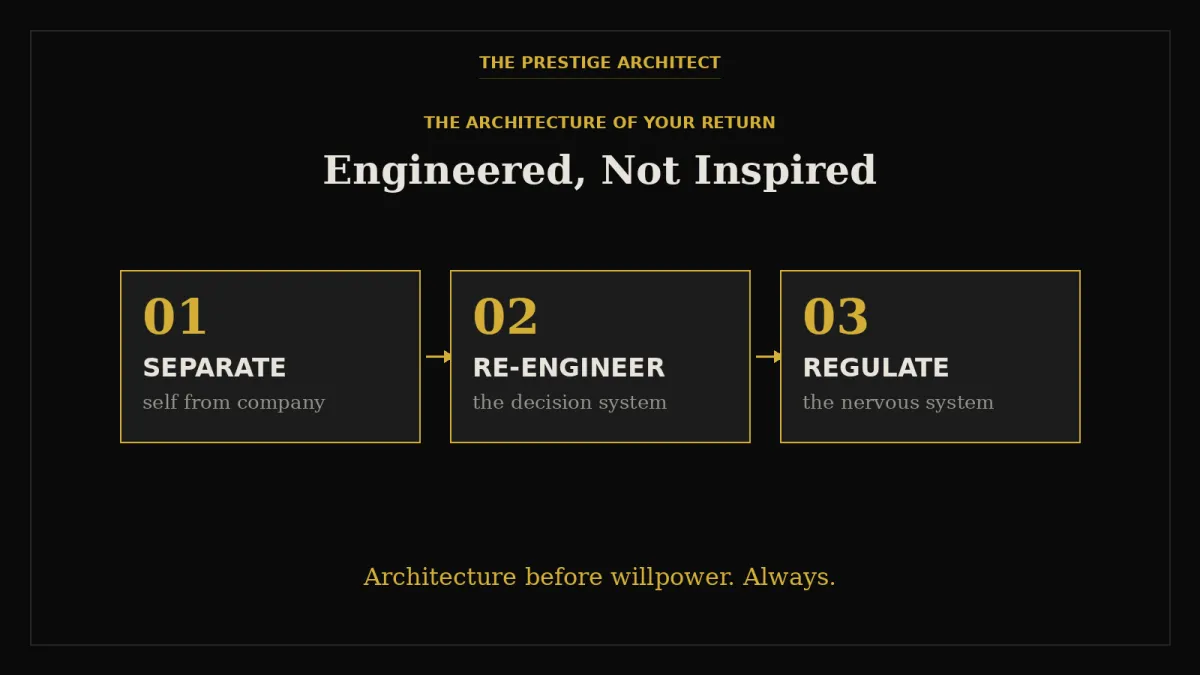
Self-differentiation is not a trait you were born without. It is architecture you build. You build it one hard conversation at a time. You hold your position and stay warm. You let the silence sit. You stop rescuing people from feelings they need to carry. This is the work inside every container I run. It is how a capable leader stops betraying themselves to keep the peace. You will not feel finished. You will feel steadier. The room will still get anxious. You will stop catching it. When you are ready to rebuild it on purpose, apply for the Silent Collapse Diagnostic™ and we begin.
Frequently asked questions
What is executive self-differentiation?
It is the built capacity to stay yourself under emotional pressure. You hold your own thinking while staying connected to anxious people. You do not merge with the room and you do not cut people off. The idea comes from Murray Bowen's differentiation of self.
Is self-differentiation the same as setting boundaries?
No. A boundary is a rule about behavior. Differentiation is an internal state that holds when the rule gets tested. You can hold a firm position and stay warm at the same time. Boundaries protect you from the outside. Differentiation steadies you from the inside.
How is differentiation different from detachment?
Detachment means you withdraw and stop caring. Differentiation means you stay connected and still think clearly. You feel the room without becoming it. That is the whole distinction. One cuts off. The other stays present and separate.
Can you build self-differentiation as an adult?
Yes. It is a capacity, not a fixed trait. Bowen found that real gains take years of deliberate practice. You build it in real conversations, under load, one position at a time. Progress is slow and it is durable.
Why do high performers struggle with self-differentiation?
Because approval got them here. They learned to read the room and keep everyone calm. That skill becomes over-functioning. They carry loads that belong to other people. The very habit that earned the promotion now runs their nervous system.
About Baz Porter®
Baz Porter® is the founder of Baz Porter LLC® and The Prestige Architect™. He is a British Army veteran, an international bestselling author, and the host of the Rise From The Ashes podcast on the C-Suite Network. He guides high-achieving leaders from Silent Collapse™ to Sovereign Leadership™: power without collapse, success without self-betrayal. He does not motivate. He architects the return.