Executive Self-Authorship: Author Your Own Standards
Written by Baz Porter®
You built a life that looks like success. You still ask other people what it should mean. That gap has a name. It is Silent Collapse™. The missing capacity has a name too. It is executive self-authorship. It is the power to author your own standards from the inside. Most leaders never built it. They inherited their rules. Then they spent decades meeting them.
Most leaders never notice this. They feel the strain and call it stress. The deeper truth is quieter. You are running a high-stakes life on borrowed rules. I wrote the manifesto for the leaders who are ready to stop.
Table of contents
Key takeaways
Executive self-authorship is the built capacity to author your own standards from the inside.
Most high achievers run on inherited rules. The rules feel like truth. They are not.
Self-authorship is not self-governance. Governance runs the rules. Authorship writes them.
The shift is developmental, not motivational. You build it. You do not force it.
This is the core of Sovereign Leadership™. Power without collapse starts here.
What executive self-authorship actually is
Executive self-authorship is the built capacity to author your own standards, values, and decisions from an internal source. You stop outsourcing your worth to titles and approval. You become the author of the rules you live by. This is the quiet engine under Sovereign Leadership™. It is how a capable leader holds power without self-betrayal.
Notice what it is not. It is not confidence. It is not a bigger goal. It is a place you lead from. The self-authored leader still hears other people. They no longer obey by reflex. The standard now lives inside them. That one shift changes everything downstream.
Self-authorship is often confused with two neighbors. It is not self-leadership. Self-leadership moves you toward a goal. It is not self-governance either. Self-governance enforces rules that already exist. Self-authorship sits under both. It is where the rules are written in the first place. Miss this layer and every system you build rests on someone else's foundation.
The hidden pattern under the strain
Adult development research explains it. Robert Kegan called it the move to the self-authoring mind. In "In Over Our Heads" (Harvard University Press, 1994), he mapped a shift most adults never complete. The socialized mind is run by other people's expectations. The self-authoring mind writes its own. Most executives lead from the first one. They look decisive. Inside, they are still seeking approval.
This is why more success does not end the strain. You cannot approval-seek your way out of approval-seeking. Marcia Baxter Magolda spent decades tracking the same capacity. Her longitudinal research found that self-authorship rarely arrives before midlife, and only under real pressure. Harvard Business Review has covered the leadership cost in the work of Kegan and Lisa Lahey. Standards you did not choose grow heavier the higher you climb.
The cost shows up as a quiet tax. Each decision runs through an invisible committee. You weigh the room before you weigh the truth. That lag drains energy no calendar can return. It also blurs your judgment. When the standard lives outside you, every choice becomes a bid for approval. The higher the stakes, the heavier the tax. Most leaders pay it for years and never see the bill.
The RAMS™ reframe
My method is RAMS™. Results, Attitude, Authenticity, Mastery, Systems. It reads the leader at the level of the nervous system and the business at once. Here is self-authorship across all five pillars.
Results. Self-authored leaders measure results against standards they set. The number still matters. It stops being the verdict on their worth.
Attitude. The socialized mind treats every room as a test. The self-authoring mind treats it as a choice. Same pressure. Different posture.
Authenticity. You cannot be true to rules you never chose. Authorship is the precondition. Authenticity is the result.
Mastery. Mastery here is not a skill. It is the capacity to hold your own standard when the room disagrees.
Systems. A standard you cannot repeat is a wish. Self-authorship becomes real when you build it into your calendar, your no, and your rest.
Collapsed vs Sovereign
Collapsed: your standards live in other people's heads. Sovereign: your standards live in you.
Collapsed: approval sets the bar. Sovereign: your values set the bar.
Collapsed: a win needs a witness. Sovereign: a win is enough on its own.
Collapsed: you audit yourself against strangers. Sovereign: you author the audit.
Collapsed: rest feels like risk. Sovereign: rest is a decision you signed.
Baz Porter® does not hand leaders a motive. He architects the self-rule that lets them hold power without collapse.
The first move is not a bigger goal. It is an honest read of where your standards actually come from. That is what the Silent Collapse Diagnostic™ gives you. One hour, live with me.
A case in point
I counsel a founder who sold for a number most people dream about. They hit every target. They still checked the phone for permission they could not name. We did not add a goal. We found the author. They learned to set one standard a week that no one else approved. Within a season, the checking stopped. The company did not change. The founder did. That is the work.
The architecture of your return
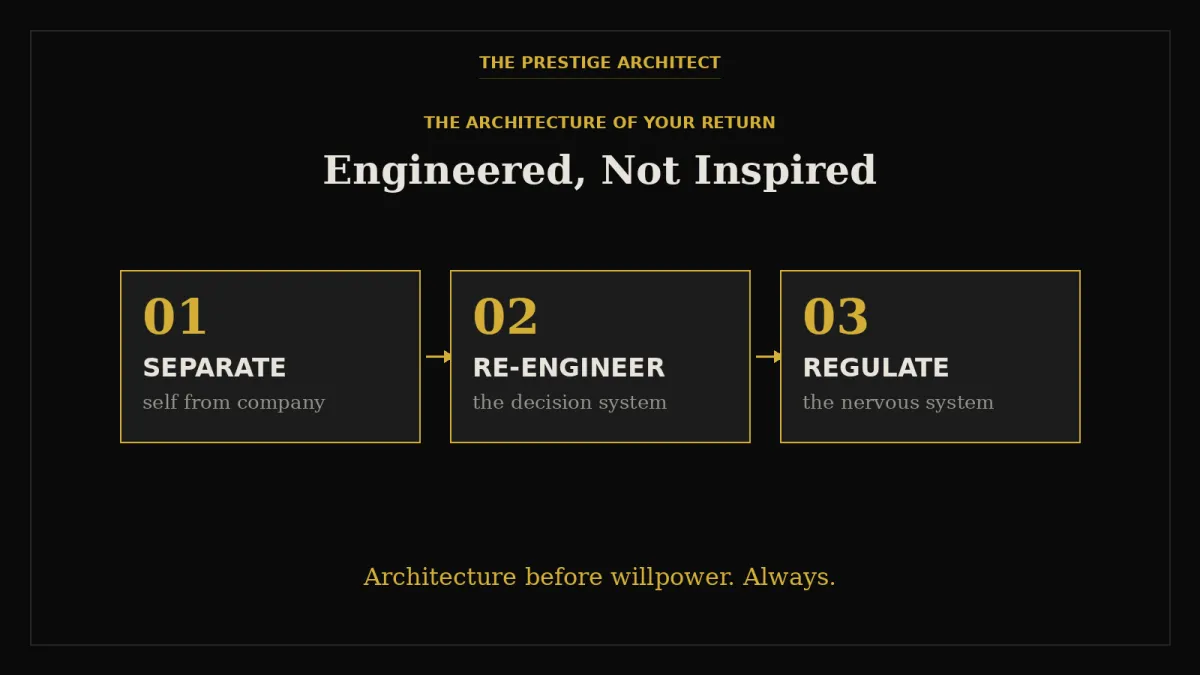
Self-authorship is not a mood. It is a build. You install it one standard at a time, inside Sovereign Leadership Architecture™. First you see the borrowed rules. Then you retire them. Then you write your own and hold them under pressure. That is the return.
Each move is concrete. Seeing the borrowed rules means naming them out loud. Retiring them means testing what breaks when you drop one. Writing your own means choosing a standard and signing it, in public, under load. Most leaders skip the last step. That is where sovereignty is made. The work is small, weekly, and repeatable.
If you are ready to author your own standards, start where every rebuild starts. Apply for the Silent Collapse Diagnostic™. We map where your authority leaked and where it returns.
Frequently asked questions
What is executive self-authorship?
It is the built capacity to author your own standards, values, and decisions from an internal source. You stop running your life on inherited rules and other people's approval. It is the developmental core of Sovereign Leadership™.
What is the difference between self-authorship and self-governance?
Self-governance runs the rules that already exist. Self-authorship writes the rules in the first place. You need governance to hold the line. You need authorship to decide where the line belongs.
Why do successful leaders still lack self-authorship?
Success rewards meeting other people's standards well. It rarely asks you to write your own. Many high achievers reach the top of the socialized mind and stall there. More wins do not close the gap.
Can you build self-authorship, or are you born with it?
You build it. Adult development research shows it is a capacity that grows, usually after midlife, under real conditions. It is a build, not a personality trait.
How do I start developing executive self-authorship?
Begin with an honest audit of where your standards come from. Name one rule you never chose. Replace it with one you author. The Silent Collapse Diagnostic™ gives you that first read, live.
About the author
Baz Porter® is the founder of Baz Porter LLC® and The Prestige Architect™. He is a British Army veteran, an international bestselling author, and the host of the Rise From The Ashes podcast on the C-Suite Network. He architects Sovereign Leadership Architecture™ for leaders moving from Silent Collapse™ to sovereign self-rule. Power without collapse. Success without self-betrayal.