Executive Conviction: Decide and Stop Second-Guessing
Written by Baz Porter®
You made the call. It was the right call. Then, at 2am, you re-litigate it. Again. This is the quiet tax on leaders who have everything except conviction. Executive conviction is not certainty. It is the built discipline to decide and hold the line while doubt is still in the room. When it is missing, you lead from a permanent flinch. That flinch is one of the engines of Silent Collapse™, the private erosion behind a public win. If you have read the manifesto, you know the aim: power without collapse.
Here is the part no one says. The second-guessing does not read as weakness on the outside. It reads as diligence. And it is eating you alive.
In this article
Key takeaways
Executive conviction is the capacity to decide and hold the line under doubt. It is not certainty.
Chronic second-guessing reads as diligence. Underneath, it is a commitment problem, not a thinking problem.
The cost is hidden: stalled teams, lost momentum, and nights spent re-litigating settled calls.
Conviction is a system you build, not a feeling you wait for.
The RAMS™ reframe moves you from a permanent flinch to a repeatable way of deciding.
What is executive conviction?
Executive conviction is the built capacity to make a clear decision and hold it while the outcome is still unknown. It is not certainty. Certainty waits for proof that never arrives on time. Conviction moves before the proof, on a sound process and a clear set of values. In leaders it looks like steadiness. Underneath, it is a system: a way of deciding that holds when the conditions do not. Within the Sovereign Leadership Architecture™, conviction is engineered, not summoned. You do not find it. You build it.
The hidden pattern
Most leaders think their second-guessing is thoroughness. The evidence says it is often a trap. The psychologist Barry Schwartz studied two kinds of decider. The maximizer hunts for the best possible option. The satisficer picks the one that clears the bar and commits. Schwartz found the maximizers were more likely to regret, to compare, and to feel worse about good decisions (Schwartz et al., Maximizing versus satisficing, Journal of Personality and Social Psychology, 2002). The lesson is sharp. The endless search for the perfect call does not protect you. It corrodes you.
So the pattern is not care. It is a hidden fear of the wrong call. Harvard Business Review has reported for years that leaders who wait for full clarity forfeit the moment. Forbes has documented the same: the best leaders decide, then act, and separate a bad outcome from a bad decision. You are not short on analysis. You are short on the will to close the loop.
The RAMS™ reframe
The Sovereign Leadership Architecture™ does not ask you to gamble. It asks you to build a way of deciding that holds. The RAMS™ framework moves through five pillars. Each one turns doubt into design.
Results. Collapsed, you measure a decision by whether it felt safe. Sovereign, you measure it by whether the process was sound. Outcomes vary. A good process compounds.
Attitude. Collapsed, doubt means stop. Sovereign, doubt is a checkpoint, not a verdict. You note it, and you still move.
Authenticity. Collapsed, you hedge so no one can pin the call on you. Sovereign, you own the decision out loud. That is command, not cover.
Mastery. Collapsed, you master the analysis and never leave it. Sovereign, you master the exit: the moment you stop deciding and start executing.
Systems. Collapsed, every call is a fresh agony with no rules. Sovereign, you build a decision system, so conviction is repeatable, not a mood.
Here is the shift, side by side.
Collapsed: I decide when I am certain. Sovereign: I decide when the process is sound.
Collapsed: Doubt means I chose wrong. Sovereign: Doubt means I am human, and I still commit.
Collapsed: I keep the option open in case. Sovereign: I close the loop and move.
Collapsed: A bad outcome means a bad decision. Sovereign: A bad outcome is data, not a verdict.
Baz Porter® does not motivate. He does not inspire. He architects. Conviction is not a feeling you wait for. It is a system you build.
If you recognize the 2am re-litigation, the next step is a clear read, not a pep talk. The Silent Collapse Diagnostic™ is one hour, live, to map exactly where the doubt is costing you the decision.
A leader who could not decide
I counseled a chief executive who could see three moves ahead and still could not pull the trigger. Every choice sat in a queue marked later. Their team stalled behind them, waiting on a yes that never came. They called it being careful. It was fear wearing a spreadsheet. We traced the rule. Early on, one wrong call had cost them badly, and the nervous system wrote a law: never decide until it is safe. So they never decided. We rebuilt the law. We gave them a process to trust instead of a feeling to wait for. Within a quarter they were clearing in a day the calls that used to sit for a month. The decisions were not perfect. They were made. And the team moved again.
The architecture of your return
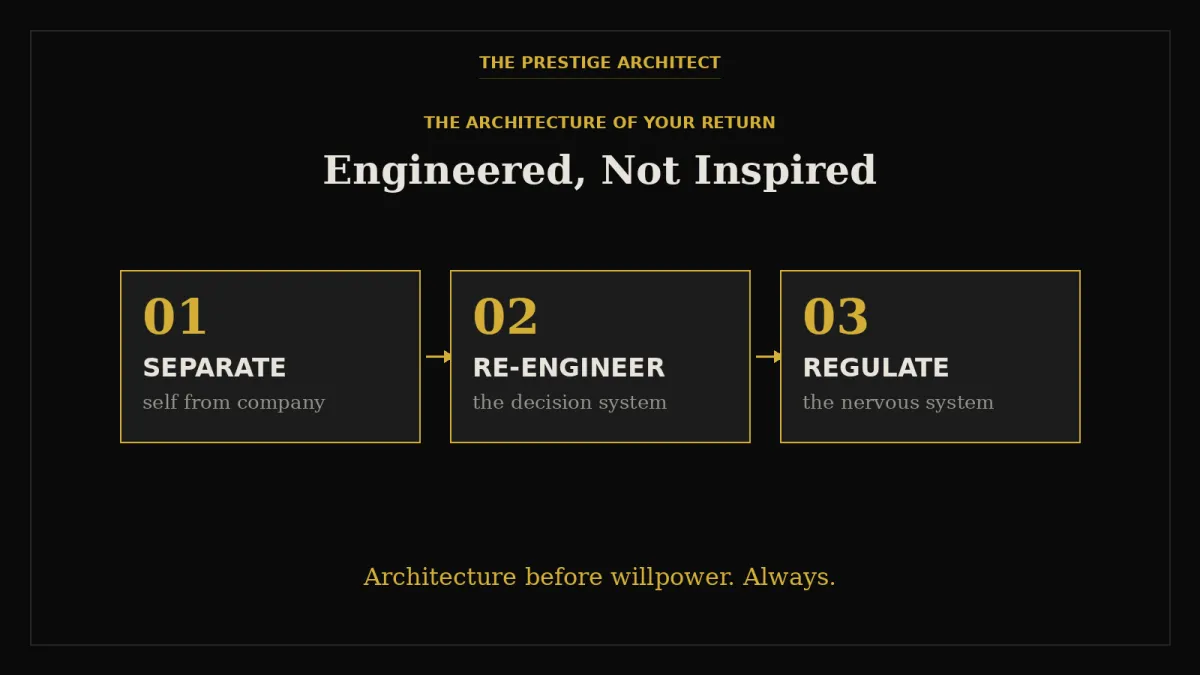
You cannot think your way into conviction. You have to build the machine that produces it. That is the return: a deliberate rebuild of how you decide, so leadership stops costing you your nights. Start with the truth on the table. Apply for the Silent Collapse Diagnostic™. In one hour we map where the second-guessing runs your leadership, what it is protecting, and the first move to build conviction you can repeat. The decision was never the hard part. Holding it was. We build that.
Frequently asked questions
What is executive conviction in leadership?
Executive conviction is the discipline to make a clear decision and hold it while the outcome is still unknown. It is not certainty, and it is not stubbornness. It rests on a sound process and clear values, so you can commit before you have proof. In the Sovereign Leadership Architecture™ it is built, not summoned.
How do I stop second-guessing my decisions as a leader?
Shift from waiting for certainty to trusting a process. Decide in advance what evidence is enough, then commit when you reach that bar. Separate a bad outcome from a bad decision, because a sound call can still meet bad luck. The habit weakens each time you close a loop instead of reopening it.
What is the difference between conviction and stubbornness?
Conviction holds a decision and stays open to new evidence. Stubbornness holds a decision and refuses all evidence. One is a commitment you can revise for cause. The other is an identity you defend past the facts. Conviction moves; stubbornness digs in.
Can a leader have too much conviction?
Yes. Conviction without a feedback loop becomes rigidity. The goal is to commit fully and still watch for real signals that you were wrong. Strong leaders decide with force and update with humility. The skill is holding both at once.
Why do successful executives struggle with conviction?
Because the higher the stakes, the louder the doubt. Every call now carries weight, so the mind hunts for a certainty that never comes. Past success also raises the fear of the first public miss. That fear reads as caution, but it quietly becomes paralysis and feeds Silent Collapse™.
About the author
Baz Porter® is the founder of Baz Porter LLC® and the architect of Sovereign Leadership Architecture™. He guides high-achieving leaders from Silent Collapse™ to Sovereign Leadership™: power without collapse, success without self-betrayal. He is an international bestselling author and the host of the Rise From The Ashes podcast on the C-Suite Network.