Executive Compassion Fatigue: When Caring Runs You Dry
Written by Baz Porter®
You are the one everyone comes to. The steady one. The person who holds the room when it shakes.
And lately, something has gone quiet in you. The care is still there. The capacity to feel it is running dry. This is Silent Collapse™, and its name here is executive compassion fatigue. It is not weakness. It is the cost of carrying other people for a long time. There is another way to lead, and it starts with a harder, truer definition of strength.
What this covers
Key takeaways
Compassion fatigue is emotional depletion from absorbing other people's stress and pain.
It is different from burnout. Burnout comes from overload. This comes from over-caring.
High performers are the most exposed. You feel more, so you carry more.
It is reversible. The care returns when the load is rebuilt, not when you try harder.
The return runs across all five RAMS™ pillars, one small step at a time.
What is executive compassion fatigue?
Executive compassion fatigue is the emotional exhaustion a leader feels after carrying other people's pain, stress, and needs for too long. It is not ordinary burnout. Burnout comes from too much work. Compassion fatigue comes from too much caring, with no way to set the weight down. The signs are quiet. You feel numb to news that used to move you. You dread the next person's problem. You keep showing up while the warmth drains out. Named by researcher Charles Figley, it is a normal response to sustained caring, and it is reversible with the right structure around you. In high performers, it is a core marker of Silent Collapse™.
The hidden pattern most leaders miss
Here is what the research shows. Compassion fatigue is not a character flaw. It is a load problem.
Charles Figley, who first defined the term, found the people most at risk are the ones who care the most. The trait that makes you a trusted leader is the same trait that drains you. You absorb what others feel. Over time, with no recovery, the well runs dry.
The pattern hides because you keep functioning. You lead the meeting. You hold the team. From the outside, nothing looks wrong. Inside, the signal that used to say "this matters" has gone flat. Forbes calls it the hidden cost of leaders who care too much. The SHRM Executive Network now treats it as a leadership risk, not a private one. The load is real. So is the way out.
The RAMS™ return: rebuilding the way you carry weight
Sovereign Leadership™ does not ask you to care less. It asks you to build a structure that lets you keep caring without running dry. RAMS™ moves across five pillars: Results, Attitude, Authenticity, Mastery, and Systems. Each one takes a small part of the weight off you.
Results: measure the load, not just the output
You track revenue and deadlines. You do not track how much emotional weight you carry. Start there. Name the people and problems you hold each week. The number is almost always higher than you think. What gets measured can be changed.
Attitude: caring is not the same as absorbing
You can care deeply and still not take the feeling into your own body. That is a skill, not a betrayal. Presence does not require you to bleed. The shift sounds small. It changes everything.
Authenticity: tell the truth about your limit
You have taught everyone that you are fine. The honest leader says the harder thing. "I have been carrying too much." Saying it is not collapse. It is the first real act of the return.
Mastery: build recovery into the week
Elite performers recover on purpose. You do not earn rest by emptying first. You protect the capacity to care by refilling before it is gone. Recovery is a discipline, not a reward. Small refills, repeated, beat one long collapse. Put them in the calendar and defend them.
Systems: stop being the only container
If every problem routes to you, the system is the problem. Build other places for people to be held. A leader who is the single point of care becomes a single point of failure. Shared weight is safer weight.
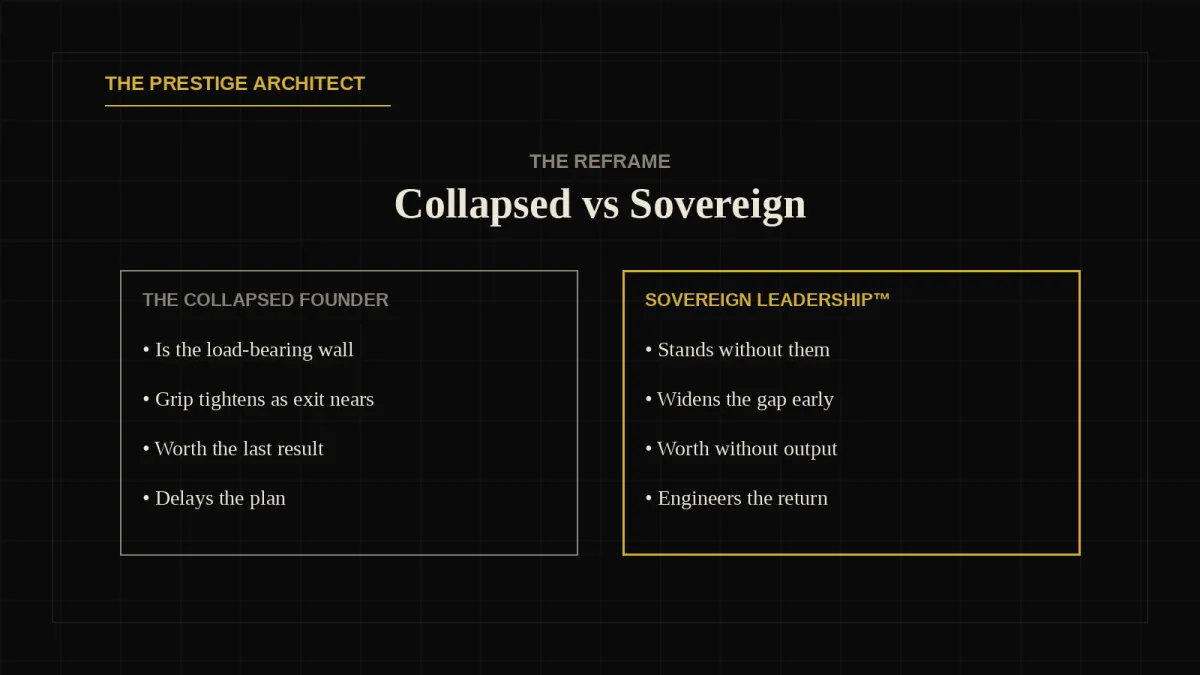
Collapsed versus Sovereign
Collapsed: absorbs every feeling in the room. Sovereign: feels it, and stays whole.
Collapsed: the only person who can hold the team. Sovereign: builds a team that holds itself.
Collapsed: rest is a reward for finishing. Sovereign: rest is how the work gets done.
Collapsed: hides the limit until it snaps. Sovereign: names the limit early.
Collapsed: caring drains the self. Sovereign: caring runs on a structure that refills.
Baz Porter® does not motivate. He does not inspire. He architects the structure that lets a leader carry weight without losing the self.
If the warmth has gone quiet in you, name it. The Silent Collapse Diagnostic™ is sixty minutes, one to one, to see the load clearly and map the return.
One leader's turning point
A founder came to me last year. Her team loved her. She had held every one of them through a hard eighteen months.
She said the thing out loud. "I feel nothing when they win now." She thought she had lost her heart. She had not. She had run the well dry.
We did not add willpower. We rebuilt the load. We named what she carried. We put other containers around the team. We built recovery into her week as a rule, not a treat.
Ninety days later, the warmth was back. Nothing about her caring had changed. Everything about how she carried it had.
The architecture of your return
Compassion fatigue does not end because you push harder. Pushing harder is what emptied you. It ends when the structure around your caring changes. That structure is something you build, on purpose.
That is the work of Sovereign Leadership Architecture™. Results you can see. An attitude that protects you. Authenticity about the limit. Mastery of recovery. Systems that share the weight. You keep your heart. You stop paying for it with yourself.
Start with one honest hour. Apply for the Silent Collapse Diagnostic™ and we will map your return together.
Questions leaders ask
What is the difference between compassion fatigue and burnout?
Burnout comes from chronic overload and too much work. Compassion fatigue comes from absorbing other people's pain and stress. You can love your work and still have compassion fatigue. The cause is caring, not the calendar.
What are the signs of compassion fatigue in leaders?
Common signs are numbness to news that used to move you, dread before someone brings a problem, irritability, and trouble switching off. Many leaders keep performing while feeling hollow inside. The performance hides the cost.
Can compassion fatigue be reversed?
Yes. Compassion fatigue is reversible and often recovers within months. The path is rebuilding your load and recovery, not caring less. The warmth returns once the structure supports it.
Why do high achievers get compassion fatigue more?
High achievers feel more and take on more. The empathy that makes you trusted also makes you exposed. Charles Figley found the most caring people are the most at risk. Your strength is also your risk.
How do I protect myself from compassion fatigue as a leader?
Track the emotional load you carry, not just your output. Build recovery into your week on purpose. Create other places for people to be held so you are not the only container. Structure protects the caring.
About the author
Baz Porter® is the founder of Baz Porter LLC® and The Prestige Architect™. He guides high performing leaders out of Silent Collapse™ and into Sovereign Leadership™: power without collapse, success without self-betrayal. He is the creator of RAMS™ and Sovereign Leadership Architecture™.