Executive Alexithymia: When You Can't Name What You Feel
Written by Baz Porter®
You can read a P&L in seconds. You cannot say what you feel. That gap has a name. It is called alexithymia, and among high-functioning leaders it is far more common than anyone admits. You feel the pressure in your chest. You cannot turn it into words. This is not coldness. It is Silent Collapse™ wearing a competent face. I wrote the Sovereign Manifesto for the leader who runs everything and cannot name what runs through them.
On this page
What is executive alexithymia?
How it shows up
The hidden pattern
The RAMS™ reframe
A leader I counseled
The architecture of your return
Questions leaders ask
Key takeaways
Executive alexithymia is a reduced ability to identify and name your own emotions.
It is common in high achievers who learned to override feeling to keep performing.
It is not a missing heart. The signal fires. The word never arrives.
Naming feeling is a skill. It can be rebuilt at any age.
The rebuild runs across all five RAMS™ pillars, one prompt at a time.
What is executive alexithymia?
Executive alexithymia is the reduced ability to identify and describe your own emotions, showing up in an outwardly successful leader. You feel physical signals. You cannot label them. Psychiatrist Peter Sifneos named the trait in 1972. It sits on a spectrum, and stress pushes you along it. For leaders, the cause is rarely a cold nature. It is years of overriding feeling to keep performing. The result is a quiet, high-functioning form of Silent Collapse™.
How executive alexithymia shows up
It rarely looks like a feeling problem. It looks like performance. You answer how are you with fine or busy. You default to logistics when someone asks about your inner world. You feel a knot before a hard meeting and read it as a scheduling issue. You are told you seem distant, and you cannot see it. The tells are physical first. Jaw tension. Shallow sleep. A short temper that arrives with no named cause. You explain each one away. The signal is real. The label is missing. This is the daily texture of a high-functioning leader living with a quiet naming gap. Left alone, it does not stay still. It hardens into distance from the people who matter most.
The hidden pattern
Here is the pattern I see in the room. Sifneos found that alexithymia is not an absence of emotion. It is a break in the line between the body and language. Work using the Toronto Alexithymia Scale shows it clusters with chronic stress and burnout (Bagby, Parker, and Taylor). Your nervous system still fires. The word for the feeling never lands. High achievers learn this early. Feeling looked like a liability, so you filed it away. The filing became automatic. Now the feeling shows up as tight shoulders, short sleep, and a flat voice at dinner. You call it being busy. Your body calls it something else.
The RAMS™ reframe
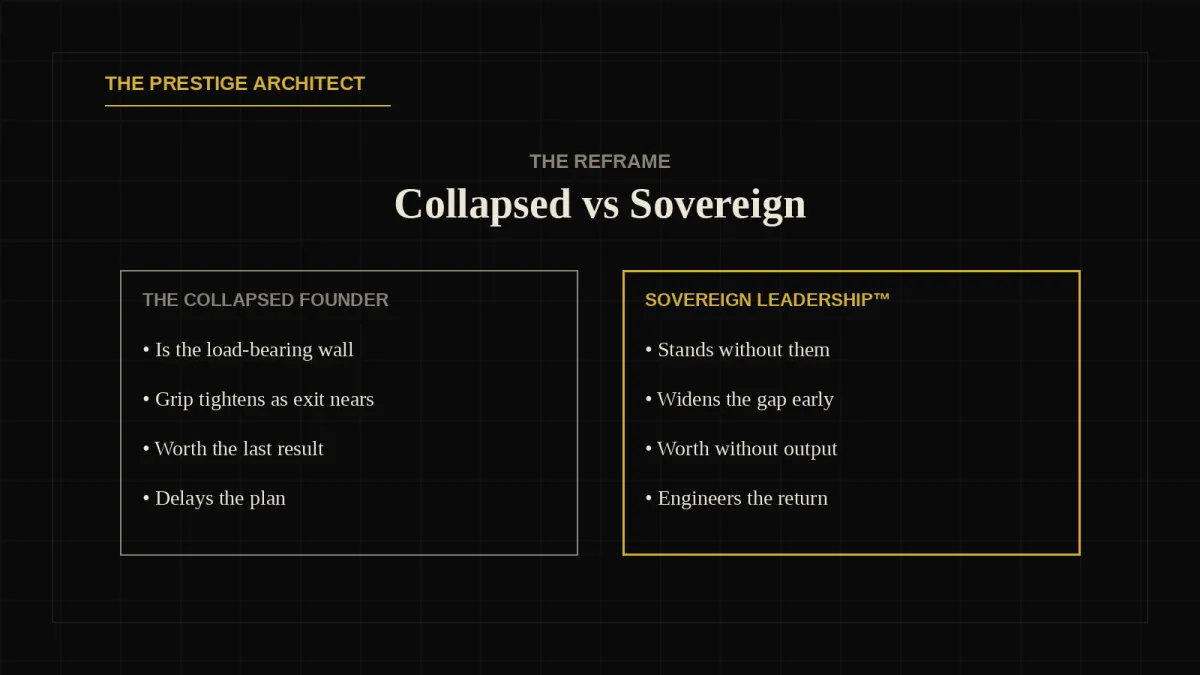
I do not counsel from theory. I architect a return across five pillars. RAMS™ is Results, Attitude, Authenticity, Mastery, and Systems. Each pillar moves you from a collapsed pattern to a sovereign one.
Results
You measure output all day. You cannot measure how you feel about it. That is a data gap.
Collapsed: results are the only signal you trust.
Sovereign: your inner state becomes data you read and act on.
When feeling is data, you stop flying half blind. You catch strain before it costs you a person or a decision.
Attitude
Your attitude toward feeling is the whole problem. You treat emotion as noise.
Collapsed: feeling is weakness to be managed.
Sovereign: feeling is information about load and direction.
You already read the market this way. Read yourself the same way.
Authenticity
You cannot be known if you cannot name yourself. People feel the distance.
Collapsed: you present competence and hide the interior.
Sovereign: you name one true state, and connection returns.
People do not need your whole interior. They need one honest word. That word is what makes you real to them again.
Mastery
Naming feeling is a skill. Skills are built, not born.
Collapsed: you assume you are simply not an emotional person.
Sovereign: you train a small emotional vocabulary until it holds.
Systems
Willpower fails here. Structure does not.
Collapsed: you wait to feel different before you act.
Sovereign: you build daily prompts that surface the feeling on schedule.
The prompt does the remembering, so you do not have to. Over weeks, the naming becomes yours and the prompt fades.
A leader who cannot name what they feel will manage everyone except themselves. I do not motivate that leader. I architect the system that gives the feeling a word.
If you recognize yourself here, start where I start every client. The Silent Collapse Diagnostic™ is sixty minutes, live with me. We locate the exact place the line went quiet.
A leader I counseled
A founder came to me able to close a nine-figure round. He could not tell his wife what he felt. He called it being practical. His body called it insomnia. We did not chase feelings. We built one prompt. Twice a day he named one physical signal and one word. In three weeks the words arrived faster. In three months his team said he had come back. Nothing about his standards changed. He simply stopped living behind glass. The result was not softer standards. It was a leader his people could finally reach.
The architecture of your return
Your return is not a feeling you wait for. It is a structure you install. You do not need to become someone else. You need the line between body and language rebuilt, one prompt at a time. That is the work I do. When you are ready to start, apply for the Silent Collapse Diagnostic™. We map the collapse, and we design the rebuild. You do not start with a diary or a retreat. You start with one signal and one word, twice a day. That is small on purpose. Small is what holds when the quarter turns brutal. The line between body and language is rebuilt the way it was lost, one repetition at a time.
Questions leaders ask
What is executive alexithymia?
It is a reduced ability to identify and describe your own emotions, seen in high-functioning leaders. You still feel bodily signals such as tension or fatigue. You cannot translate them into named emotions. It is a trait on a spectrum, not a disease.
Is alexithymia the same as burnout?
No. Burnout is depletion from sustained overload. Alexithymia is difficulty naming what you feel. They travel together often, because years of ignoring feeling both drives burnout and deepens the naming gap.
Can alexithymia be changed in adults?
Yes. Naming emotions is a learnable skill, and adults rebuild it with practice. Structured prompts that pair a body signal with a feeling word are the fastest route. Progress usually shows within weeks, not years.
Why do high achievers develop alexithymia?
Many high achievers learned early that feeling was a liability to performance. So they overrode it until the override became automatic. The skill of naming emotion then never got built. The competence stays high while the inner signal goes quiet.
How do I start naming my emotions as a leader?
Begin with the body, not the mind. Twice a day, note one physical sensation and one plain word for the feeling under it. Keep the vocabulary small at first. The Silent Collapse Diagnostic™ gives you a structured place to start.
About the author
Baz Porter® is the founder of Baz Porter LLC® and The Prestige Architect™. A British Army veteran and international bestselling author, he guides high-achieving leaders from Silent Collapse™ to Sovereign Leadership™. He does not motivate. He architects the return.