How to Build an Execution System for Your Business
Written by Baz Porter®
You do not have an idea problem. You have an execution system problem. Ideas arrive fast. They pile up on your desk and in your head. By Friday, none of them shipped. Monday, you start the whole plan over. This loop is not a character flaw. It is a missing structure. I call the private cost of that loop Silent Collapse™. You look productive to everyone outside. Inside, you are worn out from carrying every idea by hand. The fix is an architecture, not more effort. If this names your week, read the manifesto.
In this guide
Key takeaways
An execution system moves one idea from decision to done, on rails.
Unfinished work is a structure gap, not a willpower gap.
Pre-decided triggers beat motivation. The research is clear on this.
Build the path once. Stop rebuilding your week from zero.
RAMS™ names the five parts every execution system needs.
What an execution system is
An execution system is a fixed path. An idea travels it from choice to finished work. It has four parts. One place to capture every idea. One rule to pick the next one. One set of steps to move it forward. One checkpoint that says done. You decide the path once. Then every idea runs the same track. You stop inventing the process each time you sit down. That is the whole point. The system carries the load your memory was carrying. Your head gets lighter. Your work gets finished. This is not a productivity hack. It is the base structure under real output. Most people skip it. They chase tools and apps instead. A new app is not a system. A system is the decision about what happens next, made once, in advance. The app only holds that decision. Build the decision first, then pick the tool.
The hidden pattern behind unfinished work
Here is what the research shows. People do not stall for lack of goals. They stall in the gap between wanting and doing. Peter Gollwitzer studied that gap for years. His work on implementation intentions found something plain. When you pre-decide the exact when and where of an action, you act far more often. A 2006 review of 94 studies confirmed the effect at scale (Gollwitzer, American Psychologist). The plan does the work that willpower cannot hold. Your ideas stall because the trigger was never set. An execution system sets that trigger for you, in advance. Strategy research says the same thing at the company level. Most strategies die in execution, not design (Harvard Business Review). The pattern is the same for one person or a whole firm. Structure beats intent. Think about what this means for your week. The problem was never you. The problem was an open loop with no set trigger. Close the loop with a rule. Then the idea moves on its own.
The RAMS™ execution reframe
RAMS™ is my operating model. Five pillars. Results, Attitude, Authenticity, Mastery, and Systems. An execution system needs all five to hold. Miss one and the track breaks somewhere.
Results
Define done before you start. One clear outcome. Not a vague direction like "grow the brand." A finished thing you can point at and name. If you cannot name done, you cannot reach it.
Attitude
Treat a stall as data, not failure. The stall marks a missing step. Find the step. Fix the step. Drop the shame that says you are the problem. You are not. The path was.
Authenticity
Build the system around who you really are. Not the guru's five a.m. routine. Your real energy. Your real hours. Your real limits. A system you have to fake will not survive a hard week.
Mastery
Run the same path until it feels boring. Repetition builds skill. Skill makes execution feel light. A new method every week keeps you a permanent beginner. Boring is where the results live.
Systems
Write the path down where you can see it. Capture, choose, move, close. Four words. One page. The page holds the plan so your head does not. That is the shift from carrying to running.
Here is the change, laid out side by side.
Collapsed: a fresh plan every Monday. Sovereign: one path you reuse.
Collapsed: ten open ideas at once. Sovereign: one active, nine parked.
Collapsed: willpower carries the work. Sovereign: the system carries it.
Collapsed: done is a vague feeling. Sovereign: done is a defined line.
Collapsed: you rebuild from zero. Sovereign: you resume from the track.
Baz Porter does not motivate. He does not inspire. He architects the structure that holds.
Want to see which pillar breaks first for you? The Silent Collapse Diagnostic™ shows you where your execution leaks.
A founder who stopped restarting
One client ran a small firm. Sharp mind. Full of ideas. Nothing shipped. They rebuilt the weekly plan every single Monday. They thought they lacked discipline. They did not. They lacked a track. So we built one page together. A capture box. One active idea. Four steps. A clear done line. They stopped choosing from scratch each morning. In six weeks they shipped three things carried for a year. Nothing about the person changed. The structure around the person did. That is the work. Not a new you. A path your ideas can travel. They still have too many ideas. That part did not change. What changed is where the ideas go. Each one lands in the capture box. Then it waits its turn on the track.
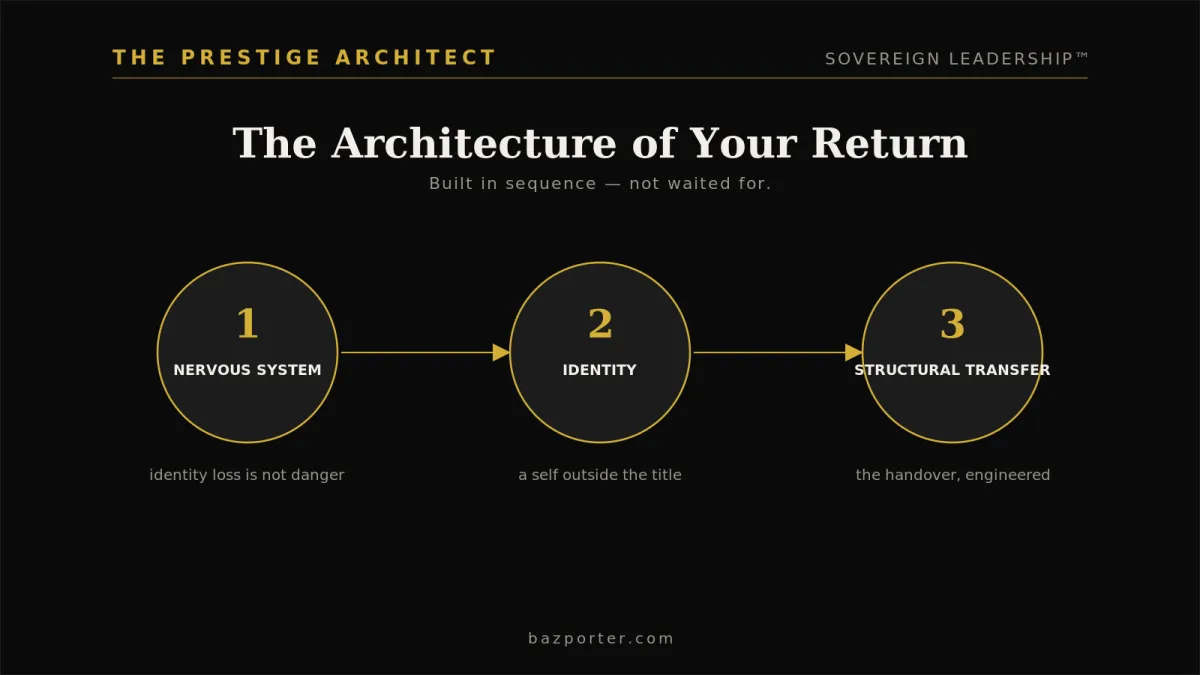
The architecture of your return
You do not need another idea. You need a track for the ones you hold. Build the four parts now. Capture. Choose. Move. Close. Reuse that same path until it runs without you pushing. That is the return from the weekly rebuild. That is Sovereign Leadership™. Power without the private collapse under it. Your energy stops leaking into restarts. It starts landing in finished work. When you are ready to build this with counsel beside you, apply through the Silent Collapse Diagnostic™.
Questions leaders ask
What is an execution system?
An execution system is a fixed path an idea travels from decision to finished work. It captures the idea, picks the next one, moves it in set steps, and marks it done. You build the path once and reuse it. It replaces the plan you rebuild every week.
Why do I have so many ideas but finish nothing?
Ideas are cheap and fast. Finishing needs a structure to carry an idea to done. Without that structure, every idea competes for the same attention and none wins. The gap is not effort. It is a missing execution system.
How do I choose which idea to work on first?
Set one rule and follow it every time. Pick the idea closest to done, or the one tied to this quarter's outcome. Park the rest in a capture list. One active idea at a time keeps the track clear.
Is this a discipline problem or a system problem?
Almost always a system problem. Discipline runs out by Wednesday. A written path does not. When the steps live on a page, you resume instead of restart. That is why the system beats raw willpower every time.
How long does it take to build an execution system?
You can draft the four parts in one afternoon. Capture, choose, move, close. The skill comes from running it, not from designing it. Most people feel the difference within a few weeks of steady reuse.
About the author
Baz Porter® is the founder of Baz Porter LLC® and The Prestige Architect™. He is a British Army veteran and an international bestselling author. He hosts the Rise From The Ashes podcast on the C-Suite Network. He guides high-achieving leaders from Silent Collapse™ to Sovereign Leadership™. He builds the architecture so power does not cost you yourself.