Why You Don't Like Who You Became to Lead
You built the career you were supposed to want. Silent Collapse™ is the part no one on your team can see. You watch the person who runs your meetings, closes your deals, holds the room. That person is good at the job. That person is also someone you would not have picked to become. The recoil is quiet. It shows up in the car before you walk inside. If that lands, start by reading the manifesto.
Written by Baz Porter®
What this covers
Key takeaways
Disliking who you became is a signal, not a character flaw.
The dislike measures a gap. It sits between your real self and the self the role rewarded.
Research on self-discrepancy ties that gap to dejection, not laziness.
You do not close the gap by trying harder in the role.
You close it by return. Return is small, structural, and repeatable.
The short answer
You do not dislike yourself. You dislike the version of you the role kept rewarding. That is a precise and useful distinction. The dislike is a measurement. It tells you how far the performed self has drifted from the real one. Most leaders read the feeling as proof they are ungrateful. It is not. It is the signal that the cost of the climb has come due. The move is not to force more gratitude. The move is to return to your real self inside the life you already built.
The hidden pattern under the dislike
There is a mechanism here. It is not a mood. Self-discrepancy theory describes what happens when your actual self drifts from the self you believe you should be (Higgins, 1987, Psychological Review). The drift does not produce guilt alone. It produces a specific dejection. A flatness. A quiet distaste for your own reflection. That is the exact feeling you carry into the parking lot.
The climb builds the drift one trade at a time. You learned to go cold in conflict because it worked. You learned to perform certainty you did not feel. You learned to put the number before the person, including yourself. None of these were betrayals in the moment. Each was a reasonable move. Together they built a self you now meet with a small flinch.
Research on the true self adds the second half. People report real wellbeing when their choices express who they actually are, and real strain when they do not (Schlegel et al., 2009, Journal of Personality and Social Psychology). The dislike is that strain, named. It is not telling you to quit. It is telling you something true has gone unlived.
The RAMS™ reframe
RAMS™ reads the leader before it reads the strategy. Five pillars. The dislike touches all five.
Results. Treat the dislike as data, not confession. Name the three traits you most dislike in your work self. Write them down. Each one points to a value you set aside to get here. The feeling is a readout. Read it.
Attitude. Stop moralizing the dislike. You are not weak for feeling it. You are accurate. The leaders who stay numb to it are the ones in trouble. Yours still works.
Authenticity. This is the pillar under the ache. Find the values you traded, not the habits you picked up. Maybe you traded directness for diplomacy. Maybe you traded presence for speed. The disliked self is the sum of those trades. Return means living one traded value again, on purpose, this week.
Mastery. You do not reverse years of drift in a weekend. You reverse it in reps. One honest sentence in a meeting you would normally manage. One decision made from your own read instead of the room's. Small. Repeatable. Real.
Systems. Willpower loses to the role. So build guardrails that make the role stop eroding you. A standing rule for how you open hard conversations. A boundary on the hours that turn you cold. The system holds the return when your resolve dips.
Here is the shape of the shift, pillar by pillar.
Collapsed: the dislike is proof I am ungrateful. Sovereign: the dislike is a signal I can read.
Collapsed: I have to keep performing the self that got me here. Sovereign: I can lead as the self I respect.
Collapsed: fixing this means blowing up the life. Sovereign: return happens inside the life I built.
Collapsed: this is who I am now. Sovereign: this is who the role rewarded, and I can choose again.
The leaders who recover do not become new people. They come back to the one they left on the way up.
If you want the clean, structured version of that return, the Fast Future Freedom Blueprint is the free entry audit. It maps the trades and the first reps back.
A leader who felt it
One client ran a division of several hundred people. Respected. Decisive. On paper, exactly who they set out to be. In private, they said one sentence. "I do not like the person I am at work." They were not depressed. They were not failing. They were accurate.
We did not rebuild them. We named three traded values. Candor. Patience. A refusal to humiliate people under pressure. Then we built three small reps and two guardrails. Within a quarter the flinch eased. Not because the job changed. Because the person running it had come partway home. The dislike had done its job. It pointed the way back.
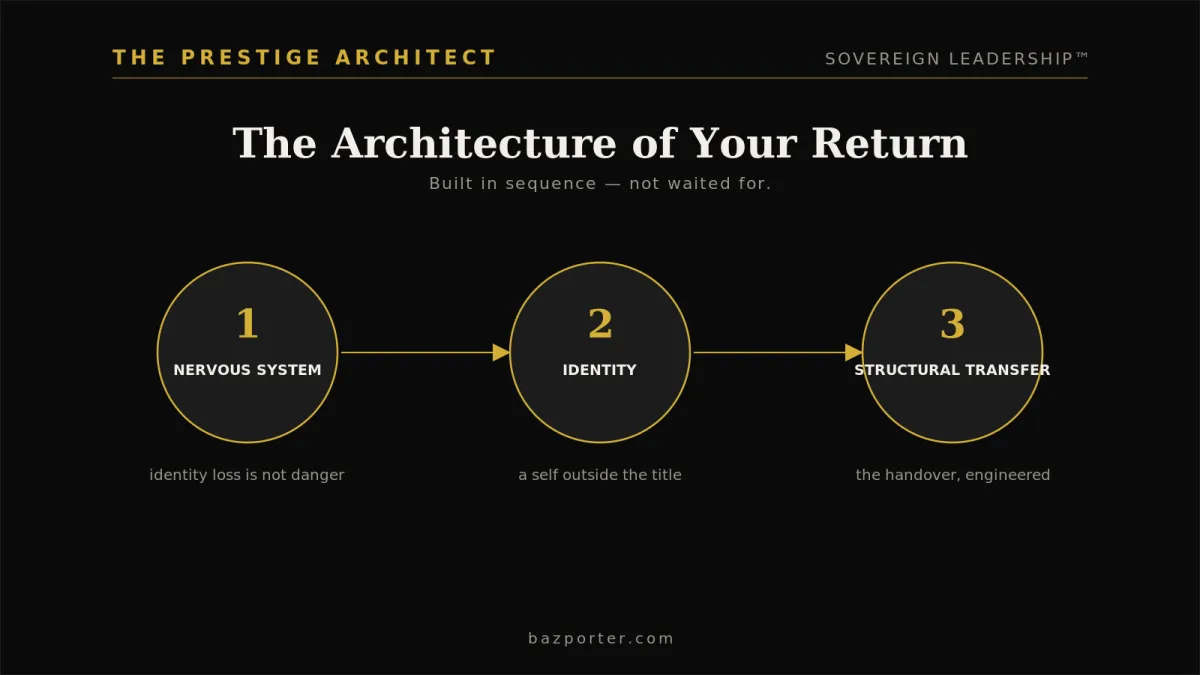
The architecture of your return
Return is engineering, not willpower. You name the trades. You pick the first value to live again. You build one system that protects it from the role. Then you repeat until the person in the reflection is one you respect.
You do not have to leave to do this. You do not have to confess it to the board. You have to stop treating the dislike as a verdict and start treating it as a map. The map is already in your chest. The Fast Future Freedom Blueprint is where you apply and begin reading it.
Questions leaders ask
Is disliking who I became a sign I am in the wrong job?
Not usually. It is more often a sign that the job rewarded a version of you that drifted from your real one. The role can stay. The self running it can return. Leaving rarely fixes a drift you can name and reverse where you are.
Why do I feel this when everything is going well?
Because the dislike is not about performance. It is about congruence. You can hit every number and still feel the gap between who you are and who you act like all day. Success does not close that gap. It often widens it.
Is this the same as burnout?
No. Burnout is depletion. This is distaste for the self the role built. You can be rested and still not like who you became. Silent Collapse™ names that specific felt state, the quiet reckoning under the surface competence.
How do I start without upending my career?
You start with one traded value and one small rep. Speak one honest sentence you would normally manage. Make one call from your own read. Return is built in reps, inside the life you already have, not in a dramatic exit.
What does "return" mean here instead of change?
Return means coming back to a self that already exists, not manufacturing a new one. You are not trying to become someone better. You are recovering the person you set aside to climb. That is a homecoming, not a makeover.
About the author
Baz Porter® works with accomplished leaders in the quiet reckoning the title hides, helping them return to the self they respect without dismantling the life they built.