
Demotivated at Work: Why High-Achievers Feel Nothing (And How to Fix It)
Feeling demotivated at work is not a failure of willpower. It’s a critical signal. For high-achievers, this sense of apathy often emerges not from a lack of success, but from a profound disconnect between your daily actions and your core values. This is your nervous system demanding a realignment. You stare at your screen, asking a quiet, unnerving question: “I’ve achieved everything, so why does it feel like nothing?”
Key Takeaways
It’s Not Laziness, It’s Misalignment: For high-performers, demotivation is a nervous system response—a visceral signal that there's a deep gap between your actions and your authentic self.
The Performance Trap Is Real: The very drive that rocketed you to success can create a physiological state that, over time, makes motivation impossible to access.
High-Achiever Demotivation Is Different: It often masks itself as high-functioning exhaustion, making it much harder to spot than traditional, flame-out-style burnout.
Recovery Requires a System, Not More Hustle: Reclaiming your drive involves a structured method for realigning your results, attitude, and personal systems—not just pushing harder.
The Silent Collapse: Why High-Achievers Feel Demotivated At Work
You’ve built a career on sheer drive and flawless execution. You climbed the ladder, smashed the targets, and collected the accolades. Yet, you find yourself staring at your screen, feeling a quiet, unnerving emptiness.
This feeling is what we call the Silent Collapse. It's the moment your external reality no longer matches your internal state. Your motivation, once a reliable engine, has sputtered to a halt, and pushing the accelerator only floods the system with more exhaustion. The internal dialogue is relentless: "If I stop performing, I'll disappear."
And you are not alone in this experience. Not even close. Global employee engagement recently cratered to just 23% in 2023, a grim statistic mirroring the lows of the pandemic. This widespread disconnection reveals that fewer than one in four workers feels genuinely invested in their role. The economic fallout is staggering, costing the global economy an estimated $8.8 trillion in lost productivity, according to Gallup's State of the Global Workplace report.
This is a completely different beast than typical burnout. While burnout often looks like visible exhaustion and cynicism, the Silent Collapse is quieter, more insidious. It’s a loss of meaning that happens despite your continued ability to perform at a high level. You still show up, lead the meetings, and deliver the results, but the internal fire is gone.
This is a crucial distinction because the solutions for one do not fix the other. Recognizing these subtle patterns is the first step toward understanding the deeper issues of executive dysregulation that can fuel this state.
To help you see the difference clearly, let's compare the unique symptoms of high-achiever demotivation with the more familiar signs of traditional burnout.
Symptoms of High-Achiever Demotivation vs Traditional Burnout

Seeing your experience laid out like this can be a powerful first step. It validates that what you’re feeling is real, it has a name, and it’s distinct from the burnout narrative we’re all so used to hearing.
The Hidden Pattern: The Performance Trap Draining Your Motivation
If you’re used to operating at a high level and suddenly feel the engine sputtering, it’s not because you’ve lost your edge. What you're experiencing is a physiological reality, something deeply wired into your nervous system. You've stumbled into what I call the Performance Trap—a vicious cycle where the very drive that forged your success starts to cannibalize your motivation from the inside out.
It all begins in your brain’s reward system. Remember early in your career? Every win—a promotion, a killer project, crushing a quarterly target—delivered a satisfying hit of dopamine. This created a potent feedback loop: achieve, feel good, repeat. This is the very engine of high performance.
But over time, your brain does what it’s designed to do: it adapts. It starts demanding bigger and bigger wins to get that same chemical rush, a phenomenon called hedonic adaptation. Before you know it, the achievements that once felt incredible now just feel like the bare minimum. The joy is gone, replaced by a crushing pressure to simply maintain an ever-climbing baseline. You're running twice as fast just to stay in the same place.
The Cortisol Connection
This constant, relentless pressure puts your entire nervous system on high alert, flooding your body with cortisol, the primary stress hormone. While a short burst of cortisol can be a lifesaver for hitting a tight deadline, chronically high levels are poison. They wreck your sleep, fog your thinking, and actively shut down the very reward pathways that create motivation in the first place.
You become biologically wired for threat detection, not inspiration. Your body is stuck in a low-grade, perpetual fight-or-flight mode, making it nearly impossible to access the calm, expansive state required for genuine creativity and engagement. Your capacity for joy literally shrinks.
This isn't a mindset problem; it's a physiological state. You've trained your nervous system to prioritize survival over satisfaction, and it's now running a program that makes motivation feel completely inaccessible.
The Feedback Loop of Disconnection
This chemical cocktail creates a dangerous feedback loop. As cortisol rises and your dopamine sensitivity plummets, you start feeling disconnected from your work, like you’re just going through the motions. To compensate, you do what you’ve always done: you push harder. You rely on pure discipline, telling yourself, "I just need to be tougher."
But this strategy only digs the hole deeper. By muscling through and overriding your body’s signals for rest and realignment, you reinforce the neural pathways of exhaustion. You are, in essence, teaching your brain that your internal needs are irrelevant—only external performance matters. Eventually, this constant self-abandonment leads to a profound sense of emptiness. The feeling of inadequacy at work can creep in, further eroding your confidence and drive.
Your body, in a final act of self-preservation, slams on the brakes. That’s demotivation. It’s not you giving up; it’s your nervous system's last-ditch attempt to stop you from burning out completely. It's a desperate, physiological plea for a different way of operating—one that doesn't demand you sacrifice your internal world for external validation. Breaking free requires understanding this biological reality, not just trying to "think more positively."
The RAMS Reframe: A New System For Motivation
So, you’re in the Performance Trap. First, understand this: feeling demotivated isn’t a personal failing. It’s a physiological state. Your body and brain have simply run out of fuel, and pushing the accelerator harder won’t get you anywhere. You’re not broken; your operating system is just outdated.
Escaping this cycle demands a completely new way of working—one that collaborates with your nervous system instead of fighting against it. This is where we stop brute-forcing our way through the day and start operating with a smarter, more sustainable framework.
This is exactly why I created the RAMS Method. It's a system designed specifically for high-achievers like you to shift from exhaustion-driven performance to embodied, sustainable leadership. This isn't about piling more onto your already-full plate. It’s about fundamentally rewiring your relationship with work, energy, and yourself. It provides a real, tangible path out of the trap by focusing on four key pillars: Results, Attitude, Mastery, and Systems.
The flowchart below shows the vicious cycle of the Performance Trap. You can see how chasing external wins leads to a constant state of high alert, flooding your system with cortisol until your motivation just... flatlines.
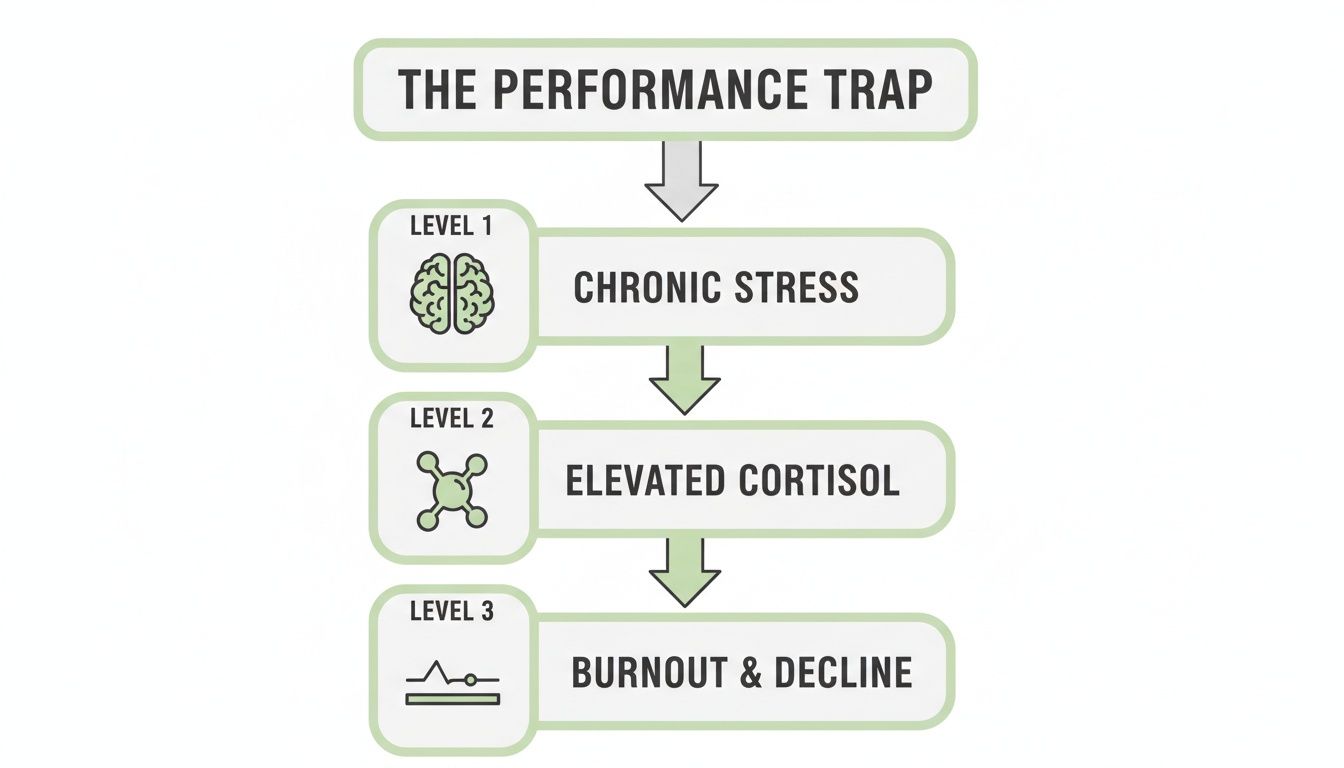
This process isn't just a feeling; it's biology. The constant stress desensitizes your brain's reward system, making it impossible to feel motivated. It’s time for a new approach.
R Is For Redefining Results
For most high-performers, "results" are all about the external scorecard—targets smashed, promotions landed, revenue goals crushed. The first pillar of the RAMS Method is to completely tear down that limited definition. We redefine Results as achieving internal alignment with what you truly value.
This is a massive shift. It's about moving from chasing what the world applauds to creating what feels genuinely meaningful to you. It starts by asking better questions:
Does this project resonate with my core values, or am I just checking a box?
Does this "win" feel good in my body, or just look good on a spreadsheet?
Is this outcome guiding me toward the leader and person I actually want to become?
When your daily actions are in harmony with your internal compass, motivation is no longer something you have to hunt for. It becomes the natural outcome of living and leading from a place of authenticity. The game is no longer about proving your worth, but expressing it.
A Is For Cultivating A New Attitude
Your old attitude was probably one of relentless, gritty determination—a "push through no matter what" mindset. It got you far, no doubt. But it's also the very thing that drove you straight into the Performance Trap. The Attitude pillar of RAMS is about evolving beyond sheer willpower to cultivate embodied presence and nervous system regulation.
This means you start listening to your body’s signals instead of silencing them. You learn to recognize the early whispers of stress—the clenched jaw, the shallow breath, the mind that won't shut off—and you develop the tools to bring yourself back to center, right in the moment.
It's the practice of becoming the calm eye of the storm, rather than being the storm itself. An embodied attitude means your power flows from a place of grounded stability, not frantic, cortisol-spiked energy.
This isn’t about becoming passive. It’s about leading from a place of immense internal strength and clarity, which allows you to make sharper decisions and handle challenges with poise, not pressure.
M Is For A Different Kind Of Mastery
You've spent a lifetime mastering your industry, your skills, and complex problems. The third pillar, Mastery, turns that focus inward. It’s no longer about conquering the next external challenge, but about mastering your own internal state and leadership energy.
This is the ultimate form of self-sovereignty. True mastery is knowing your energetic patterns inside and out. It’s understanding what drains you and what fills you up. It is the quiet confidence to set and hold powerful boundaries, to communicate with unwavering clarity, and to lead others from a place of deep self-trust.
This kind of mastery means you know yourself so well that external praise or criticism no longer dictates your sense of self-worth. You become your own source of validation. That shift permanently breaks the cycle of needing another achievement to feel like you’re enough.
S Is For Building Sustainable Systems
Finally, the Systems pillar is about creating the personal and professional structures that protect your energy, not just optimize your time. Your old systems were likely built for one thing: maximizing output. Your new systems will be designed to maximize sustainable performance and well-being.
In practice, this looks like:
Energy Audits: Regularly taking stock of where your energy is flowing and consciously redirecting it.
Boundary Rituals: Creating clear on/off switches for your workday to stop energy leaks into your personal life.
Delegation Frameworks: Systematically handing off tasks that drain you or don't leverage your unique genius.
Recovery Protocols: Building non-negotiable time for rest and replenishment directly into your calendar, treating it with the same importance as a board meeting.
These systems are your guardrails. They protect you from your own high-achieving tendency to over-function and over-give until you're running on empty. They provide the essential structure for your new, more embodied way of leading to truly take hold.
You can learn more about how these four pillars create a powerful flywheel for change in our detailed guide on the RAMS Method, Baz Porter's leadership framework explained.
The Return: Your First 30 Days To Deliberate Action
Understanding the RAMS framework is one thing. Actually bridging the gap between that knowledge and taking real, tangible action is something else entirely. The journey out of that heavy, demotivated state doesn't start with a massive, life-altering overhaul. It begins with small, consistent steps.
This 30-day plan is designed to put the core principles of RAMS into practice without adding yet another overwhelming project to your plate. We're not trying to do more. The whole point is to create tiny pockets of space—space to reconnect with yourself, regulate your nervous system, and start plugging the leaks draining your energy.
Think of the next month as a series of small, low-stakes experiments. Let’s get started.
Week 1: Reconnect With Your Results
The first week is all about gently pulling your focus away from external validation and back toward your own internal compass. Demotivation often sets in when our daily actions drift miles away from our core values. This week, we start closing that gap.
Your primary task is a Values-to-Action Audit. Don't worry, this isn't some heavy, soul-searching project. It's a simple, five-minute reflection at the end of your day.
Identify Your Top 3 Values: First thing Monday, pick three values that feel most important to you right now. Maybe it's integrity, creativity, or connection. Write them on a sticky note and put it somewhere you'll see it.
Daily 5-Minute Check-in: At the end of each workday, ask yourself two simple questions: "Where did I honor one of these values today?" and "Where did my actions feel out of sync with them?"
No Judgment Allowed: This is critical. You are simply observing. The goal is to gather data, to see the space between who you are and what you do. This awareness is the first, non-negotiable step toward realigning your professional "Results."
A client of mine, a Senior VP in tech, realized through this exercise that "creativity" was a core value she hadn't touched in years. Her days were a blur of budget meetings that left her feeling completely drained. Her first small action? Blocking 30 minutes on a Friday for pure brainstorming, no agenda. That tiny shift was the first spark she’d felt in months.
Week 2: Regulate Your Attitude
This week, we turn our attention to your nervous system. Your "Attitude" isn't a mindset you can just force with positive thinking; it's a physiological state that you have to cultivate. We'll do this with a simple, five-minute daily practice.
Your task is to practice the Physiological Sigh twice a day. This is a powerful, science-backed technique that instantly tells your stress response to stand down. It’s simply two quick inhales through the nose, followed by one long, slow exhale through the mouth.
Morning Anchor (2 minutes): Before you even glance at your phone, sit on the edge of your bed and do five rounds of the Physiological Sigh.
Midday Reset (3 minutes): Set a calendar reminder around lunchtime. Step away from your desk and do another five rounds.
This isn't meditation; it's a mechanical reset for your nervous system. You are manually telling your body it's safe, breaking the cycle of chronic, low-grade fight-or-flight that absolutely kills motivation.
As you start this journey, it's also worth considering practical changes in your work environment. Exploring options like reasonable adjustments for mental health at work can be a game-changer, helping to create the supportive space your nervous system needs to recover.
Weeks 3 and 4: Design Your First System
The final two weeks are about building a protective structure around your energy. That constant feeling of being demotivated is often just a symptom of having porous boundaries. We're going to design one clear Boundary System to stop the leaks.
Your task is to choose one area where you feel your energy is most consistently drained and build a simple system to protect it.
Examples of Boundary Systems:
The "No-Meeting" Block: If back-to-back meetings are your kryptonite, block out 90 minutes of non-negotiable "deep work" time on your calendar every single day. Defend it like a fortress.
The "End of Day" Ritual: If work constantly bleeds into your personal time, create a shutdown ritual. Close your laptop, put your work phone in a drawer, and say a specific phrase out loud, like, "My workday is complete."
The "Decision Filter": If you say "yes" to everything, create a filter. For any new request, your default response becomes, "Let me check my priorities and get back to you." This buys you time to actually assess if it aligns with your values (see Week 1).
By the end of these 30 days, you won't have solved everything. But you will have tangible proof that change is possible. You'll have reconnected with what matters, learned a tool to regulate your state, and built your first wall to protect your energy. This is how you begin your recovery from burnout and start the shift from feeling demotivated to taking deliberate, sovereign action.
Why Demotivation Hits Female Leaders The Hardest
If you feel like the motivation drain hits you differently as a woman in leadership, you’re not imagining it. It’s real. While the Performance Trap can snare any high-achiever, the systemic pressures piled on women create a uniquely crushing burden.
This isn't a personal failure. It’s a rigged game, and the exhaustion you feel is the logical outcome of navigating it every single day.
This struggle is rooted in what psychologists call the "double bind." The corporate world expects you to be authoritative and decisive, but also communal and nurturing. Be too direct, and you're labeled "abrasive." Be too collaborative, and you're not a "real" leader. It’s an impossible tightrope walk.
And walking it requires an immense amount of emotional labor—the invisible, unrewarded work of managing your own emotions while simultaneously soothing and stabilizing your team.
The Amplifying Effect of Systemic Pressure
This constant pressure to be everything to everyone is a direct pipeline to burnout. You're not just managing projects; you're managing perceptions, fighting unconscious bias, and carrying the emotional well-being of your team in a way your male counterparts simply aren't expected to.
It’s utterly exhausting.
And this isn't just a feeling; it’s a measurable crisis. Engagement among female managers worldwide recently cratered by seven percentage points—a drop more severe than for any other group. This trend shows exactly how women in leadership are being squeezed between impossible executive demands and the critical need to support their teams.
This isn't just a tough job; it's a systemic drain. Feeling demotivated is the logical endpoint when you’re forced to run a second, invisible marathon of emotional and perceptual management every single day.
For a deeper dive into the specific challenges and triumphs, see our breakdown of key women in leadership statistics.
Exhaustion-Driven Performance vs Embodied Leadership
The old model of leadership—the one that disproportionately burns out women—is built on exhaustion. It demands you sacrifice pieces of yourself to fit the mold. The new paradigm, Embodied Leadership, is about leading from a place of integrated, authentic strength.
It’s the difference between forcing your performance and allowing your power to flow naturally. Here’s a breakdown of what that shift actually looks like.

Recognizing these two opposing models is the first step toward reclaiming your energy and your career. The demotivation you feel isn't a sign that you're failing; it's a powerful signal that the old, broken model is failing you.
It’s a call to step into a new form of leadership—one that honors your energy, your well-being, and your authentic power.
Your Path Forward To Sovereign Leadership
Let’s be crystal clear: that demotivation you felt at work was never a sign that you were failing. It was a direct signal from your body, a flare sent up by your nervous system telling you the old way of operating was officially bankrupt. The relentless push for external validation, the self-sacrifice for the sake of the next milestone—that model is no longer sustainable.
The way forward isn’t about slapping a bandage on your motivation. It's about a complete reinvention of how you lead.
This is the shift toward Sovereign Leadership. It's the profound, sometimes terrifying, and ultimately liberating return to yourself.
Sovereign Leadership is what happens when you lead from a place of deep internal alignment, unwavering self-trust, and a nervous system that isn't running on fumes. It’s the quiet power that comes from knowing your value is non-negotiable, independent of your last quarterly report or the chatter in the boardroom. It's the end of the war against yourself.
A New Model Of Leadership
This journey doesn't just tweak your career; it rewrites the entire operating system for your life. You start making deliberate choices rooted in what you actually value, not just reacting to the endless storm of external demands. It means you begin treating your energy as your single most precious asset, and you build the kind of unapologetic systems required to protect it.
As you step onto this new path, learning how to strategically offload becomes non-negotiable. For instance, truly understanding the tasks of an executive assistant isn't just about delegation; it's a critical skill for any leader looking to reclaim their time and focus on the high-level, visionary work that only they can do.
The ultimate goal is no longer to climb another ladder. It's to build your own throne—a seat of power grounded in your unique genius, your unwavering integrity, and your embodied presence.
The Return To Yourself
The exhaustion and demotivation you experienced were simply the symptoms of a deep and painful disconnection from yourself. The RAMS method gives you the map, but the destination has always been a return to your most authentic, powerful self.
This is not another project to manage. It's not another goal to hustle for. It is a process of un-learning the brutal habits of self-abandonment that high-achievers are so often taught is the price of admission.
It is about remembering the leader you were always meant to be, before the world gave you a script and told you to perform.
Your next move isn't about pushing harder. It's about getting smarter and profoundly more aligned. It is about finally choosing a system that works with your biology, not against it. This is your invitation to move beyond just recovering and start truly leading from a place of sovereignty.
We Hear You: Your Questions Answered
Even with a clear map in hand, starting this kind of journey brings up questions. It's completely normal. Let’s tackle some of the most common ones we hear from women leaders who are ready to untangle these complex feelings and step into a new way of leading.
How Can I Tell If I’m Just Tired Or Truly Demotivated?
This is the big one. Tiredness is physical; a good night's sleep, a weekend off, and you feel recharged. Demotivation is something deeper—it’s a soul-level exhaustion that sleep can't touch.
Think of it this way: demotivation is a persistent, chronic lack of interest and connection to your why. It’s that cynical voice that whispers during meetings, the sense of dread that creeps in on Sunday night, and the hollow feeling you get even after a major win. When achievements that once lit you up now feel like just another item crossed off a list, that's not fatigue. That’s your nervous system sending a powerful signal that your daily actions are fundamentally out of sync with your core values.
How Long Does It Realistically Take To Recover From This?
Recovery is a personal journey, not a race with a finish line. That said, most leaders who commit to the initial steps in the RAMS method feel a tangible shift—a sense of relief and renewed clarity—within the first 30 days. This isn’t about a quick fix; it’s about creating sustainable change from the inside out.
The first phase is all about stabilizing your nervous system and creating immediate breathing room with new, supportive habits. The deeper work, like fully realigning with your values and redesigning your leadership from the ground up, unfolds over the next several months. The goal here isn't a temporary motivational boost; it's about building lasting sovereignty over your life and career.
I’m Not In A Formal Leadership Role. Can I Still Use These Principles?
Absolutely. Sovereign leadership isn't about a title on your business card; it's an internal state of being. The principles of the RAMS method are universal because they speak to core human needs: alignment, purpose, and self-regulation.
The four pillars are essential for anyone feeling disconnected from their work:
Results: Aligning what you do with who you are at a core-value level.
Attitude: Mastering your internal state and managing your own energy.
Mastery: Developing profound self-awareness and emotional intelligence.
Systems: Creating the structures in your life that protect your well-being.
Whether you're an entrepreneur, a key member of a team, or a C-suite executive, these tools are designed to help you take radical ownership of your energy, your engagement, and the trajectory of your entire life.
Feeling demotivated at work isn’t a sign of failure. It's a sign that it’s time for a new approach—one that honors your energy as much as your ambition. At Baz Porter, we specialize in guiding high-achieving women out of the Performance Trap and into Sovereign Leadership.
If you are ready to move from exhaustion-driven performance to embodied, sustainable success, this is your next step. Discover the system that will help you reclaim your drive and lead from a place of authentic power.