How to Be Close to People Without Being Useful
You can be the most reliable person in every room and still feel strangely alone in all of them. People call you first. They lean on you. And somewhere along the way, being needed quietly replaced being known. This is one of the clearest signatures of Silent Collapse™: you are close to everyone and held by no one. If that line lands, read the manifesto before you go further.
Written by Baz Porter®
On this page
The short answer
To be close to people without being useful to them, you separate contribution from connection. You keep helping where it is real. But you stop using help as the price of belonging. You let people see you tired, unsure, and off-duty. You receive before you give. Closeness without usefulness is not a feeling you wait for. It is a structure you build, one honest exchange at a time.
Key takeaways
Being needed and being loved are not the same signal. One tracks your output. The other tracks you.
If you only feel close while solving, you have built exchange relationships, not communal ones.
The fear underneath is simple. If you were not useful, who would stay.
The return is architectural. You change what you offer first, and closeness follows.
Letting yourself be helped is not weakness. It is the repair.
The hidden pattern beneath being needed
Most capable leaders learned one rule young. Be useful and you get to stay. So usefulness became the entry fee for love. You did not choose this on purpose. You absorbed it. Over decades it hardened into an identity.
Psychology has a precise name for the split. Margaret Clark and Judson Mills drew the line between exchange relationships and communal relationships (Clark and Mills, Personality and Social Psychology Bulletin, 1993). In exchange relationships, benefits are given with an expectation of return. In communal relationships, care is given based on need and genuine regard, with no ledger running. You have likely turned nearly every bond into an exchange. You give, so you are owed presence. The problem is quiet. An exchange can never feel like being loved, because it is always, at some level, being earned.
This is why the help no longer warms you. You are running communal needs through an exchange engine. The engine works. It just cannot produce the thing you actually want.
The RAMS™ reframe across five pillars
RAMS™ is how we rebuild this at the root. Five pillars, one return.
Results. Stop measuring your worth by what you resolved today. Count one thing instead. Did anyone get close to the real you.
Attitude. Drop the posture of the dependable one for an hour a day. Be a person, not a resource. Notice who stays.
Authenticity. Say the unfinished thing. Tell someone you are tired before you fix their problem. Authenticity is you without the utility wrapper.
Mastery. Learn to receive. Let a friend carry something for you and do not repay it that week. This is a skill, and you are out of practice.
Systems. Design the relationship, do not just feel your way through it. Build small, repeatable moments where you show up with nothing to offer. Systems hold the change when willpower fades.
Here is the shift, collapsed against sovereign:
Collapsed: you are close only while solving. Sovereign: you are close while simply present.
Collapsed: you give to be allowed to stay. Sovereign: you stay because you belong.
Collapsed: being needed feels like love. Sovereign: being known feels like love.
Collapsed: help is the bridge to people. Sovereign: help is one room in the house, not the door.
Collapsed: you fear rest will cost you the bond. Sovereign: rest is where the bond gets proven.
You did not become distant because you gave too little. You became distant because you only let people meet the part of you that performs.
If you cannot tell whether your closeness is real or transactional, start by naming the pattern. The Silent Collapse Diagnostic™ inside the Fast Future Freedom Blueprint maps exactly where usefulness replaced connection in your life.
A leader who stopped being useful on purpose
A founder I counsel ran a company and, quietly, everyone in it. Family too. The group chat went silent unless something broke, and then it lit up with their name. They told me the truth leaders rarely say. "I think people would forget me if I stopped being handy."
We did not add more boundaries. We changed one input. Three times a week they reached out with no fix attached. No advice. No offer. Just presence. A text that said "thinking of you," nothing more. The first week felt like free-falling. By the third, two friends called back with the same question. "Are you okay? You seem more here." They were. The usefulness had been hiding them in plain sight.
Harry Reis and his colleagues describe why this worked. Intimacy grows through perceived partner responsiveness, the sense of being understood, validated, and cared for (Reis and Shaver, in the Handbook of Personal Relationships, 1988). Responsiveness needs a real self to respond to. When all people meet is your function, there is nothing to feel close to. Lower the utility, and a person finally appears.
The architecture of your return
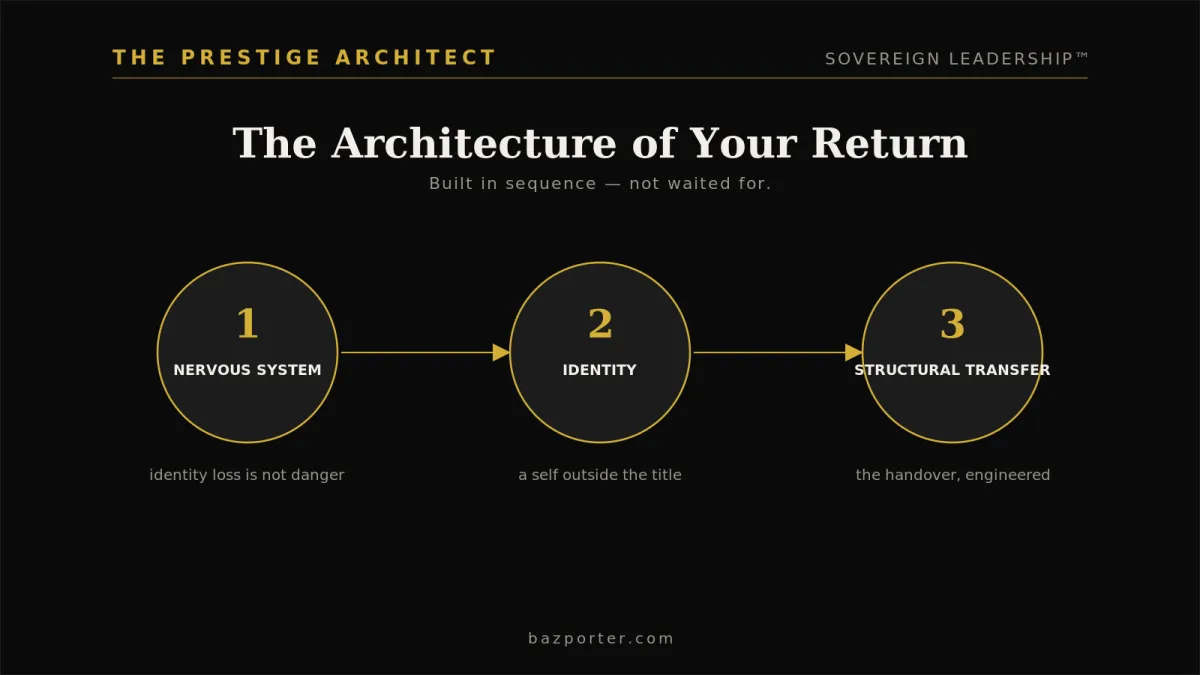
You will not think your way out of this. You build your way out. The return runs in three moves.
First, separate the streams. Keep genuine help where it belongs. But stop routing love through it.
Second, practice receiving. Each week, let someone give to you and resist the urge to even the score. Sit in the discomfort. That discomfort is the old rule dying.
Third, install presence without product. Short, regular contact where you offer nothing but yourself. This is the system that rewires the bond.
None of this means you stop contributing. It means your worth stops living there. You become a person who helps, not a help that happens to be a person. That is the move we call the return, and it is a rebuild, not a reinvention. When you are ready to architect it with a plan rather than a hope, begin with the Fast Future Freedom Blueprint.
Questions leaders actually ask
Why does being needed stop feeling like being loved?
Because being needed tracks your output, and love tracks you. When every bond runs on what you provide, you live inside an exchange. An exchange can feel important and still feel lonely. Being loved asks nothing in return, and that is exactly the thing usefulness cannot buy.
How do I stay close to people without being useful to them?
Start by making contact that carries no fix. Reach out with presence, not advice or offers. Let people see you off-duty and unfinished. Over time, the relationship learns it can hold you without a task attached. Closeness without usefulness is built, not waited for.
What is the difference between being needed and being known?
Being needed means people rely on what you do. Being known means people have met who you are underneath it. You can be deeply needed and barely known at the same time. That gap is where the loneliness of the load-bearing leader lives.
Will I lose people if I stop being so helpful?
Some relationships were built on your usefulness, and those may thin out. That is painful and also clarifying. The bonds that remain are the ones that wanted you, not your function. Most leaders find that the people who matter move closer, not further away.
How do I know if my relationships are built on usefulness?
Notice when you feel close. If it is only while solving, giving, or rescuing, usefulness is doing the work connection should. The Silent Collapse Diagnostic™ inside the Fast Future Freedom Blueprint helps you see the pattern clearly and where to start the return.
About Baz Porter®
Baz Porter® is the founder of The Prestige Architect™ and the author of the Sovereign Leadership body of work. He counsels successful leaders through Silent Collapse™ back to a self that is more than useful, using the RAMS™ framework. His work names the quiet erosion high-functioning people rarely say out loud, and maps the return. Begin with the Fast Future Freedom Blueprint.