Burnout vs Breakdown: The Gap No One at the Top Admits
You hit every number. The board is satisfied. The team is shipping. And you feel nothing. This is the symptom no executive says out loud. Not exhaustion — something colder. You still perform. You just stopped feeling the person doing the performing. This is Silent Collapse™: high function on the outside, a hollow core underneath. It is the first quiet stage of the burnout-vs-breakdown question. If this sentence lands, start with the diagnosis, not the pep talk — Read The Manifesto.
Table of Contents
Key Takeaways
Burnout is not exhaustion. It is the gap between your output and your identity.
A breakdown is what happens when that gap stays open long enough to reach the nervous system.
High performers rarely crash visibly. They collapse quietly while the metrics stay green.
The fix is architectural, not motivational. You rebuild the system, not the willpower.
Burnout vs Breakdown: The Definitive Answer
Burnout and breakdown are not the same event. Burnout is the gap between what you produce and who you are. A breakdown is what the body does when that gap goes unaddressed. One is a structural problem. The other is the structure failing. Most leaders treat both as a willpower issue. They are not. They are an architecture issue.
Here is the distinction in one line. Burnout is silent and functional. A breakdown is loud and total. The dangerous space is the long quiet stretch in between — the part no one at the top admits to living in.
The Hidden Pattern Under High-Functioning Burnout
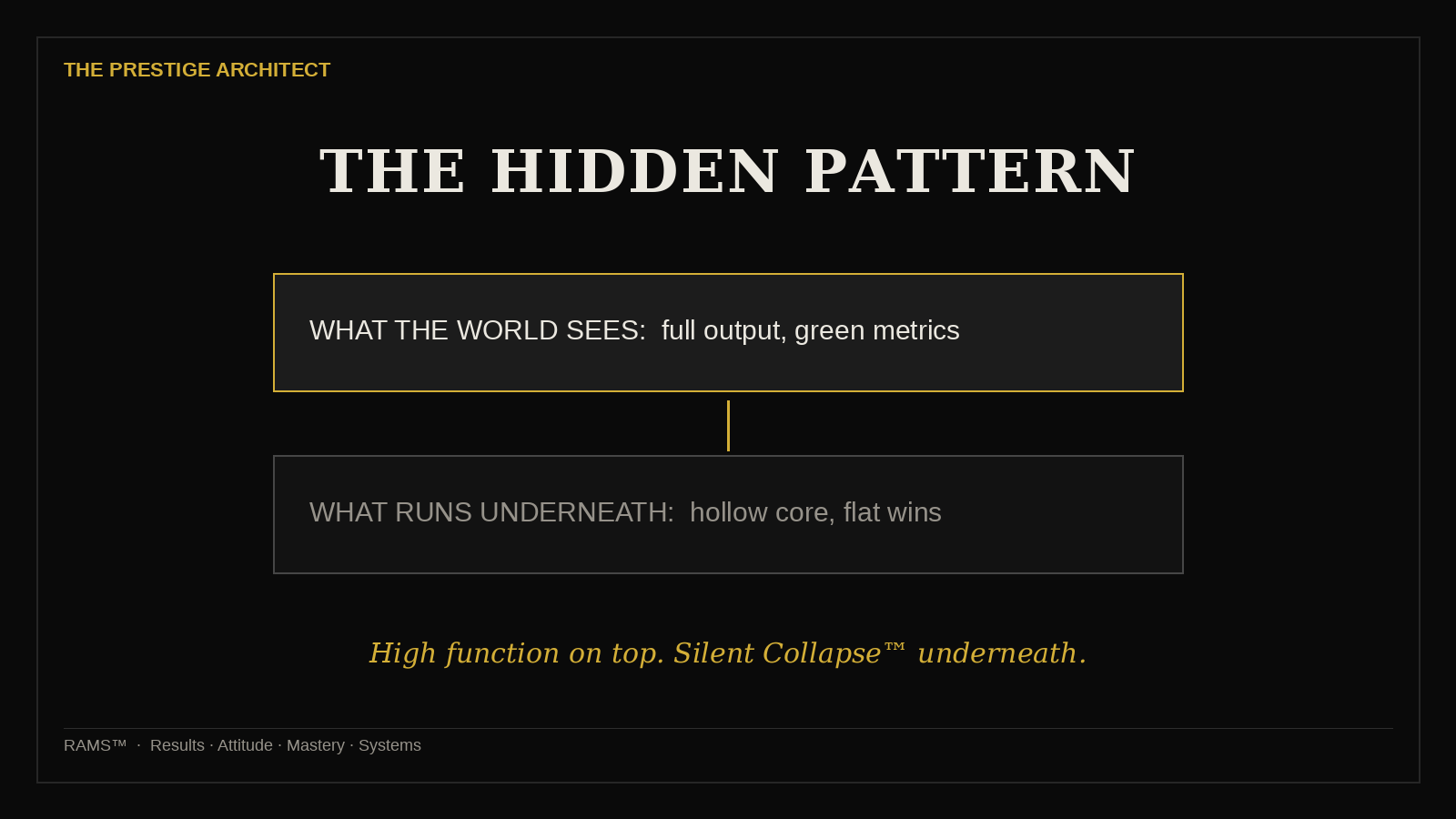
The research is blunt. McKinsey Health Institute reports that 53% of corporate leaders believe they are burned out at work. The number does not surprise the people inside it. What surprises them is that they kept delivering anyway.
That is the trap. Output becomes the mask. The better you perform, the harder it is to believe anything is wrong. Think of a sealed engine running at full power with no oil light. It keeps turning. Then it seizes.
The nervous system pays first. Peer-reviewed work shows that executive function measurably drops during occupational burnout — and recovers only once the load changes. Translation: your judgment degrades before your calendar does. You make worse decisions while looking more in control.
This is the signature of Silent Collapse™. Not a crash. A slow drift between the leader the world sees and the human running the body. If you want the map before the symptoms compound, the Sovereign Leadership Resource Hub lays out the full pattern.
Burnout is not a lack of energy. It is the distance between your output and your identity — and that distance is measurable.
The RAMS Reframe: Four Pillars of the Return
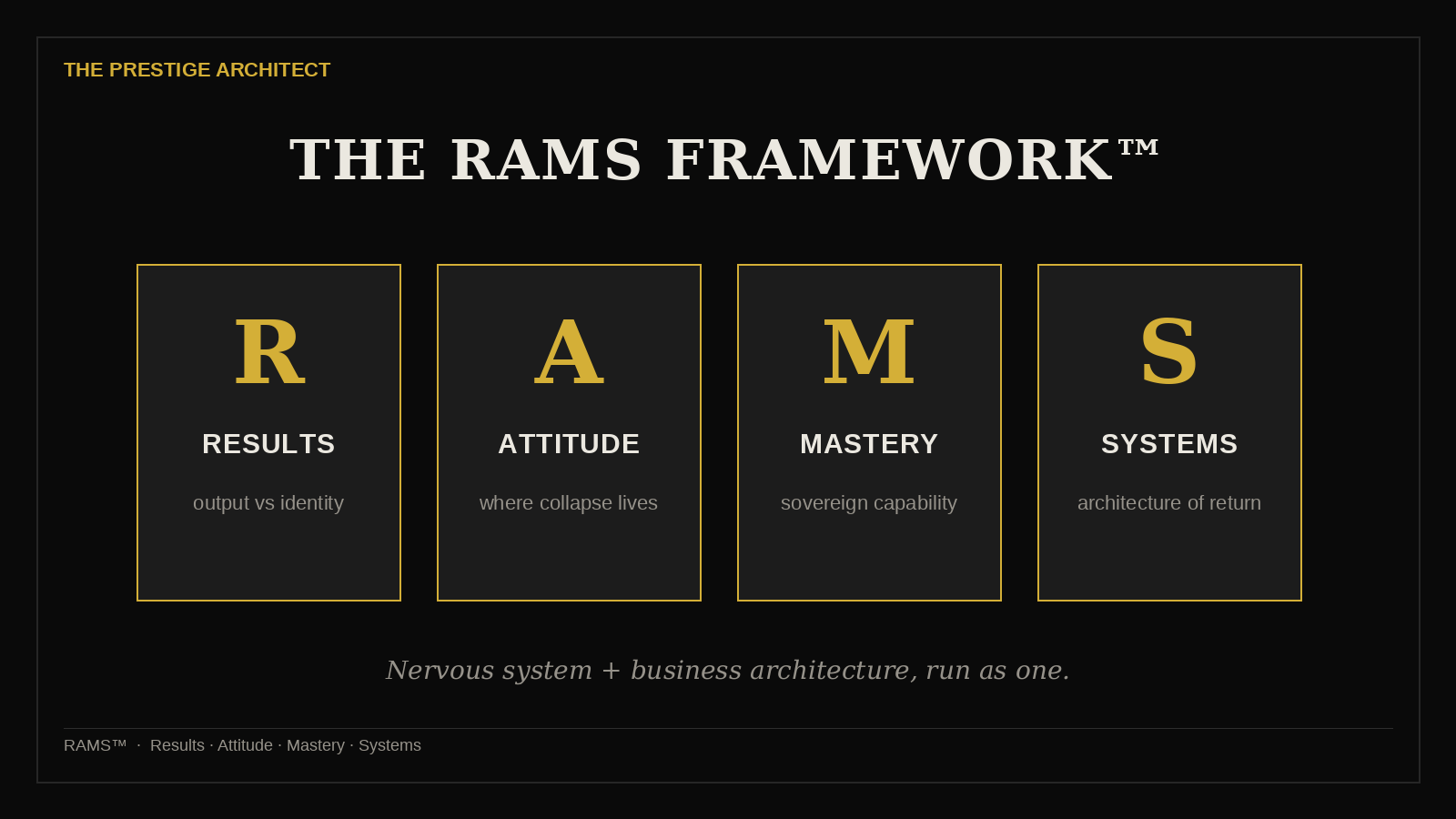
The way out is not rest. Rest treats the symptom. The RAMS Framework™ treats the architecture. RAMS™ runs on four pillars at once — Results, Attitude, Mastery, Systems — at the level of the business and the nervous system together. The body and the company run on the same wiring. When one is dysregulated, both are compromised.
Results — The Output–Identity Gap
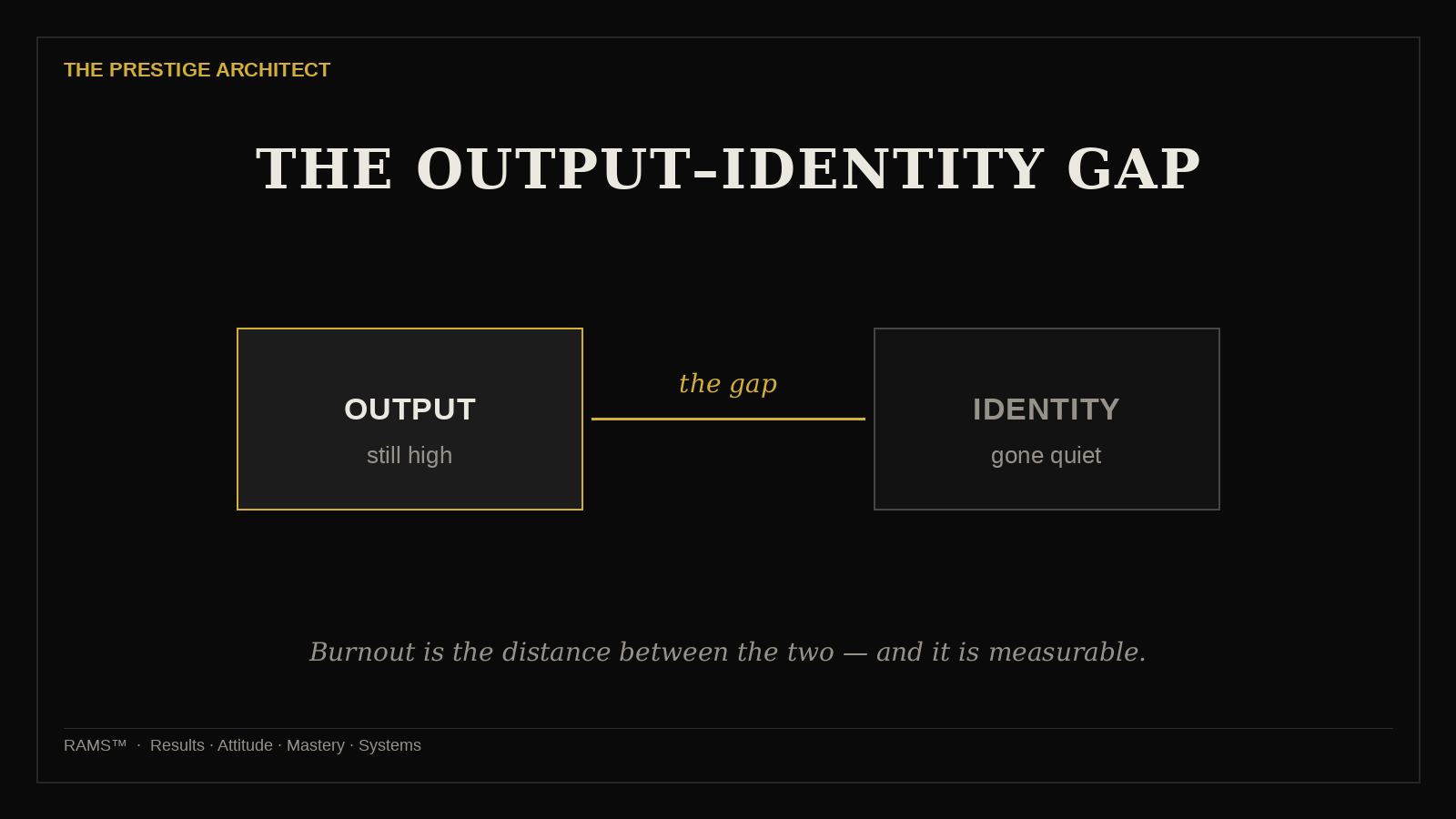
Results stop meaning anything when they are no longer connected to identity. You hit the target and feel hollow. That hollow is data, not weakness.
The symptom: wins land flat. The next goal arrives before the last one registers.
Operational rule: measure who a result makes you, not only what it earns.
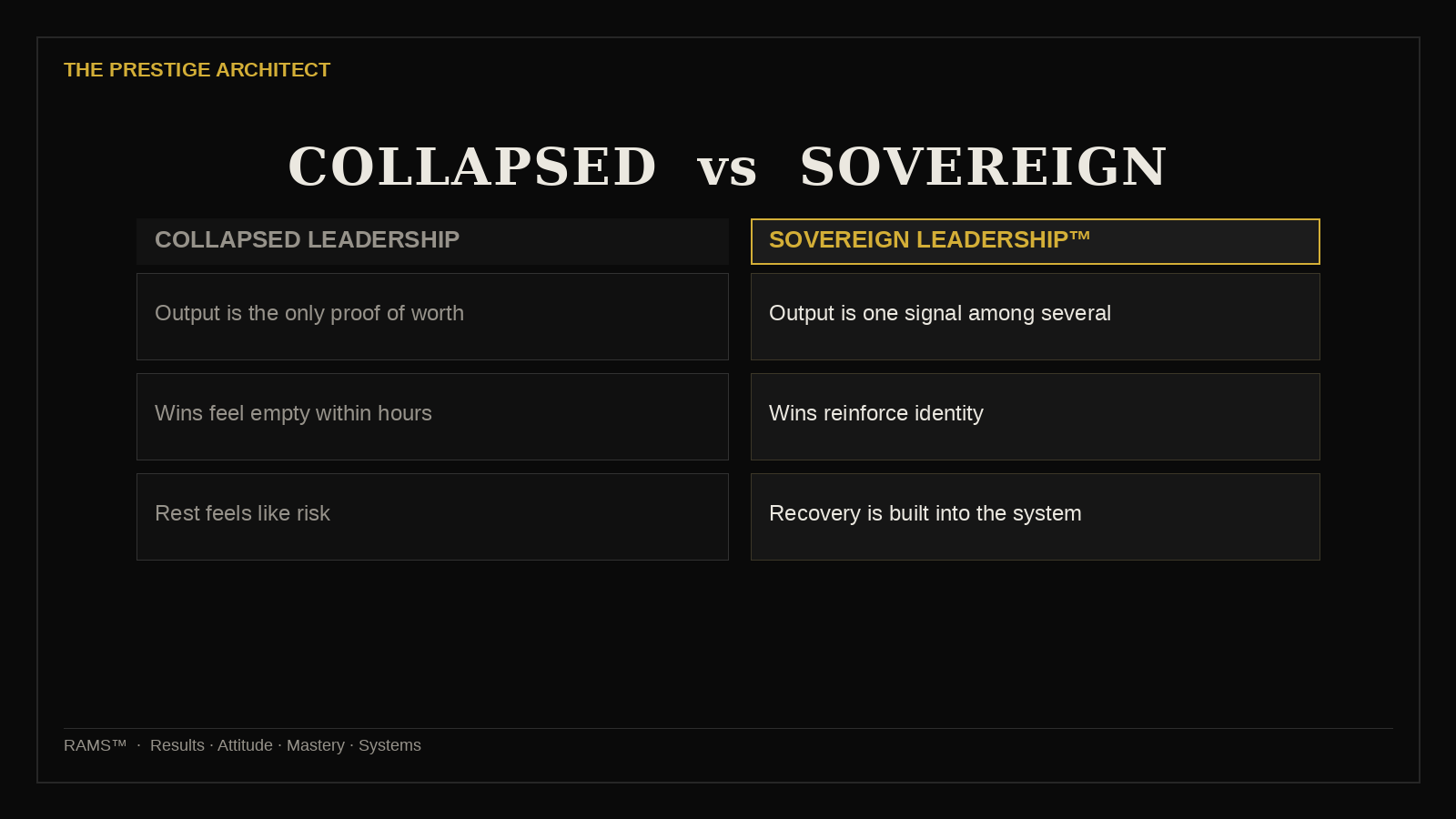
Collapsed LeadershipSovereign Leadership™ Output is the only proof of worthOutput is one signal among several Wins feel empty within hoursWins reinforce identity, not anxiety Rest feels like riskRecovery is built into the system
Collapsed Leadership vs Sovereign Leadership™:
Worth: Collapsed makes output the only proof of worth. Sovereign treats output as one signal among several.
Wins: Collapsed wins feel empty within hours. Sovereign wins reinforce identity, not anxiety.
Rest: Collapsed treats rest as risk. Sovereign builds recovery into the system.
Attitude — Where the Collapse Lives
Attitude is the internal operating system. It is where the collapse actually lives. The voice that says, "If I stop, everything falls apart," is not insight. It is a worn pattern running unchecked.
The pattern: control mistaken for safety. More grip, less feeling.
Command decision: name the pattern out loud. A pattern you can name is a pattern you can interrupt.
Mastery — Skill vs Sovereign Capability
Skill is doing the work well. Sovereign capability is doing the work without losing yourself inside it. High performers have skill in surplus. They run short on the second thing.
Skill scales output.
Sovereign capability scales output without draining the operator.
This is the line between a leader who lasts and one who burns the engine to hit a quarter. If your symptoms have a name but no map yet, Take the Silent Collapse Diagnostic.
Systems — The Architecture of the Return
Systems are where the return is built. Not in a retreat. Not in a single decision. In the architecture that holds you when motivation is gone. A leader without recovery built into the system is one shock away from a breakdown — no matter how strong the willpower looks.
You do not rise to the level of your discipline. You fall to the level of your architecture.
Case Vignette: The CFO Who Felt Nothing
A CFO came in after the strongest year of her career. Record raise. Clean audit. Full recognition. She described it flatly: "I have everything I wanted. Why do I feel nothing?" That is the line at the center of Silent Collapse™.
We did not add rest. We rebuilt the architecture. We separated her results from her identity. We named the control pattern running her attitude. We installed recovery as a system, not a reward. Within a quarter the flatness lifted — not because she worked less, but because the structure finally held her. Systems first. Feeling followed.
The Architecture of Your Return
The return is not inspiration. It is nervous-system sovereignty — the capacity to lead at full power without leaving yourself behind. You stop managing collapse and start engineering its absence.
A breakdown is not the opposite of strength. It is the bill for an architecture that was never built.
This is the work of The Prestige Architect®: power without collapse, success without self-betrayal. You do not need more drive. You need an architecture that makes the drift impossible. Burnout is the warning. A breakdown is the bill. The return is the build. When you are ready to build it, Apply to Work With Baz.
Frequently Asked Questions
What is the difference between burnout and a breakdown?
Burnout is the gap between your output and your identity — you keep performing while feeling disconnected from the work. A breakdown is what happens when that gap stays open long enough to disrupt daily functioning across work, relationships, and health. Burnout is silent and functional. A breakdown is total.
Why do I feel nothing even though I am successful?
Flatness after a win is a core sign of high-functioning burnout and Silent Collapse™. When results are the only measure of worth, achievement stops registering emotionally. The hollow feeling is data about the gap between what you produce and who you are — not a character flaw.
Can you be burned out and still high-performing?
Yes. High-functioning burnout is the most dangerous kind precisely because the metrics stay green. Research shows executive function quietly degrades during burnout while output is maintained, which means judgment erodes before performance visibly drops.
How do you recover from executive burnout without stepping back?
Recovery is architectural, not motivational. Rest treats the symptom; rebuilding the system treats the cause. The RAMS Framework™ separates results from identity, names the internal pattern driving the collapse, and installs recovery as a built-in system rather than an occasional reward.
Is burnout a willpower problem?
No. Burnout is a structural problem. Treating it as a discipline failure deepens it, because more force on a failing architecture accelerates the failure. The fix is engineering the system that holds you when willpower runs out.
British military veteran. Two-time international bestselling author. Founder, The Prestige Architect®. Host, Rise From The Ashes podcast, C-Suite Network. Boulder, Colorado.