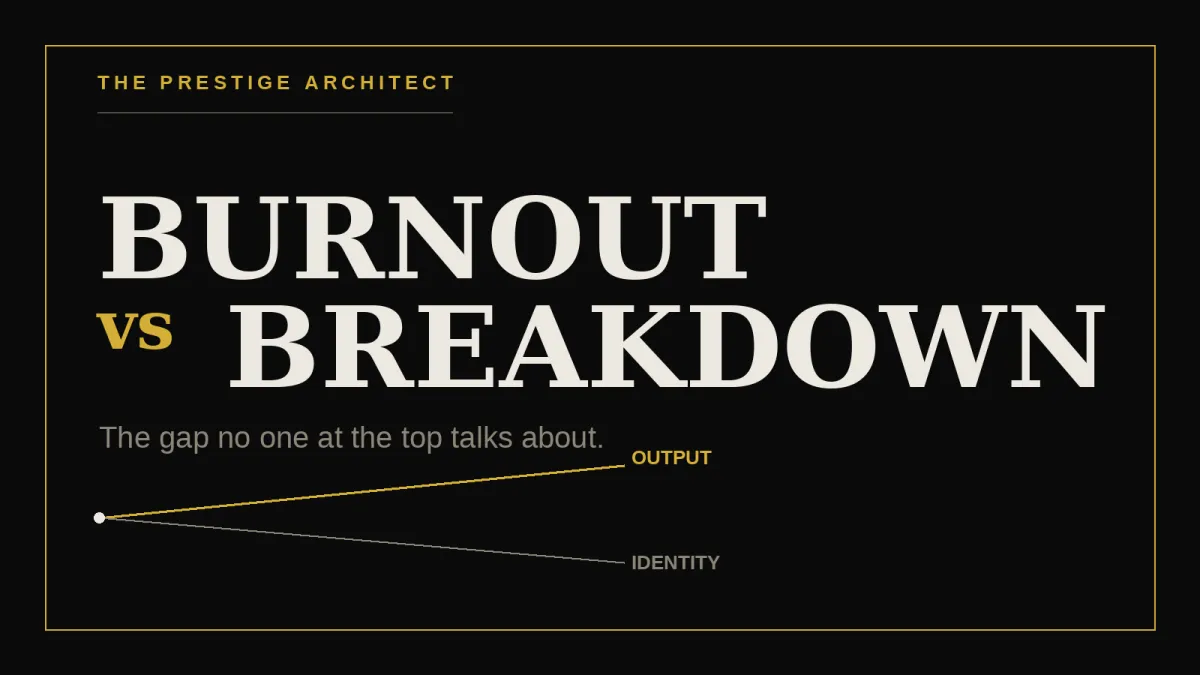
Burnout vs Breakdown: The Gap No One at the Top Talks About
Burnout vs Breakdown: The Gap No One at the Top Talks About
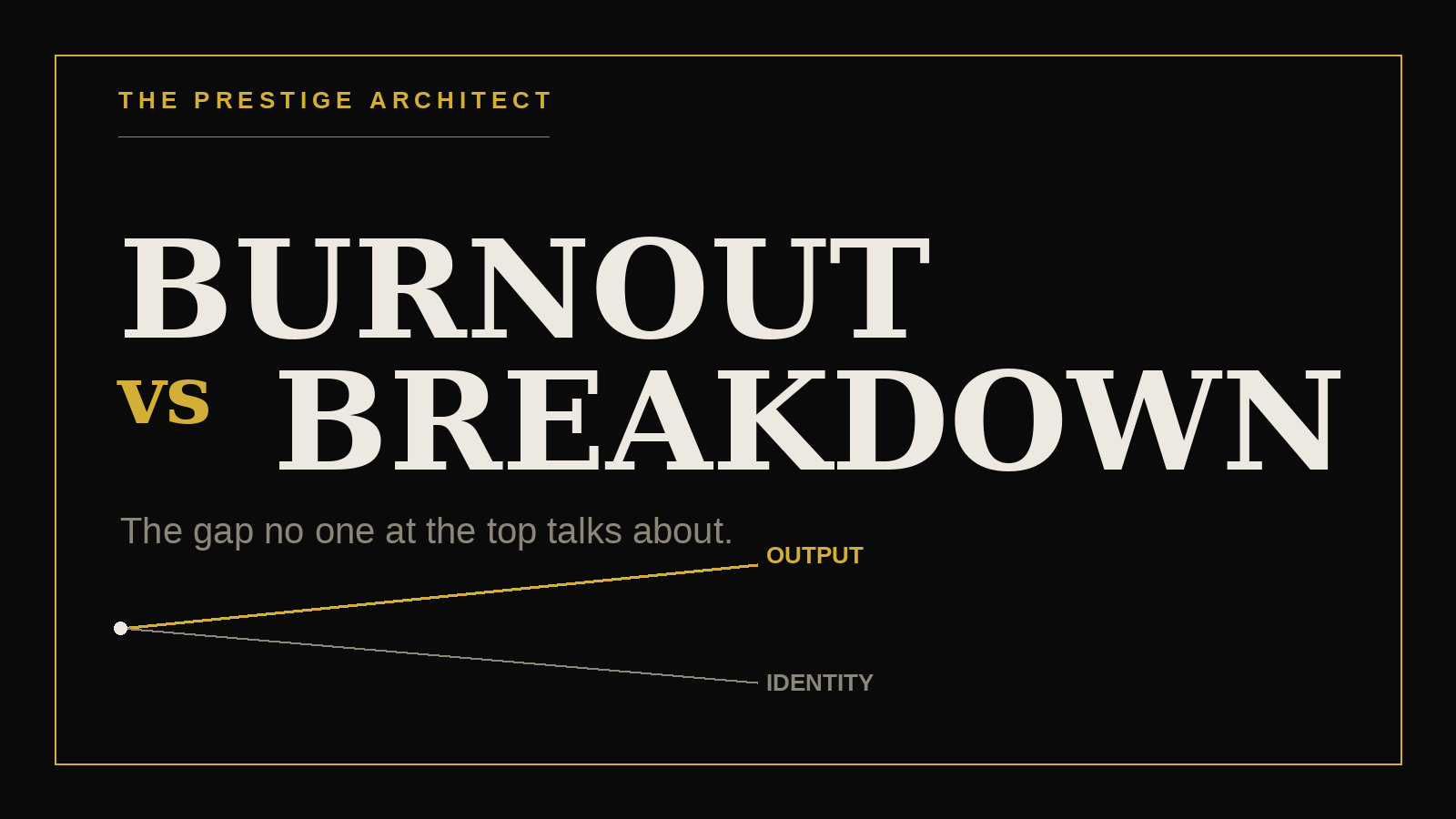
You are not tired. You are running. The calendar is full, the numbers are up, and the team thinks you are fine. Inside, something has gone quiet. The work still gets done. The feeling behind it does not return. This is the first signal of Silent Collapse™ — the state where output stays high while the person behind it goes missing. It is not exhaustion. It is a widening gap between what you produce and who you are. Most leaders name it burnout. They are reading the wrong gauge. Read The Manifesto.
Table of Contents
Key Takeaways
Burnout is exhaustion. Breakdown is collapse. Between them sits a gap most high performers never name.
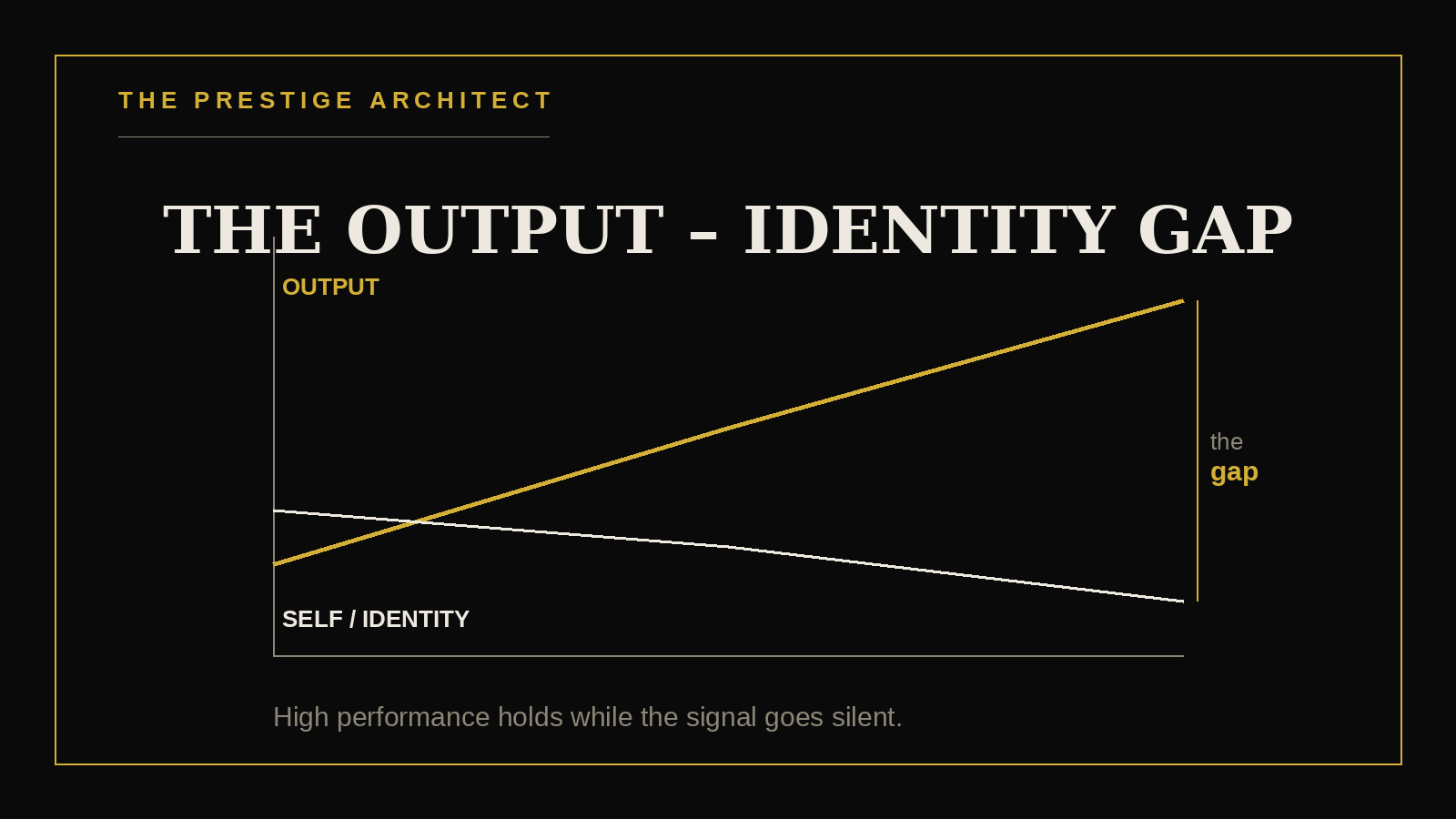
The real measure is the distance between output and identity. When the work continues but the self goes quiet, you are in Silent Collapse™, not simple fatigue.
More effort widens the gap. Pushing harder is the instinct that turns burnout into breakdown.
The return is built, not felt. Sovereignty is an architecture you install, not a mood you wait for.
Burnout vs Breakdown: The Definitive Answer
Burnout is the slow drain of energy and meaning inside one role. A breakdown is when that drain spreads and the whole system stops holding. The dangerous space is the one between them — high output, dead signal — and that space is Silent Collapse™. It is the gap between what you produce and who you have become. Read that gap early and you never reach the breakdown.
The Hidden Pattern Under the Exhaustion
The World Health Organization defines burnout by three markers: energy depletion, mental distance from the job, and reduced efficacy (WHO, ICD-11). Useful. Incomplete. It measures the work. It does not measure the worker.
Here is the pattern I see in executives. The body has been in survival for years. The nervous system runs hot and never lands. Performance holds because performance became the identity. Strip the feeling out and the output keeps moving on its own — like an engine still turning after the driver left the car.
This is why the standard read fails. Harvard Business Review found burnout is driven by the conditions around the person, not a flaw inside them (HBR, 2019). True. And there is a layer beneath it. When self-worth is welded to output, every pause feels like a threat. So you do not pause. You produce. The gap grows in silence. That silence is the symptom. Most leaders mistake it for control.
Want the full diagnosis of how this state forms? Start with Sovereign Leadership Resource Hub.
The RAMS Reframe: Reading the Real Gauge
The RAMS™ framework reads the body and the business as one architecture: Results, Attitude, Mastery, Systems. Burnout shows up in all four. So does the return. Here is how each pillar exposes the gap.
Results — The Output and Identity Gap
Results are the easiest lie to live inside. The dashboard is green. The quarter closed. And still the signal is dead. Operational rule: output is not proof of health. It is often proof of momentum after the feeling has gone.
Collapsed read: "I am still hitting the numbers, so I am fine."
Sovereign read: "The numbers hold. The signal does not. That gap is the data."
In 2026, leaders are stepping down in record numbers while their metrics still look strong. The numbers were never the warning. The gap was.
Attitude — Where the Collapse Lives
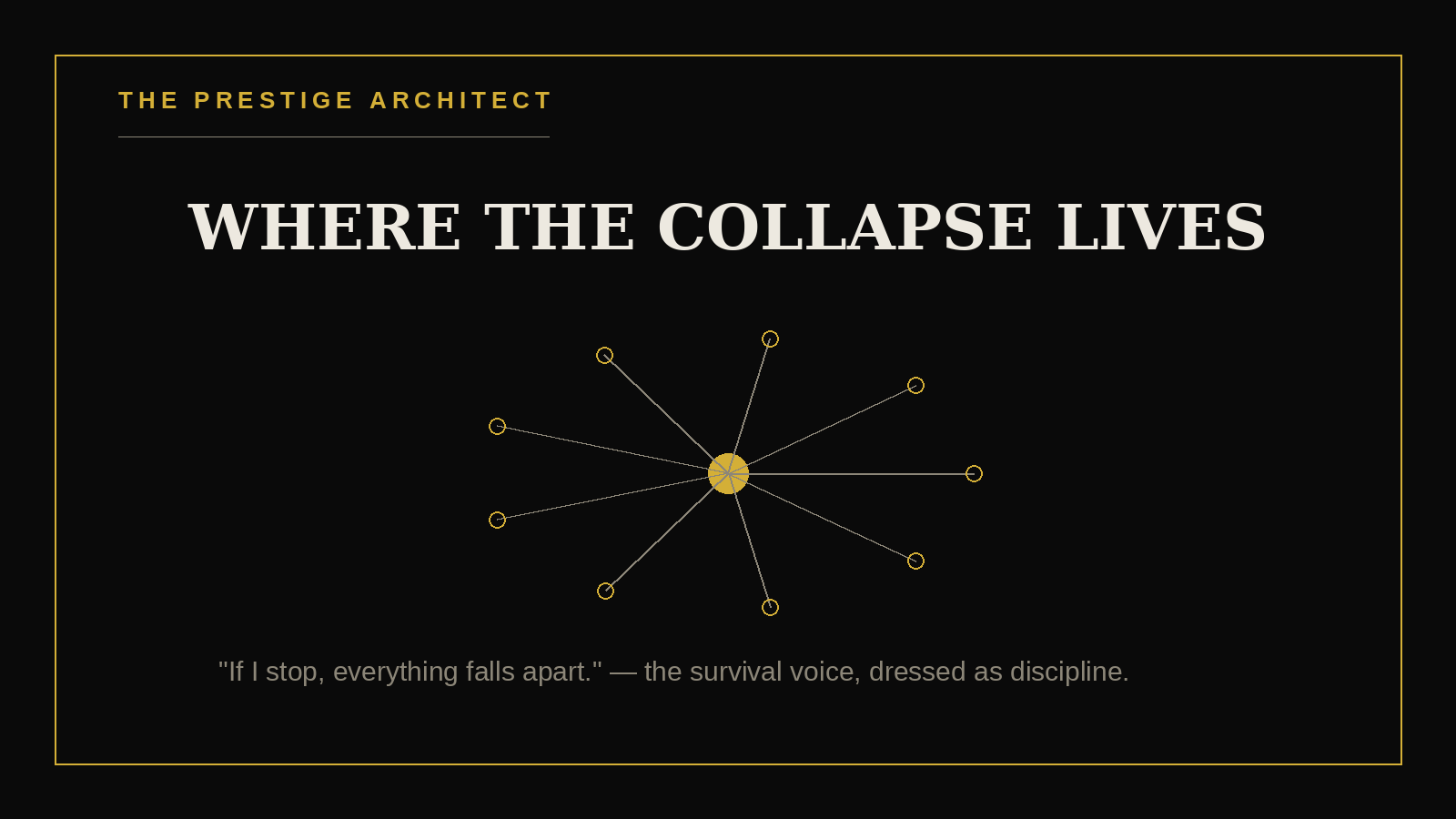
Attitude is the internal operating system. It is the running voice that says, "If I stop, everything falls apart." Command decision: that voice is not strategy. It is a nervous system stuck in survival, dressed up as discipline.
The collapse does not live in your calendar. It lives in the belief that rest is a risk you cannot afford.
Change the architecture under that belief and the exhaustion stops being a permanent state. Leave it untouched and no amount of recovery time holds.
Mastery — Capability, Not Volume
High performers confuse volume with capability. More decisions, more hours, more weight carried alone. That is not mastery. That is load. Operational rule: sovereign capability is the skill of holding pressure without being run by it.
Volume: doing more to stay ahead of the fear.
Mastery: doing less, with a regulated body, and producing more that lasts.
Systems — The Architecture of the Return
Willpower does not close the gap. Architecture does. Systems are the structures that regulate the body and the business so neither one depends on you grinding through. The table below reads the two states side by side.
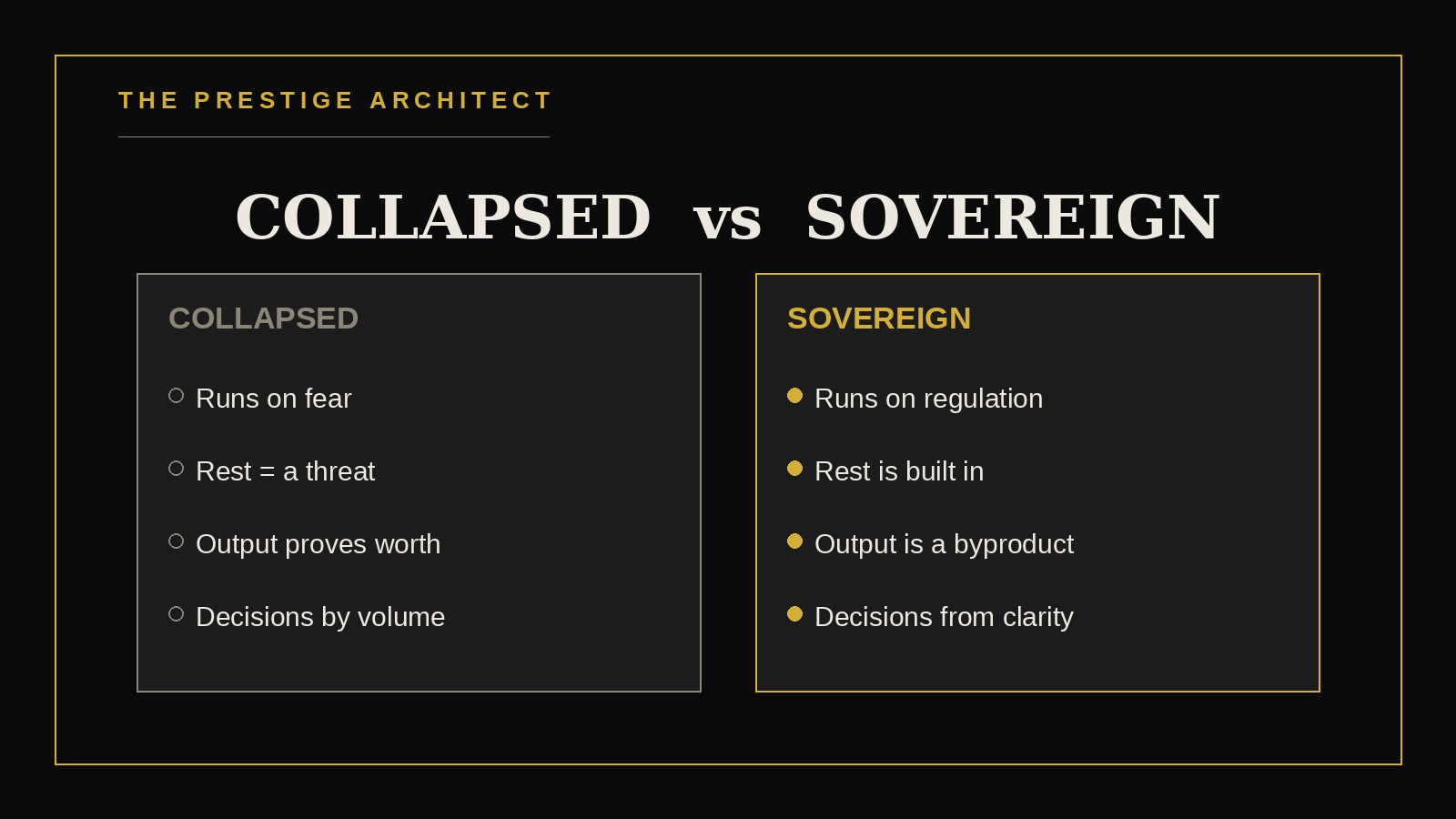
SignalCollapsed LeaderSovereign Leadership™ Energy sourceFear of it all falling apartA regulated nervous system RestA threat to be avoidedA built-in part of the system OutputProof the self is still worthyA byproduct of a steady operator DecisionsVolume, made under pressureFewer, made from clarity
If you recognize the left column, name it before it names you. Take the Silent Collapse Diagnostic.
Case Vignette: The CFO Who Looked Fine
A CFO came to me at the top of her field. Record raise closed. Board impressed. At home, she felt nothing. She had read every burnout checklist and passed them all — that was the problem. The standard tools measured her output, and her output was excellent. We stopped measuring the work and started measuring the worker. We rebuilt the systems under her week so her body learned to land. We installed a regulated baseline instead of a survival one. Within ninety days the signal came back. The numbers never dropped. She just stopped disappearing behind them.
The Architecture of Your Return
The return is not a feeling you wait for. It is a structure you install. Sovereignty starts in the nervous system — the body learning that it is safe to stop running. From there the business gets rebuilt to match: fewer decisions made from fear, more made from a steady center. You do not push your way out of collapse. You engineer your way back to yourself.
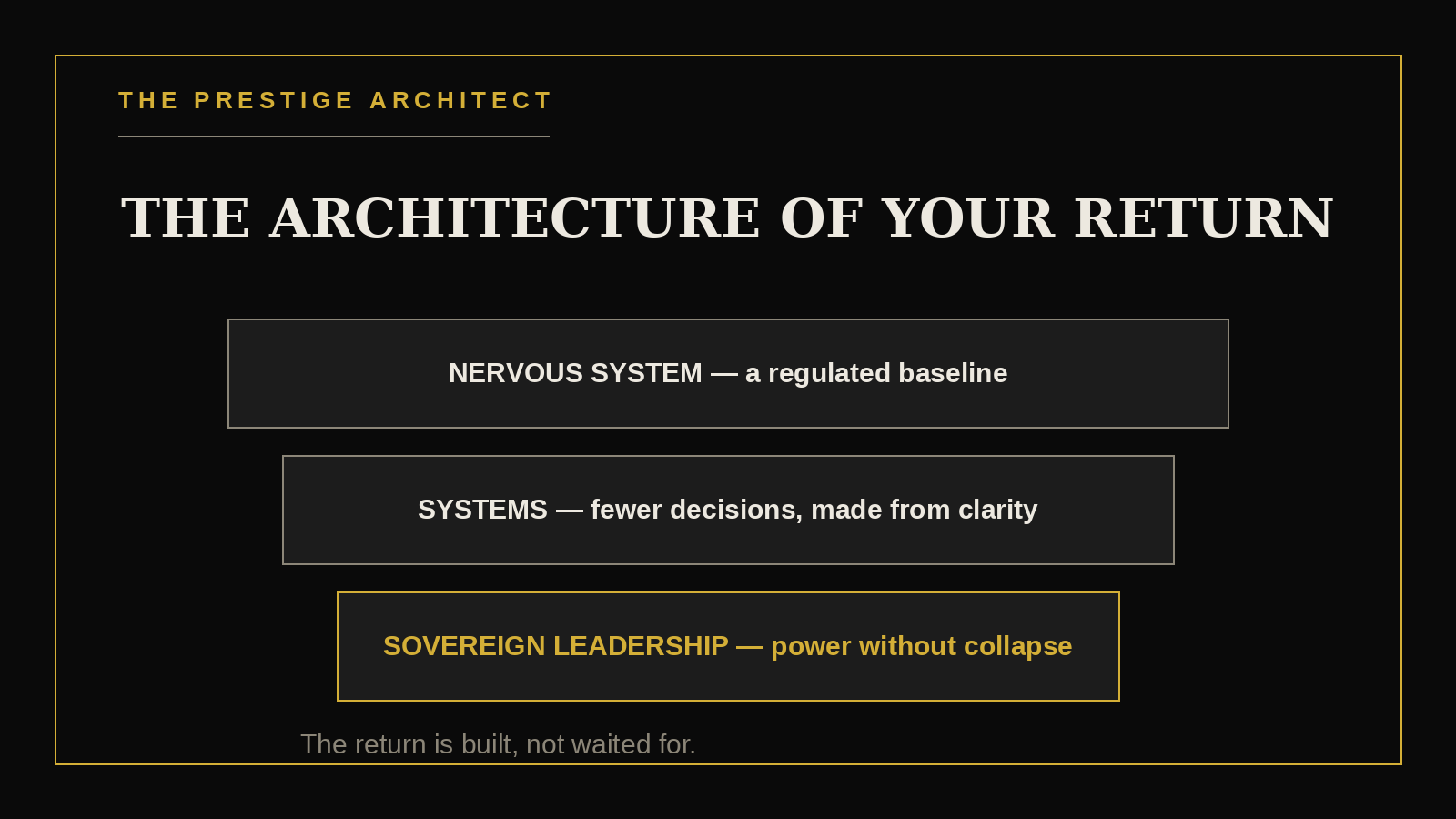
This is the work of The Prestige Architect®: power without collapse, success without self-betrayal. The gap between output and identity does not close by accident. It closes by design. If you are ready to build the return rather than wait for it, Apply to Work With Baz.
Frequently Asked Questions
How do I know if I am burnt out or heading for something worse?
Burnout stays anchored to the work and the exhaustion attached to it. The warning sign of something deeper is the gap: the work continues at full strength while your feeling behind it goes silent. High output with a dead signal is the marker to watch. That state is Silent Collapse™, and it sits between burnout and breakdown.
Why do I still feel empty when everything looks successful?
Because success was measured in output, and output was never the thing that went missing. When self-worth is fused to performance, you keep producing long after the meaning drains out. The emptiness is the gap between what you achieve and who you are. It is data, not a flaw.
Can rest alone fix high-functioning burnout?
Rest helps, and rest alone does not hold if the underlying architecture stays the same. A nervous system trained to treat stopping as a threat will run hot again within days of returning. The fix is structural: regulate the body and rebuild the systems so recovery is built in, not borrowed.
Is burnout a sign of weakness in a leader?
No. The WHO classifies burnout as an occupational phenomenon driven by chronic workplace stress, not a personal failing. The leaders most at risk are often the highest performers, because their output keeps masking the collapse underneath. Naming it early is a mark of command, not weakness.
British military veteran. Two-time international bestselling author. Founder, The Prestige Architect®. Host, Rise From The Ashes podcast, C-Suite Network. Boulder, Colorado.