Burnout vs Breakdown: The Identity Gap No Executive Names
You are still hitting the numbers. The board is satisfied. Your calendar is full, your title is intact, and no one around you sees a problem. Yet something inside has gone quiet. This is the first sign of Silent Collapse™ — the structural erosion of identity underneath performance that still looks flawless from the outside. Most leaders reach for the word burnout. The word is too small. Before you name it, Read The Manifesto.
Table of Contents
Key Takeaways
Burnout is exhaustion. A breakdown is a rupture. Silent Collapse™ is neither — it is identity eroding while output holds.
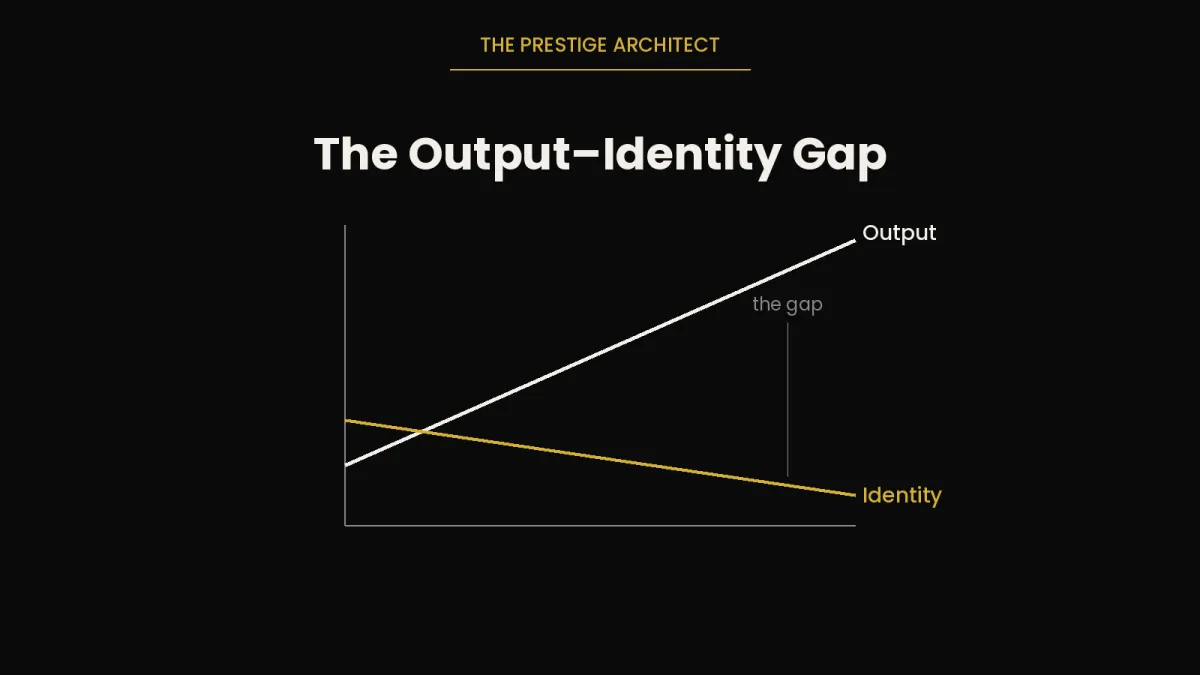
The real measure is not how tired you are. It is the distance between what you produce and who you have become.
You cannot rest your way out of an identity problem. Recovery is architecture, not a vacation.
Sovereign Leadership™ rebuilds the nervous system first, then the business. The leader before the strategy.
Burnout vs Breakdown: The Definitive Answer
Burnout is chronic occupational exhaustion — depletion, cynicism, and reduced efficacy anchored to your work. A breakdown is broader. It ruptures multiple systems at once: sleep, relationships, health, function. Between the two sits a third state most executives live in and never name. Output stays high. Identity quietly disappears. That is Silent Collapse™, and it is the state this article maps.
The Hidden Pattern Under the Exhaustion
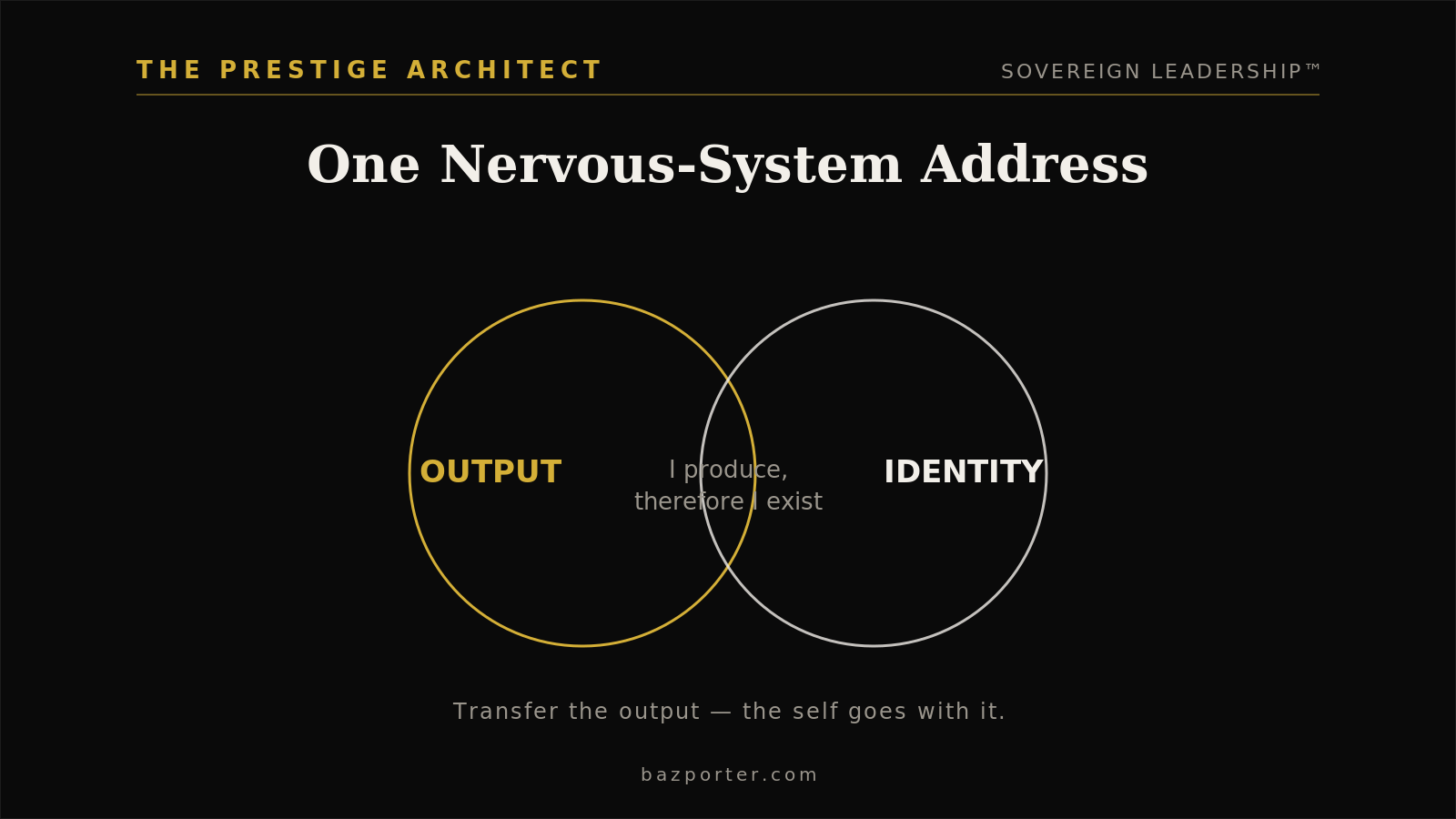
Everyone treats burnout as a fuel problem. Run too hard, run out of gas, refill with rest. That model is wrong for people at the top. Rest fixes tiredness. It does nothing for a self that has fused with a role.
Harvard Business Review reported in 2026 that burnout looks different across the org chart. Executives burn out from value conflicts. Founders burn out from over-identifying with their mission. The HBR research names the pattern I see in every high-performer I work with: the exhaustion is a symptom, and identity is the site of the injury.
Think of a bridge that carries full traffic while the steel underneath corrodes. The load looks fine. The deck holds. Then one ordinary day it does not. Silent Collapse™ is the corrosion phase — invisible, structural, and never fixed by lighter traffic. Your nervous system has learned that stopping equals danger. So you never stop, and the erosion compounds.
McKinsey frames burnout as a systemic design problem, not a personal failing — a matter of unclear priorities and misaligned structures, not weak individuals. The same is true one layer down, inside you. The architecture is the problem. Want the deeper framing first? Sovereign Leadership Resource Hub.
The RAMS™ Reframe: Five Pillars
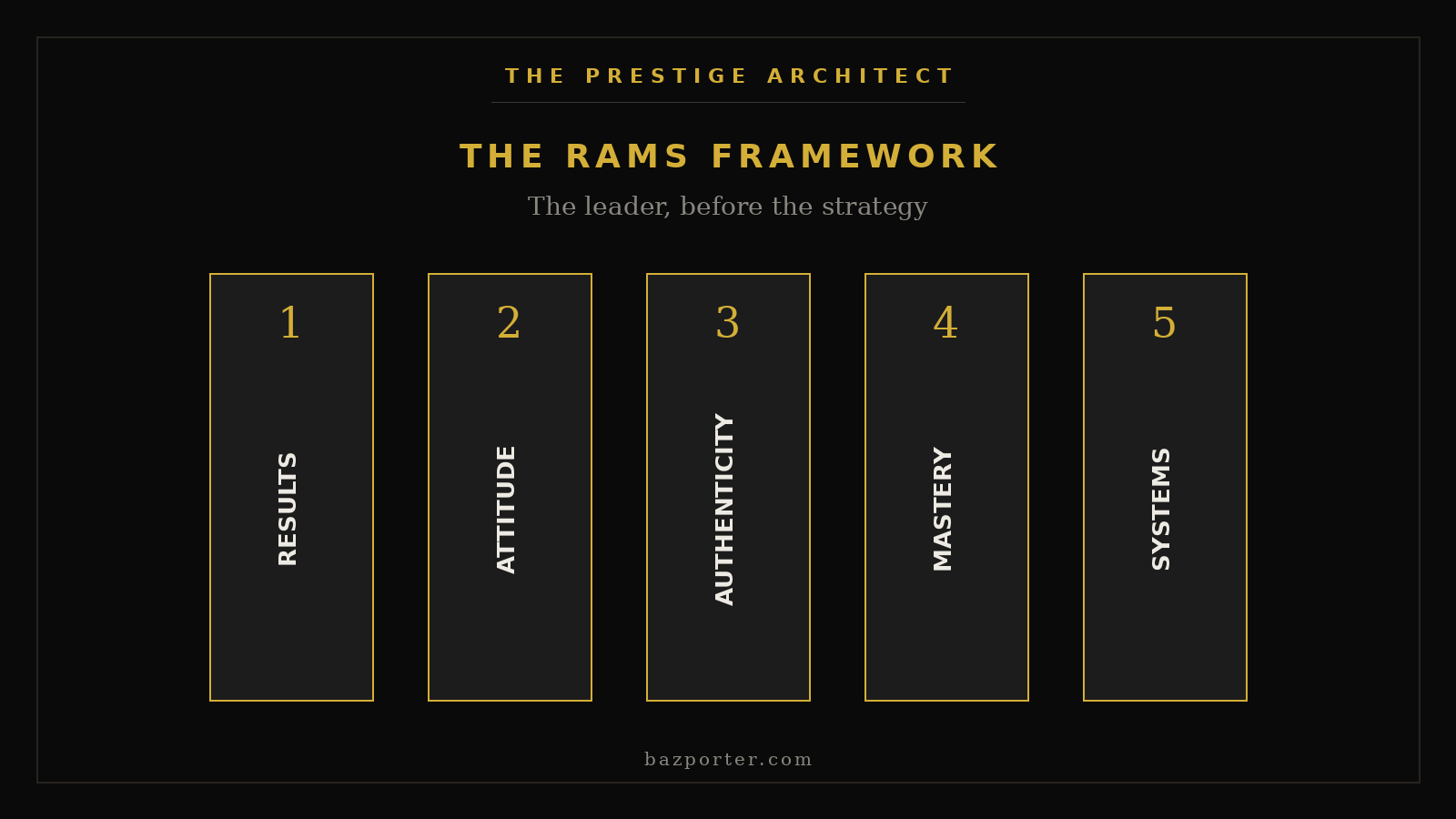
I do not treat exhaustion. I read structure. The RAMS Framework™ runs at two levels at once — the nervous system and the business. Both run on the same architecture. When one is dysregulated, both are compromised. Here are the five pillars: Results, Attitude, Authenticity, Mastery, Systems.
Read the contrast as a diagnostic — Collapsed Leader vs Sovereign Leadership™:
Results. Collapsed: output rises, meaning drops. Sovereign Leadership™: output and identity move together.
Attitude. Collapsed: stopping feels like danger. Sovereign Leadership™: rest is a controlled instrument.
Authenticity. Collapsed: the performed self hides the lived self. Sovereign Leadership™: private and public are one.
Mastery. Collapsed: more skill, less capacity. Sovereign Leadership™: capability is regulated, not volume.
Systems. Collapsed: the person carries the load. Sovereign Leadership™: the architecture carries the load.
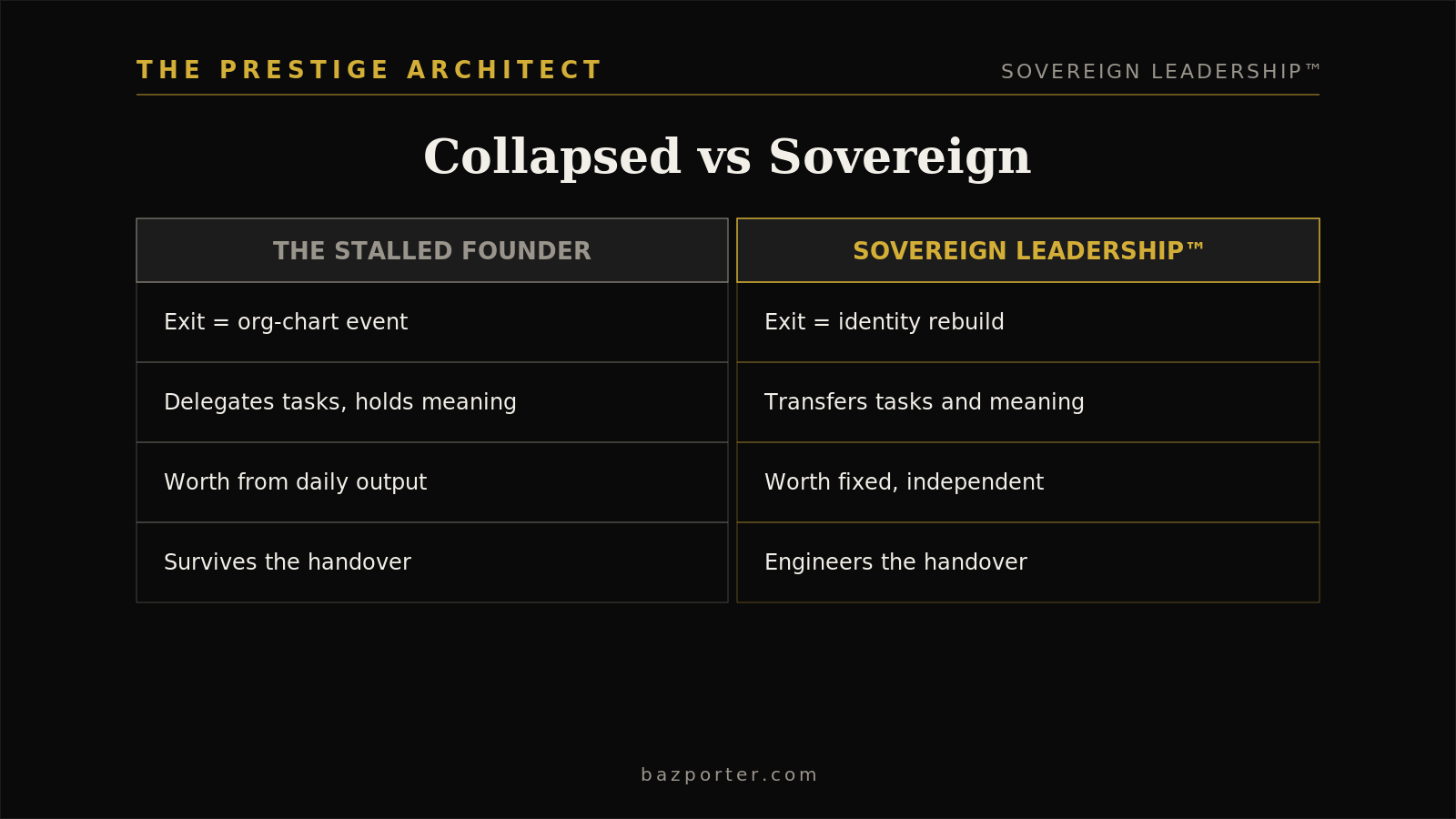
Results — The Output vs Identity Gap
Burnout is not how tired you are. It is the gap between what you produce and who you are. When the gap is small, work feeds you. When the gap widens, every win lands hollow. You hit the target and feel nothing.
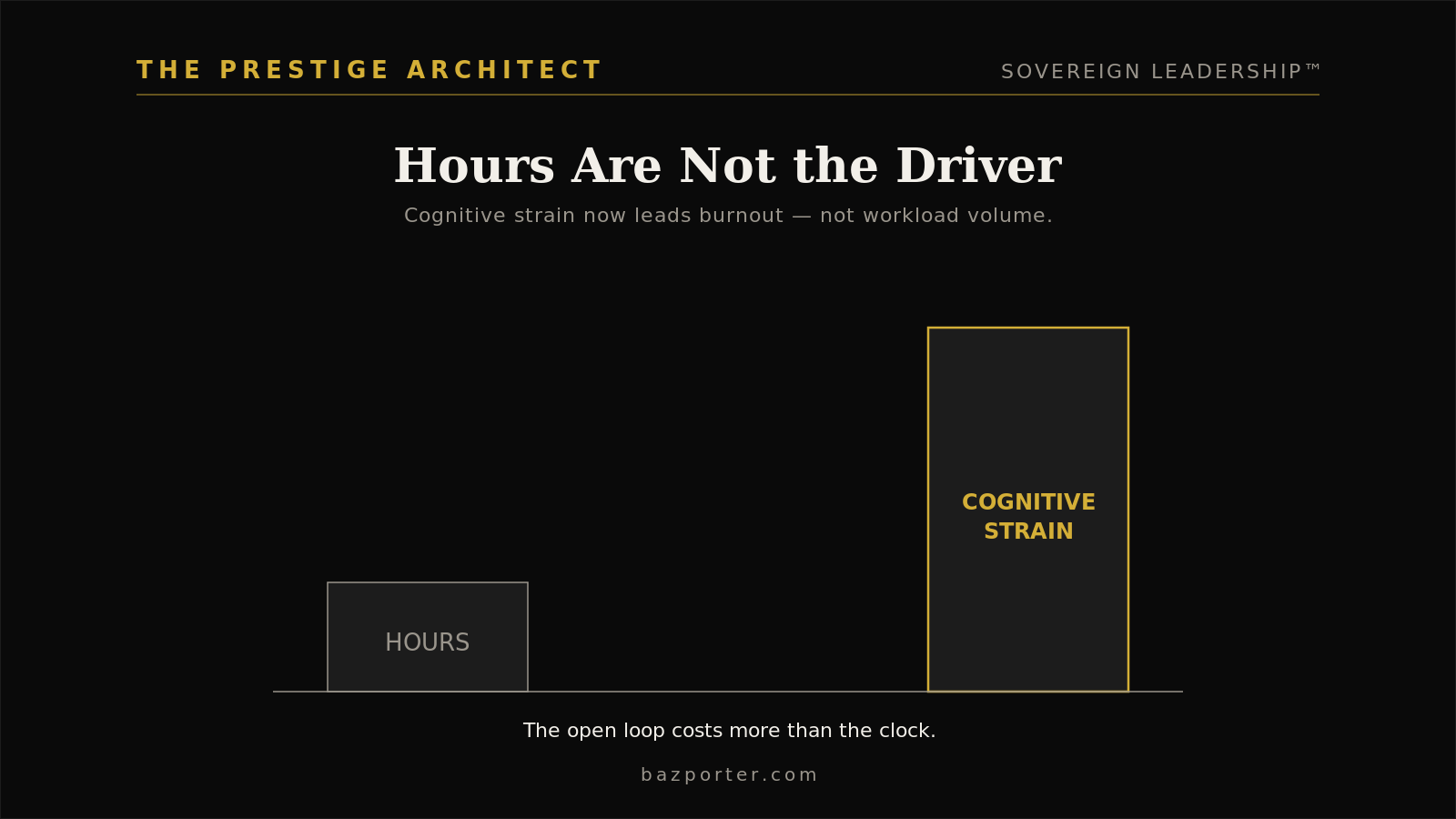
Track the gap, not the hours. Hours measure effort. The gap measures erosion.
Name the hollow wins. A result that returns nothing is data, not failure.
Operational rule: if the scoreboard climbs while the self goes silent, the problem is structural, not seasonal.
Attitude — Where Collapse Lives
Attitude is the internal operating system. This is where collapse takes root. The belief runs underneath everything: "If I stop, everything falls apart." That belief is not discipline. It is a dysregulated nervous system wearing a leadership costume.
Burnout is not a fuel problem. It is an identity that fused with a role and forgot it had a self underneath.
Authenticity — The Private/Public Divide
The public self performs certainty. The private self is running on empty. That divide is the engine of Silent Collapse™. The wider the gap between the performed leader and the lived person, the faster identity erodes. Closing that divide is not weakness on display. It is structural repair.
Ready to see your own signal clearly? Take the Silent Collapse Diagnostic.
Mastery — Skill vs Sovereign Capability
You have more skill than you have ever had. You also have less capacity than you did a decade ago. That is the trap. Skill is what you can do. Sovereign capability is what you can hold without dysregulating.
Skill scales output. It does not scale nervous-system tolerance.
Capability scales the self. It is trained, not accumulated.
Command decision: stop adding skills to a system that cannot carry the ones you own.
Systems — The Architecture of Your Return
A person carrying the whole load is not a strategy. It is a countdown. Systems move the weight off the individual and into the structure. This is the pillar that ends the erosion — because it stops asking your body to be the load-bearing wall.
Case Vignette: The Founder Who Was Fine
A founder came to me at eight figures. Revenue up. Team strong. On paper, exceptional. She told me she felt nothing at the wins and dread at the idea of stopping. No breakdown. No missed number. Textbook Silent Collapse™. We did not touch her schedule first. We rebuilt the architecture — nervous-system regulation, then decision structure, then the private/public divide. Output held the entire time. What changed was the person producing it. She returned to herself without losing a quarter.
The Architecture of Your Return
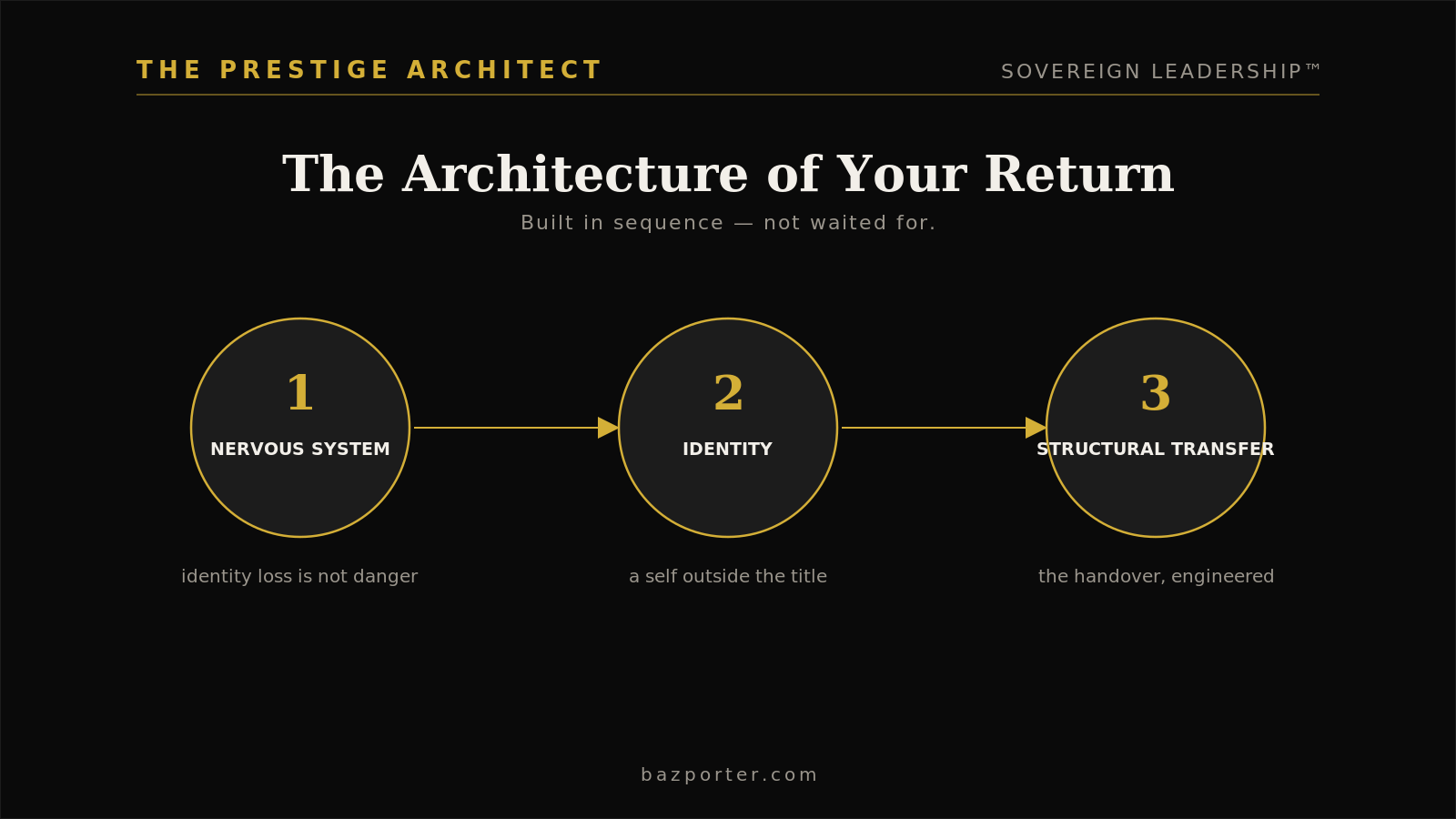
You do not need permission to rest. You need a structure that no longer runs on self-erasure. Recovery here is not inspiration. It is nervous-system sovereignty — teaching your system that safety and performance can coexist. Rest becomes an instrument you command, not a collapse you fear. The return is not a softer version of you. It is the same power, minus the self-betrayal.
This is the work I do inside The Prestige Architect®. Not lighter traffic. New steel. If you are ready to rebuild the architecture underneath the performance, Apply to Work With Baz.
Frequently Asked Questions
How do I know if it is burnout or something worse?
Burnout stays anchored to your work — depletion, cynicism, reduced efficacy. A breakdown spreads across sleep, relationships, and health at once. If your output is intact but your sense of self has gone quiet, you are in a third state: Silent Collapse™. If symptoms concern you, seek qualified medical or mental-health support.
Why do I feel nothing after a win?
A hollow win signals a widening gap between output and identity. The result is real. The self that used to be fed by it has gone offline. That is a structural signal, not ingratitude.
Can rest fix executive burnout?
Rest fixes tiredness. It does not repair an identity fused with a role. A vacation returns you to the same architecture that eroded you. Recovery is a redesign of the structure, not a pause inside it.
What is the first step back?
Regulate the nervous system before you touch the calendar. Safety first, structure second, schedule last. The self has to learn that stopping is not danger before any plan will hold.
British military veteran. Two-time international bestselling author. Founder, The Prestige Architect®. Host, Rise From The Ashes podcast, C-Suite Network. Boulder, Colorado.