How to Build a Second Act Without Burning the First
Part of you has already left. You are still in the role. Still delivering. Still the one everyone counts on. But some quiet part of you has started building a different life in its head. A second act. A next chapter that is actually yours. And right behind that thought comes the fear. To have it, you would have to blow up everything you built. This is the Silent Collapse™ talking, and it lies about the price. The work of The Prestige Architect™ is not demolition. It is design. Before you read another word, read the manifesto.
Written by Baz Porter®
What this covers
Key takeaways
A second act is an addition, not a detonation. You build the next chapter alongside the first, never on its ashes.
The urge to burn it all down is a systems failure, not a character flaw. The old system gave you no room to test anything new.
Reinvention research is clear. People who last change through small experiments, not one dramatic leap.
You keep the income, the standing, and the relationships while the second act earns its place.
The move is return, not reinvention. You are recovering what you wanted, not becoming a stranger.
How do you build a second act without burning the first?
You build it in parallel. You keep the first act running as your base. Then you carve out small, low-risk experiments that test the next chapter in real life. Each experiment gives you data, not a vow. The second act earns its place slowly, on evidence. You only step back from the first act once the second one can hold your weight. That is the whole method. No cliff. No fire. A bridge you cross one plank at a time.
The hidden pattern under the second act
Here is what almost no one names. The wish for a second act is not new ambition. It is an old self asking for room. Psychologists Hazel Markus and Paula Nurius called these "possible selves," the versions of you that you carry but rarely live (American Psychologist, 1986). You already hold the second-act self inside you. It has just been starved of practice.
There is more. Herminia Ibarra studied leaders who actually reinvented their working lives. They did not leap. They tested "provisional selves" through small trials, kept what fit, and dropped what did not (Administrative Science Quarterly, 1999). The ones who leaped first and thought later tended to land back where they started.
So the trap is the all-or-nothing frame. Your mind says stay loyal to the first act, or torch it and start over. Both are cliffs. One buries the possible self. The other buries the life that funds it. Neither is design. The restlessness is real. The two options are false.
The RAMS™ reframe: build the second act as a system
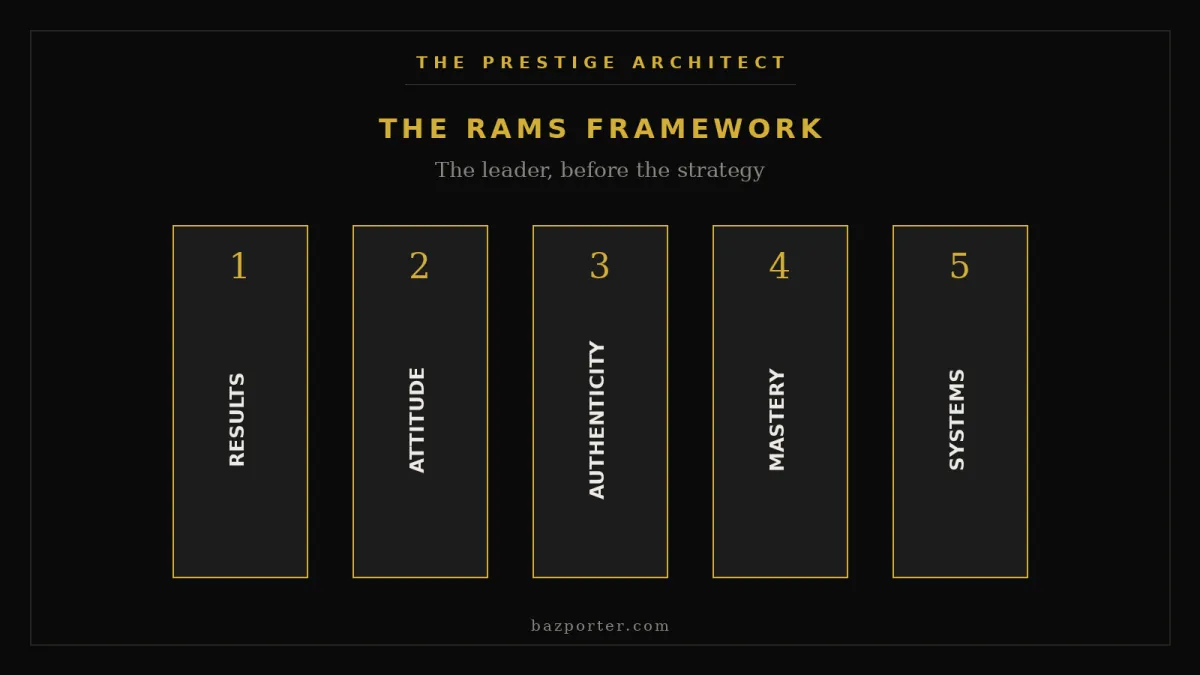
RAMS™ is how I take the itch to walk away and turn it into architecture. Five pillars. Run in order.
Results
Define what the second act must produce before you touch it. Not a feeling. A result. More autonomy. A different kind of work. Time with the people who matter. Name the outcome in one sentence. A second act without a defined result is just an escape with better branding.
Attitude
Drop the guilt. Wanting more is not a betrayal of the life you built. The people who love you do not need you quietly dying in a role. A second act built from shame collapses. One built from honesty holds.
Authenticity
Test the real self, not the fantasy. The daydream is a mood. The possible self is a practice. Try the work. Take the small project. Have the honest conversation. Authenticity is not a single leap of faith. It is a series of small, honest trials that tell you the truth.
Mastery
Build the skill before you need the income from it. A second act fails when you jump into a craft you have not practiced. Master it on the side first. Let competence, not desperation, set the timing.
Systems
This is the pillar that saves the first act. Put the second act on a schedule. Protect a few hours a week and defend them. Track what each experiment returns. Systems turn a wish into a build. Systems are why you never have to jump. This is the whole reason the fire is optional.
Collapsed versus Sovereign
The difference is not courage. It is design.
Collapsed: one dramatic exit, no plan, everything staked on a feeling. Sovereign: many small experiments, each one reversible.
Collapsed: burn the first act to fund the second. Sovereign: let the first act fund the second while it proves itself.
Collapsed: reinvent into a stranger. Sovereign: return to the self the role crowded out.
Collapsed: timing set by desperation. Sovereign: timing set by evidence.
The leaders who last do not leap. They build the next thing quietly, and step across only when it holds their weight.
If you cannot yet see the first plank from where you stand, that is exactly where to begin. Book the Fast Future Freedom Blueprint and we will map it together.
What this looks like in a real life
A managing partner sat across from me, certain of one thing. She had to quit. Twenty years built. A firm with her name on the door. And a private plan to sell it all and disappear into something smaller. We did not touch the firm. We built one experiment instead. Four hours a week on the work she actually missed. Ninety days later she had proof the second act was real, and proof it was not yet ready. She kept the firm. She kept the income. And for the first time in years she stopped fantasizing about running, because she was finally building. The exit was never the answer. The experiment was.
The architecture of your return
Start with one result you want the second act to give you. Write it in a single sentence. Then design the smallest experiment that tests it in the real world this month. Not a resignation. A trial. Protect the hours. Run it. Read the data honestly. Keep the first act running the entire time, so nothing you love is at risk while you learn.
This is return, not reinvention. You are not becoming someone new. You are giving room back to the self that built all of this in the first place. The first act does not have to die for the second one to live. When you are ready to design your second act on paper, book the Fast Future Freedom Blueprint.
Questions leaders ask
How do I start a second act while working full time?
You carve out a small, fixed block of time and run one experiment inside it. A few protected hours a week is enough to start. The goal is evidence, not scale. Keep the full-time role as your base while the second act proves whether it is real.
Isn't building in parallel just slower?
It is slower to feel and far faster to last. A dramatic exit often ends in a costly return to the old kind of work within a year or two. Parallel building rarely fails that way. You trade the rush of the leap for a second act that actually holds.
How do I know when to finally leave the first act?
You leave when the second act can hold your weight, not before. That means it produces real results, you have the skill it demands, and the numbers work without heroics. Let evidence set the date. Desperation is a bad clock.
What if my second act fails?
Because you built it in parallel, a failed experiment costs you a few hours, not your livelihood. You read what it taught you and design the next trial. Nothing you love is on the line. That is the entire point of not burning the first act.
Is wanting a second act a sign something is wrong with my life?
Usually it is a sign you outgrew the life you built, which is normal for capable people in their forties and fifties. The restlessness is information, not a defect. It is a possible self asking for room. The work is to give it a real, tested place.
About Baz Porter®
Baz Porter® is the founder of Baz Porter LLC® and the architect of Sovereign Leadership Architecture™. He guides high-achieving leaders from Silent Collapse™ to Sovereign Leadership™: power without collapse, success without self-betrayal. He is the creator of RAMS™ and the host of the Rise From The Ashes podcast on the C-Suite Network.