Attention Management: Engineer Where Your Mind Goes
Written by Baz Porter®
You do not have a time problem. You have an attention management problem. The most capable leaders I counsel run full calendars and empty minds. They answer every message and remember none of the work that mattered. This is the quiet edge of Silent Collapse™: a sharp mind rented out, one interruption at a time, until the person behind the title cannot hear their own thinking. The rebuild starts where you already know it should. Read The Sovereign Manifesto, then come back and build the system.
On this page
Key takeaways
Attention management is the discipline of governing where your mind goes, on purpose.
Attention is a finite asset. You allocate it, or the day spends it for you.
Task switching leaves residue. Part of your mind stays behind on the last thing.
Willpower is not the plan. A system that makes focus the default is the plan.
This is architecture, not motivation. You build it once and it holds.
What attention management actually is
Attention management is the deliberate practice of governing where your mind goes. You treat attention as a finite asset you allocate on purpose. You do not treat it as a resource the day is free to spend for you. Time management sorts your hours. Attention management protects the quality of thought inside them. For a leader in Silent Collapse™, this is the difference between being busy and being present. One is measured in tasks. The other is measured in the decisions only you can make.
The 2026 executive conversation has caught up to this. Forbes now calls attention the executive asset no one budgets. That framing is correct. Attention behaves like capital. It is scarce. It compounds when protected. It leaks when left open. Most leaders audit their money to the dollar. Almost none audit their attention at all. That gap is where the collapse hides.
The hidden pattern: attention residue
Here is the mechanism most leaders never name. When you switch tasks, your attention does not switch cleanly. A part of your mind stays behind on the previous task. The researcher Sophie Leroy named this "attention residue" in her 2009 study in Organizational Behavior and Human Decision Processes. Her finding was blunt. People who move fast between tasks perform worse on the task in front of them. The residue drags.
Now count your day. A message here. A quick answer there. A calendar with no gaps. Each switch feels productive. Each one leaves residue. By afternoon you are running on a mind that is never fully anywhere. This is not weakness. It is the predictable result of an open attention system. Harvard Business Review has made the same point for years: the busier you are, the more you need protected quiet to think.
The RAMS™ reframe: five pillars
The RAMS™ method rebuilds attention management across five pillars. Results, Attitude, Authenticity, Mastery, and Systems. Each one moves you from a collapsed pattern to a sovereign one.
Results. The collapsed leader measures output volume. The sovereign leader measures the quality of the decisions protected attention produces. More done is not the goal. Better judgment is.
Attitude. The collapsed leader treats every interruption as loyalty. The sovereign leader treats protected attention as leadership. You are not rude for guarding your mind. You are responsible.
Authenticity. The collapsed leader gives their sharpest hours to other people's priorities. The sovereign leader guards those hours for the work only they can do. Your best thinking is not a public utility.
Mastery. The collapsed leader reacts to every ping. The sovereign leader builds the skill of single focus under pressure. This is trained, not wished. It grows with repetition.
Systems. The collapsed leader relies on willpower. The sovereign leader installs a system that makes focus the default. Willpower fails by noon. A system does not get tired.
Here is the same shift as a simple ledger.
Collapsed: attention is spent by whoever asks last. Sovereign: attention is allocated before the day starts.
Collapsed: switching feels like progress. Sovereign: switching is a measured cost.
Collapsed: the calendar holds everyone else's priorities. Sovereign: the calendar protects deep work first.
Collapsed: willpower is the plan. Sovereign: the system is the plan.
You do not have an attention problem. You have an attention architecture problem. Architecture is fixable.
If you cannot tell where your attention leaks, that is the first thing to map. The Silent Collapse Diagnostic™ is a 60 minute session, live with me, built to find it.
A founder who thought it was discipline
A founder came to a Diagnostic certain the problem was discipline. He believed he was lazy. He was not. His day had no protected block anywhere in it. Every hour belonged to someone else. He was giving his freshest attention to his inbox and his residue to his strategy. We did not add willpower. We built one protected block and one rule to defend it. Within two weeks his hardest decisions moved from midnight to morning. His team noticed before he did. Nothing about him changed. His architecture did. That is the whole point. Discipline was never the missing piece. The design was.
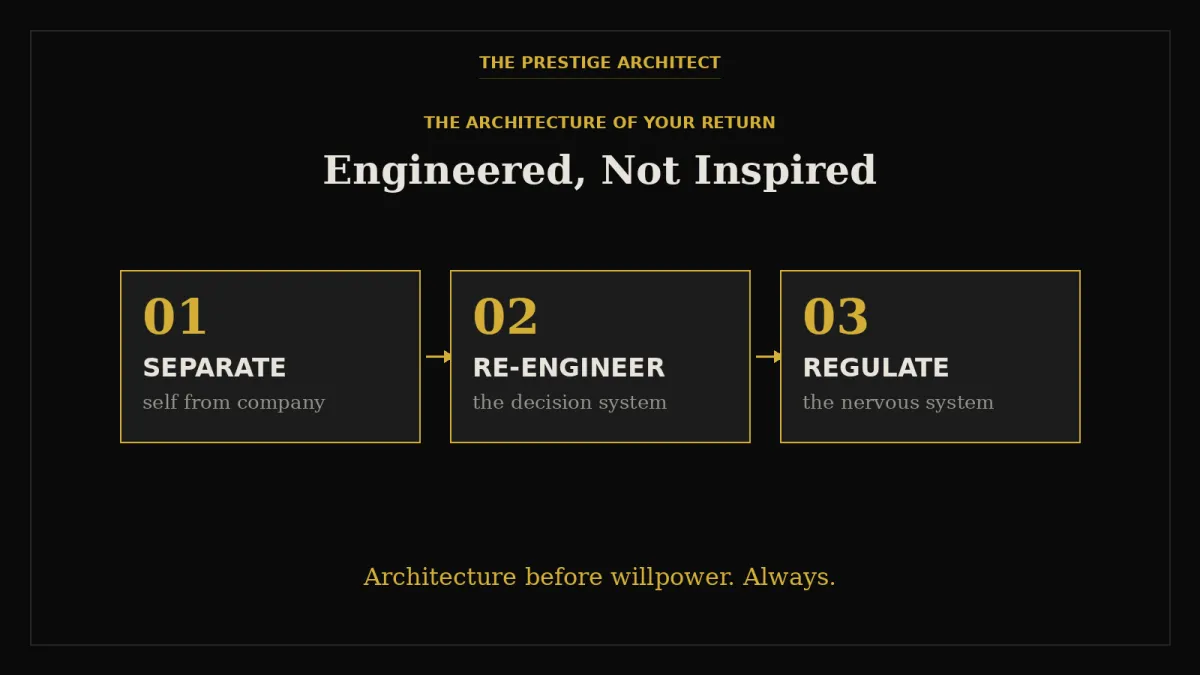
The architecture of your return
Attention management is not a hack you try on Monday and lose by Friday. It is a system you design once and defend on purpose. The return is real. Your judgment sharpens. Your presence comes back. The work that only you can do finally gets your best hours. This is the return that Sovereign Leadership™ is built to protect: power without collapse, success without self-betrayal.
If you are ready to build it, start where every rebuild starts. Apply for the Silent Collapse Diagnostic™. We map where your attention leaks, and we design the system that holds it.
Frequently asked questions
What is the difference between attention management and time management?
Time management sorts your hours into slots. Attention management governs the quality of thought inside those slots. You can have a perfect calendar and a scattered mind. Managing attention protects the thinking, not just the schedule.
Why can't I focus even when I have the time?
Open time does not equal protected attention. If your mind carries residue from constant switching, the hours are yours but the focus is not. The fix is a system that removes the switches, not more hours on the calendar.
Is attention management a skill I can actually build?
Yes. Single focus under pressure is trained through repetition, like any discipline. It grows when you protect a block, defend it with a rule, and repeat it daily. The skill is in the Mastery pillar of the RAMS™ method.
How do leaders protect their attention from constant interruptions?
They stop relying on willpower and install a system. That means one protected deep-work block placed before the day fills, plus a clear rule that defends it. The calendar protects the priority, so the person does not have to.
How do I know if my attention problem is part of Silent Collapse?
When a capable leader cannot hear their own thinking under a full calendar, that is a signal, not a character flaw. The Silent Collapse Diagnostic™ is a 60 minute session, live with Baz Porter®, that maps exactly where your attention and energy are leaking.
About the author
Baz Porter® is the founder of Baz Porter LLC® and The Prestige Architect™. He is a British Army veteran and an international bestselling author. As host of the Rise From The Ashes podcast on the C-Suite Network, he guides high-achieving leaders out of Silent Collapse™ and into Sovereign Leadership™: power without collapse, success without self-betrayal.