Why You Always Feel Behind in Your Business
Silent Collapse™ rarely looks like collapse. It looks like a capable person who feels behind, every week, and cannot say why. You open the laptop on Monday. Last week did not carry forward. You are starting from zero again. This is not a character flaw. It is a structural one, and it has a name. For the frame behind all of this, start with the manifesto.
Written by Baz Porter®
What this covers
Key takeaways
You feel behind because you rebuild from zero each week, not because you are slow-moving.
No system means every task restarts from scratch. The clock never stops.
The planning fallacy makes the gap feel like proof you are failing.
The real fix is a container that carries the work forward, so Monday starts mid-stream.
Sovereign Leadership™ is built, not felt. You architect the exit from the loop.
Why you always feel behind
You always feel behind because your business has no memory. The work does not hold. It lives in your head, and your head empties overnight.
You do not feel behind because you are slow. You feel behind because you start over. With no system to hold the work, every week resets to zero. So you chase a line that keeps moving. Silent Collapse™ is the quiet result: a capable person, working hard, convinced they cannot do this.
Read that again. The feeling is real. The cause is not effort. Ideas arrive faster than you can land them. Nothing finishes. Each Monday, the pile looks the same. So you conclude the problem is you. It is not.
The hidden pattern under the feeling
There is a documented reason the gap feels permanent. Researchers call it the planning fallacy. Buehler, Griffin and Ross (1994), in the Journal of Personality and Social Psychology, showed people underestimate how long their own tasks will take. They do this even when they remember past tasks running long.
Now apply it to a business with no systems. You plan the week as if you begin ahead. You do not. You begin at zero and rebuild. The plan was wrong before Monday arrived. So the gap opens, and it reads like failure.
There is a second layer. Perlow (1999), in Administrative Science Quarterly, named it the time famine. It is the chronic sense of too much to do and no time to do it. The famine is not caused by weakness. It is caused by a work design that forces constant restarts. Change the design and the famine ends.
Put both layers together and the loop is clear. You underestimate the rebuild. You then run out of time. The week ends behind. The mind files it as one more count against you. Two studies, one conclusion: the behind feeling is manufactured by structure, not by you.
The RAMS™ reframe across five pillars
RAMS™ is Results, Attitude, Authenticity, Mastery, Systems. It reads the person before the strategy. Here is the feeling of being behind, read through all five pillars.
Results
Stop measuring against an imaginary caught-up line. That line is fiction. Measure one thing carried forward this week. One closed loop beats ten opened.
Attitude
The behind feeling is data, not a verdict. It tells you a system is missing. It does not tell you that you are less. Read the signal. Then act on it.
Authenticity
You keep performing on top of it. Someone asks how it is going, and you say fine. The mask costs more than the work. Drop it in one safe room and the pressure drops with it.
Mastery
Mastery is not doing more. It is doing the same thing the same way each week. Repetition cuts a groove. The groove carries the work when your energy does not.
Systems
This is the lever. A system is memory outside your head. It holds the plan, the client, the next step. Build it once. Then Monday starts mid-stream, never at zero.
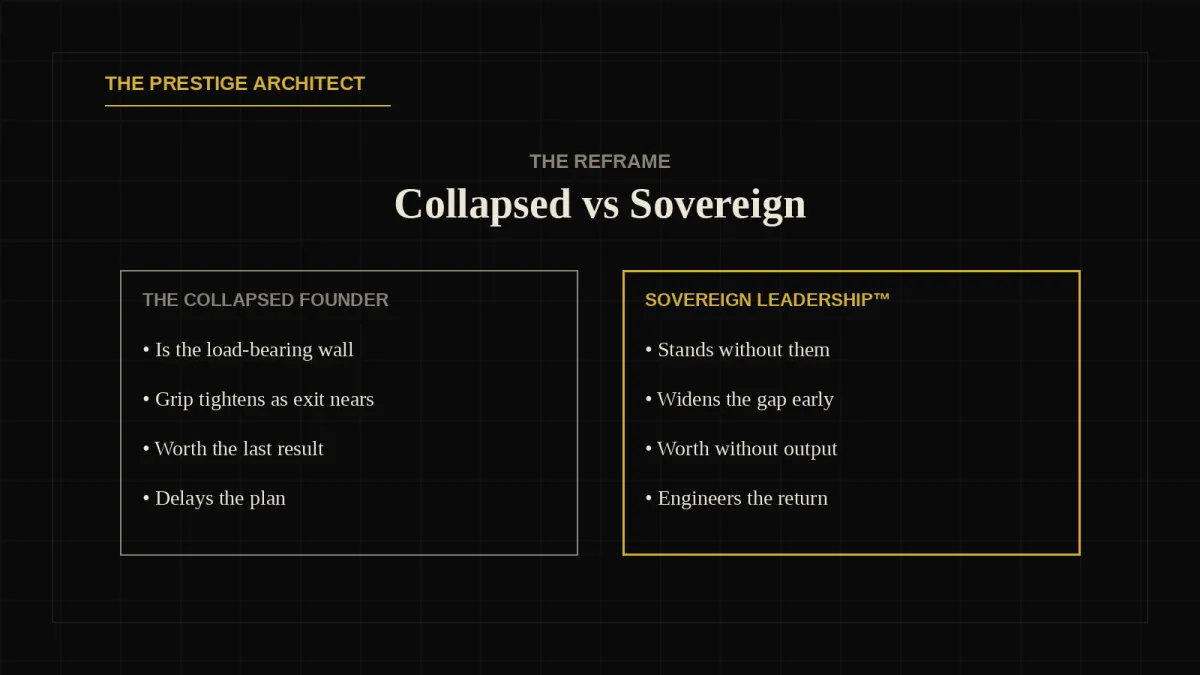
Collapsed versus Sovereign
The difference is not effort. It is architecture.
Collapsed rebuilds from zero every week. Sovereign starts where last week ended.
Collapsed keeps the plan in the head. Sovereign keeps the plan in a system.
Collapsed measures against caught-up. Sovereign measures one loop closed.
Collapsed hides the strain. Sovereign names it in one room.
Collapsed works harder. Sovereign builds the thing that works for them.
Baz Porter does not motivate. He does not inspire. He architects the return.
If the behind feeling has become your normal, name it before it hardens. The Silent Collapse Diagnostic™ shows you where the loop is running.
One founder's turning point
A founder came to me last year. They ran a real business with real revenue. Bright, driven, and behind. Every Monday felt like page one.
They told nobody. The partner asked; the answer was fine. Inside, each restart proved a quiet case: you cannot do this.
We did not add effort. They had plenty. We built one capture home for the work. Every open loop went into it. Each loop got one decision and one next step.
The behind feeling did not vanish in a day. It thinned. Monday stopped being page one. The work waited where they left it. Within a season, the case against them lost its evidence.
The change was not dramatic. It was quiet and structural. One home, one review, one rule, held for a month. That was the whole intervention. The relief came from design, not from trying harder.
The architecture of your return
You do not need more drive. You need a container that remembers. That is the whole move out of the loop.
Start small and fixed. One home for every task. One weekly review at the same hour. One rule: nothing lives only in your head.
Guard the weekly review like a client call. It is the hour that keeps every loop closed. Skip it and the head fills again. Hold it and the system holds you.
This is not motivation. It is Sovereign Leadership™, built on purpose. The behind feeling is a design output. Change the design and the output changes.
When you are ready to see your own loop clearly, apply for the Silent Collapse Diagnostic™. It is one honest hour on where the work leaks, and what to build first.
Questions people ask
Why do I always feel behind in my business?
You feel behind because the work does not carry forward. With no system, each week restarts from zero. You plan as if you are ahead, then rebuild instead. The planning fallacy makes that gap read as personal failure. It is a design problem, not a character one.
Is feeling behind a sign of Silent Collapse™?
It can be an early one. Silent Collapse™ is a capable person quietly losing faith in themselves while still performing. The behind feeling, week after week, is one of its clearest tells. Naming it early is how you stop it hardening.
How do I stop starting over every week?
Give the work a memory outside your head. Put every open task in one capture home. Give each task one decision and one next step. Review it weekly at a set hour. Monday then begins mid-stream instead of at zero.
What is the planning fallacy?
It is a documented bias. People underestimate how long their own tasks will take, even after past tasks ran long. Buehler, Griffin and Ross studied it in 1994. In a business with no systems, it keeps you permanently behind your own plan.
Does working harder fix feeling behind?
No. More effort into a system that resets each week only deepens the famine. The fix is structural. Build a container that holds the work, then the same effort finally compounds instead of evaporating.
Written by Baz Porter®, founder of Baz Porter® and The Prestige Architect™. British Army veteran and international bestselling author. He architects the return from Silent Collapse™ to Sovereign Leadership™ using RAMS™. Power without performance. Peace without retreat.