
The Truth
She's Been Waiting For.
Intelligence for women who lead at the highest level
and are done pretending it doesn't cost them.
These aren't motivational articles. They are precision intelligence —
written for the woman who has achieved everything the world told her to achieve
and still wakes up at 4 AM wondering why none of it feels like enough.
Listen: You don't have a performance problem.
You have a nervous system problem. And that is exactly what we address here.
Words on a page can name it.
The work changes it.
If something you read here landed — if you felt seen in a way you rarely do — that recognition is data. It means your nervous system already knows what it needs. The Silent Collapse Diagnostic is where we make it precise.
Take the Silent Collapse Diagnostic Or explore working with Baz Porter® directly →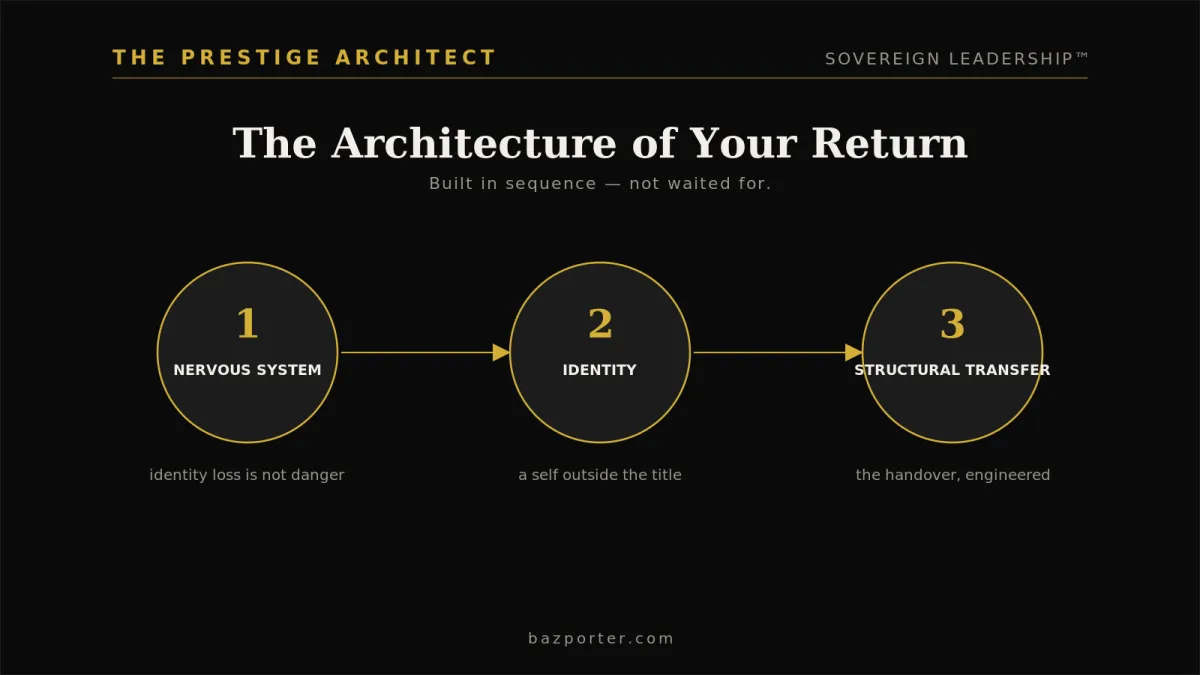
Leadership Succession Planning Models: The Method
Your succession plan names a person. It does not transfer what made you effective. That gap is where most plans fail.
This is Silent Collapse™ at the org level. The chart moves. The readiness does not. I do not motivate. I architect. A succession model transfers a system, not a seat. It starts with the truth inside the Manifesto.
What This Covers
Key Takeaways
A succession model transfers readiness, not just a title.
Most models plan the chart and ignore the person.
The strongest model builds successors years before the exit.
Succession is an architecture. It is designed, not hoped for.
You can map your own readiness with the Silent Collapse Diagnostic™.
The Definitive Answer
A leadership succession planning model is the structure that decides who leads next. It sets how power, knowledge, and standards transfer. It is the blueprint under the transition.
Most models name a successor and stop. That is a list, not a model. A name does not carry your judgment.
A real model transfers three things. Capability. Relationships. And the standard the role demands. Miss one and the handoff breaks.
Here is the core truth. You do not lose a leader when they leave. You lose them when the system left with them.
Think of it as an architecture, not an event. A good model is load-bearing. It holds weight long before the day it is needed.
That is why a name on a form fails. A form does not carry judgment. A structure does.
The Hidden Pattern
The data is stark. Poor succession destroys enormous value at the top.
Harvard Business Review put the cost in the trillions across public companies (Fernandez-Araoz and colleagues). Most boards treat succession as an event, not a system. So they choose late and choose wrong.
Here is the deeper pattern. The outgoing leader often fuses identity with the role. When the role goes, the person collapses. That distress leaks into every choice about who comes next.
A dysregulated handoff is a bad handoff. The psychology of identity and stress shapes the decision more than the org chart does. Fear picks a clone. Clarity builds a successor.
The Three Models Leaders Use
Most leadership succession planning models fall into three types. Each solves a different problem.
The emergency model. A named backup for sudden loss. It buys time. It does not build a leader.
The replacement model. A slate ranked against today's role. It is tidy. It plans for the past, not the future.
The development model. A pipeline built years ahead. It transfers readiness on purpose. This is the architecture that lasts.
The first two protect the chart. Only the third protects the enterprise. Build the third and the first two come free.
Here is the trap. Most boards pick the replacement model because it is fast. Fast feels safe. It is not.
You are ranking people against a role that is already changing. By the time they step up, the seat has moved. The plan was accurate and useless.
The RAMS™ Reframe
I run every rebuild through RAMS™ — Results, Attitude, Authenticity, Mastery, Systems. It operates at the business level and the nervous-system level at once. The body and the business share one architecture. Dysregulate one and you compromise both.
Results
Collapsed: Succession is a document filed for the board. It protects the meeting, not the mission.
Sovereign: Succession is a live pipeline. It produces ready leaders on schedule.
Attitude
Collapsed: The exit feels like a loss to survive. Fear runs the choice.
Sovereign: The exit is a design you own. Clarity runs the choice.
Authenticity
Collapsed: You pick a successor who mirrors you. Comfort masquerades as fit.
Sovereign: You pick for the role the future needs. The choice serves the mission, not the ego.
Mastery
Collapsed: You hoard the knowledge that made you central. Dependence feels like value.
Sovereign: You transfer the judgment on purpose. Your mastery becomes theirs.
Systems
Collapsed: Succession is a one-time scramble near the door.
Sovereign: Succession is engineered years ahead by design.
Baz Porter does not motivate. He does not inspire. He architects the system beneath the leader — so the enterprise outlasts the person who built it.
You cannot hand off a standard you have never measured. Start with yourself. Map your readiness with the Silent Collapse Diagnostic™.
The Method in Practice
The architecture is not abstract. It runs on three moves, in order. Each one is a build, not a hope.
One. Define the future role. Name what the seat will demand in three years. Build toward that, not toward your resume.
Two. Build the pipeline early. Grow two or three candidates for years. Give them scope, stakes, and real failure.
Three. Transfer, then step back. Hand over judgment before you leave. Let them decide while you still can catch a fall.
Run this for years and the handoff is quiet. No scramble. No collapse. The enterprise never feels the gap.
Notice what the method protects. It protects you from your own fear at the exit. And it protects the people who inherit what you built.
A Case Vignette
A founder came to me at fifty-eight. The company ran on her judgment alone. The board had no plan and no candidate.
She feared the exit. So she kept the knowledge close. That fear was the risk, not the timeline.
We did not write a document. We built the architecture. Future role defined. Two successors grown. Judgment handed over in stages.
The shift was not a document. It was a decision to let go on purpose. She traded control for continuity.
Two years later she stepped back on her terms. The company did not miss a beat. She had built a system, not a monument.
The Architecture of Your Return
Succession is not the end of your leadership. It is the proof of it. Power without collapse. Success without self-betrayal.
This is Sovereign Leadership Architecture™ — the system that returns the leader to herself while the enterprise stands. You do not need a name on a form. You need a structure that outlives you.
The offer is not a rescue. It is a rebuild. And a rebuild starts with the truth of where you stand today.
The best succession model is the one you build early. Start before you need it. That is how an enterprise outlives its leader.
When you are ready to build it, apply for a private session.
Frequently Asked Questions
What is a leadership succession planning model?
It is the structure that decides who leads next and how power transfers. It moves capability, relationships, and standards. A name alone is not a model.
Which succession model is best?
The development model wins over time. It builds successors years ahead. Emergency and replacement models only protect the chart.
When should succession planning start?
Years before the exit, not months. Readiness takes time to build. Late planning forces a rushed and risky choice.
Why do so many succession plans fail?
Because they transfer the title, not the judgment. The leader hoards knowledge and the successor inherits a gap. Fear also picks a clone over a fit.
How do I build a succession map?
Define the future role first. Grow two or three candidates against it. Transfer judgment in stages while you can still catch the fall.
Where do I start?
Start with your own readiness. The Silent Collapse Diagnostic™ maps your current state in minutes. You cannot hand off what you have not named.
About Baz Porter®
I am Baz Porter®, founder of Baz Porter LLC® and The Prestige Architect®. I am a British Army veteran and an international bestselling author. I guide high-achieving leaders from Silent Collapse™ to Sovereign Leadership™. I do not motivate. I architect the system beneath the leader.