
The Truth
You've Been Waiting For.
Intelligence for leaders who operate at the highest level
and are done pretending it doesn't cost them.
These aren't motivational articles. They are precision intelligence,
written for the leader who has achieved everything the world said to achieve
and still wakes up at 4 AM wondering why none of it feels like enough.
Listen: You don't have a performance problem.
You have a nervous system problem. That is exactly what we address here.
Executive Irritability: The Silent Collapse™ Signal
Silent Collapse™ rarely arrives as tears. It arrives as a shorter fuse. You snapped at a capable director over a font. You heard the edge in your own voice. Then you replayed it for an hour. That reaction is not a character defect. It is data. I am Baz Porter®, and I do not motivate. I architect. Executive irritability is one of the first honest reports your nervous system files. It files it long before the collapse is visible to your board. Most leaders manage the tone and miss the message. Read the manifesto for the frame before the fix.
On this page
Key takeaways
Executive irritability is reduced frustration tolerance under chronic load. It is not a temper problem.
It is an early marker of the cynicism dimension of burnout, decades before diagnosis.
The snap is your regulation running out of headroom, not your character running out of patience.
Suppressing the edge does not restore capacity. It hides the reading.
The fix is structural. You rebuild regulation through systems, not willpower.
The definitive answer
Executive irritability is reduced frustration tolerance under sustained load. It is not anger. It is a regulation problem wearing anger's clothes. The trigger is small. The response is large. The gap between them is the whole story.
High performers rarely rage. They clip. A curt reply. A jaw held tight in a meeting. A sigh that a whole team learns to fear. You still deliver. You still lead. That is why nobody intervenes. The output stays high while the operator quietly depletes.
Here is the clinical truth. Irritability is not the failure. It is the warning light. The failure is treating the light as the problem and covering it with more composure. You cannot discipline your way out of a capacity deficit.
The hidden pattern
Christina Maslach spent a career mapping burnout. Her model names three dimensions: emotional exhaustion, cynicism, and reduced efficacy. Irritability lives inside the cynicism dimension. It is a named early marker, not a side effect (Maslach & Leiter, World Psychiatry, 2016).
So the short fuse is not random. It is your system reporting exhaustion through the only channel left open. The American Psychological Association traces the same arc across high-demand roles.
There is a second layer. Self-regulation runs on a finite resource. When it depletes, top-down control weakens, and small triggers produce large reactions. Researchers call this ego depletion (NIH / PMC, 2016). By 4pm your regulation account is overdrawn. The font becomes the enemy. The pattern is predictable, which means it is buildable.
Notice what this rules out. The edge is not proof that you are unkind. It is proof that you are running a high-output life on a regulation budget built for a smaller one. The person is sound. The architecture is undersized. That distinction changes everything about the fix.
The RAMS™ reframe
I run every leader through RAMS™: Results, Attitude, Authenticity, Mastery, Systems. Irritability touches all five. Here is the reframe.
Results. Your numbers hold, so the cost stays hidden. The real result you are tracking is wrong. Track regulated hours, not just revenue. A leader who snaps at 4pm is leaking trust the dashboard never shows.
Attitude. You call yourself impatient. That label is a verdict, and it ends inquiry. Replace it with a reading. "My capacity is overdrawn" is a fact you can act on. Contempt for the symptom keeps you stuck.
Authenticity. The composed face and the clipped tone are now two different people. Your team feels the split before you name it. Authenticity is not oversharing. It is closing the gap between your inner load and your outer signal.
Mastery. You mastered the work. You never built mastery over your own state. That is the missing discipline. Regulation is a trainable skill, not a personality trait you were denied.
Systems. Willpower is the resource that just failed you. So we stop relying on it. We build systems that protect capacity before the reserve runs dry. The edge is engineered out, not gritted through.
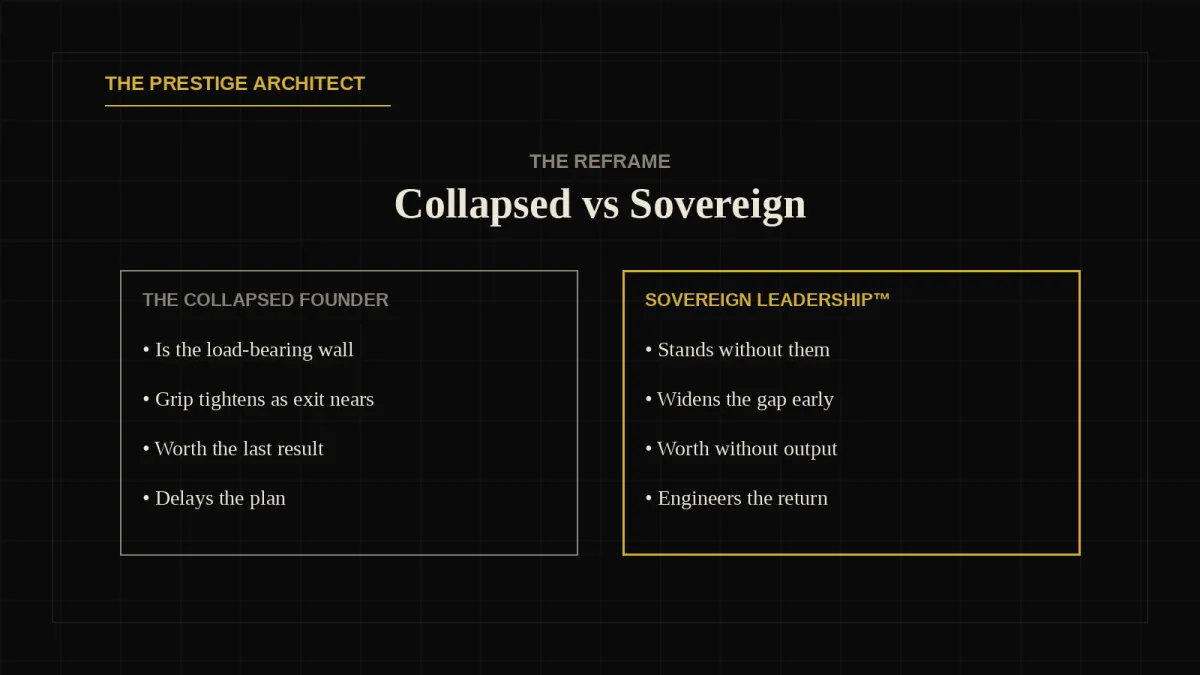
The difference between a leader who collapses and one who stays sovereign is how each reads the edge.
Collapsed: reads the snap as a flaw. Sovereign: reads the snap as a signal.
Collapsed: suppresses the edge and hides the data. Sovereign: decodes the edge and restores the reserve.
Collapsed: relies on willpower at 4pm. Sovereign: relies on systems built at 9am.
Collapsed: apologizes, then repeats the cycle. Sovereign: re-architects the load that caused it.
Collapsed: protects the image. Sovereign: protects the capacity.
Irritability is not the enemy of composure. It is the last messenger composure keeps ignoring. — Baz Porter®, The Prestige Architect®
You do not need to grip harder. You need to see the reading clearly. The Silent Collapse Diagnostic™ shows you exactly where your capacity is leaking, in about ten minutes.
A case from the room
A founder came to me at forty-nine. Ninety million in revenue. She led with a stillness people admired. In private, she described a new sound in her own voice. A hardness. Her teenager had started leaving the room when she walked in.
She had read it as a moral failure. It was not. It was a capacity deficit with a clear origin. Her calendar held zero recovery. Every hour was extraction. Her regulation account never refilled, so it defaulted to the edge.
We did not work on her patience. We rebuilt her architecture. Recovery blocks became non-negotiable. Decisions were sequenced to protect her sharpest hours. Within a month the edge receded. Not because she tried harder. Because the system stopped draining her dry. Her daughter came back into the room.
The architecture of your return
You will not fix executive irritability with an apology tour. The apology treats the symptom. The load stays. The edge returns next Tuesday. That is not weakness. It is physics.
Your return is structural. We find the hours that deplete you and the ones that restore you. We protect the reserve before it runs out, not after you have already snapped. We rebuild your regulation as a system your leadership can stand on.
The first step is a clear reading. Begin with the Silent Collapse Diagnostic™. It names where your capacity is bleeding and what to rebuild first. Power without collapse is an architecture. We build it.
Questions leaders ask
Is executive irritability the same as being a difficult leader?
No. A difficult leader chooses the edge as a tactic. An irritable leader has lost the reserve that used to hold it. The behavior looks similar. The cause is opposite. One is a strategy. The other is a signal of depletion.
Why am I only irritable at the end of the day?
Self-regulation runs on a finite reserve. Every decision withdraws from it. By late afternoon the account is overdrawn, so small triggers produce large reactions. The timing is a clue, not a coincidence. It points straight at your load design.
Will managing my tone fix it?
Managing tone hides the reading. It does not restore the reserve. You will hold the line until the reserve empties again, then the edge returns. Real recovery is structural. You rebuild the capacity underneath the tone, not the surface above it.
How do I know if this is early Silent Collapse™?
Irritability, numbness, and a widening gap between your outer calm and inner load are the early markers. The Silent Collapse Diagnostic™ gives you a precise reading in minutes. It shows the leak before it becomes a public failure.
Can irritability damage my leadership even if my results are strong?
Yes, and quietly. Your numbers can climb while trust erodes underneath them. A team that braces for the edge stops bringing you hard truth. You lose signal at the exact moment you need it most. The cost lands on the culture long before it reaches the dashboard.
About the author
Baz Porter® is the founder of Baz Porter LLC® and The Prestige Architect®. A British Army veteran and international bestselling author, he guides high-achieving leaders from Silent Collapse™ to Sovereign Leadership™. Power without collapse. Success without self-betrayal. He architects the return that keeps the person and the position both intact.

Words on a page can name it.
The work changes it.
If something you read here landed, if you felt seen in a way you rarely are,
that recognition is data. It means your nervous system already knows what it needs.
The Silent Collapse Diagnostic™ is where we make it precise.
Want the deeper context first? Read the Manifesto to learn more.