
For High-Achieving Women
Who Are Done Being Strangers to Themselves
You've built the empire. The multi-6-figure business. The corner office everyone envies.
But here's what nobody sees...
You're dying inside The 4 AM anxiety attacks. The calendar as armor.
The terrifying question that keeps you awake...
"If I stopped performing... would I disappear?"
Finally Choose Themselves Over Their To-Do Lists
Discover Why 97% of "Successful"
Women Are Secretly Collapsing Yours Free.


Dear Beautiful Soul,
I see you.
Not just your achievements or your carefully curated LinkedIn profile.
I see the woman behind the titles, beyond the metrics, beneath the mask of "having it all together."
I see you at 3AM, when the world is quiet but your mind isn't.
When the questions you can't ask in the boardroom become too loud to ignore.
"Why does achieving everything I wanted feel like losing myself?"
"When did success start feeling this heavy?"
I know this journey intimately.
Not because I'm another coach with strategies and systems (though yes, those matter).
But because I've walked alongside women who dared to question everything they built.
Like Lorraine, who found herself in the darkest place imaginable both personally and professionally.
Today, she's not just surviving; she's reaching heights she "didn't even realize she was looking for."
Her words, not mine:
"What Baz does is life altering. He reached my heart, my soul, and allowed me to come alive again."
Or Angela, who transformed her relationship with power entirely.
She stopped pushing through exhaustion and started leading from authentic presence.
Now her team doesn't just respect her they're inspired by her whole, unfiltered truth.
Then there's Sabrina, who discovered what happens when you stop trying to fit into old leadership models.
"Baz doesn't just offer advice," she shares, "he ignites a fire within. He empowers you to unlock unprecedented potential not just in yourself, but in your entire organization."
This isn't just about executive burnout or stress management.
Those are just symptoms of a deeper truth.
This is about reclaiming your soul in the midst of success.
About remembering who you were before the world told you who to be.
About leading from a place of power that doesn't require perfection.
I've watched women step into boardrooms not with rehearsed speeches, but with unshakeable presence.
I've seen them make million-dollar decisions from a place of inner knowing, not endless analysis.
I've witnessed them build global teams while staying deeply connected to themselves.
Your success got you here.
But your truth will take you further.
You don't need another strategy.
You need permission to lead differently.
To breathe differently.
To succeed differently.
To be differently.
The transformation you're seeking isn't about adding more to your already full plate.
It's about coming home to the woman you've always been beneath the achievements.
Ready to remember who you are beyond the titles?
With deep understanding and unwavering belief in your next chapter,
Baz
P.S. The fact that you're still reading means your soul knows something your schedule hasn't admitted yet.
It's time for real change.
Not the kind that looks good on paper, but the kind that feels true in your bones.

12 week Private Mentorship Program
Strategic Identity Reset
- 6 Private 90-Minute Sessions with Baz Porter
- Comprehensive Identity & Authenticity Assessment
- Success Wound Identification & Healing Protocols
- Authentic Leadership Development Protocols
- 4-Week Post-Program Integration Period
- Custom Identity Reclamation Resources
- Stop waking up at 4 AM wondering if you matter beyond what you produce
- End the exhausting performance that's killing your soul while keeping your success
- Make decisions from your authentic self, not from fear of disappointing others
- Lead without the armor and watch people finally connect with the real you
- Create legacy impact that feeds your soul, not just your bank account
Million Dreams Community
Where High-Achieving Women Transform Together
- Weekly hot seat calls with direct solutions
- Immediate executive strategy planning
- Elite peer accountability
- Direct access to proven frameworks
- Reclaim 10+ hours weekly
- Transform your energy in 30 days
- Build unshakeable leadership presence
- Create impact without exhaustion


Hi I'm Baz...

I know what it's like to look successful on the outside while falling apart on the inside.
My journey from British military veteran to rock bottom taught me the hardest truth, sometimes you have to lose everything to find yourself.
After my own dark night of the soul battling depression, facing homelessness, and questioning everything I discovered something powerful.
Real transformation isn't about pushing harder. It's about coming home to yourself.
Today, I guide high-achieving women from exhaustion to embodied leadership. Featured in Yahoo, CEO Weekly, Women Leaders Magazine, and Digital Journal, my work goes beyond traditional coaching.
Not because I have all the answers, but because I understand the questions that keep you up at 3AM.
This isn't about adding more strategies to your life. It's about remembering who you were before the world told you who to be.
Ready to come home to yourself?
TAKE YOUR FIRST STEP
Begin With Your Private Reset Ritual
Join hundreds of female executives who started their transformation here.
No pressure. No performance. Just presence.
(Start sleeping better in 5 days or less)

How to Be More Self Aware: An Unfiltered Guide for High Achievers
True self-awareness isn't a passive trait you either have or you don't. It's a gritty, hands-on process. It demands a rigorous, radically honest practice of aligning your internal world—your thoughts, your emotions, your nervous system's knee-jerk reactions—with your external actions.
It’s about brutally closing the gap between the leader you think you are and the leader your team actually experiences.
Key Takeaways
Pinpoint Your Awareness Gap: Learn to spot the subtle signals of disconnection—the chasm between your perceived self and your real-world impact—that almost all high-achievers miss.
Understand Your Internal Wiring: We’ll pull back the curtain on the neuroscience behind your emotional blind spots and see how a dysregulated nervous system perpetuates destructive cycles of control and perfectionism.
Implement a Practical Framework: Get your hands on a clear, actionable system (RAMS) to build authentic self-awareness into your leadership and daily life, finally moving from burnout to genuine sovereignty.
Achieve Nervous System Sovereignty: Discover how to regulate your internal state in real-time, allowing you to lead from a place of grounded clarity instead of primal reaction.
The High Achiever's Dangerous Blind Spot
For most high-achieving women I work with, success is their native language. You hit the targets. You lead the teams. You build the empires.
But behind the closed doors of your own mind, a different conversation is happening. It’s that quiet, persistent whisper that says, “If I stop performing for one second, I will cease to exist.” This is what I call the silent collapse—an internal state of profound disconnection and hollowness, even as the outside world showers you with accolades.
Your self-worth gets dangerously tangled up with your output, creating a massive blind spot. You're succeeding, but you're not actually connected to the woman who is doing the succeeding.

This feeling isn't just in your head; it’s a well-documented phenomenon. Research from organizational psychologist Dr. Tasha Eurich reveals a staggering disconnect: while 95% of people believe they are self-aware, only a tiny 10-15% actually are.
Why such a massive gap? Our brains are hardwired with natural blind spots. We judge ourselves through the filtered lens of our good intentions while completely underestimating how our actions, energy, and unspoken stress are actually landing on others.
The True Cost of Unexamined Success
Becoming more self-aware involves a brutally honest audit of the gap between who you believe you are and how you actually show up under pressure. It requires moving beyond intellectual understanding to an embodied, physiological practice of regulating your internal state to make conscious choices, rather than reacting from outdated survival patterns.
The very same drive that fuels your incredible success can also become the source of your greatest undoing.
When every action is ruthlessly measured by its outcome, you slowly, imperceptibly, lose touch with your internal compass. This almost always leads to a pattern of overcoming perfectionism through sheer force of will—a strategy that is as exhausting as it is unsustainable.
The real cost isn't just burnout. It's the slow-motion erosion of self. You become a walking collection of achievements instead of an integrated, whole person. This guide is about leading you back.
Why Your Brain Keeps You Disconnected
Ever feel like you’re running on a hamster wheel? You're achieving more than ever, yet feeling less connected to it all. This isn't a personal failure. It’s a biological reality.
For high-performing women, the very mental wiring that fuels success often sabotages self-awareness. Your brain, in its relentless drive for achievement and safety, can inadvertently keep you disconnected from your truest self.
Think of your mind as an internal operating system. For many leaders, this system is running on outdated, reactive code written during moments of intense stress from your past. It’s a program built for survival, not sovereignty.
This programming is rooted deeply in your nervous system. The constant pressure, the impossible deadlines, and the weight of performance keep your body locked in a low-grade state of fight-or-flight. This is where your amygdala—the brain's primitive smoke detector—takes over.

The Amygdala Hijack in the Boardroom
An amygdala hijack is what happens when your emotional, primal brain overrides your rational, executive brain. A team member challenges your decision, a project veers off course, or you get a piece of critical feedback, and your nervous system screams threat.
In that instant, you’re not a CEO in a boardroom; you’re a primal human facing down a predator.
What happens next is instantaneous and unconscious:
Your prefrontal cortex, the seat of logic and self-awareness, effectively goes offline.
A flood of adrenaline and cortisol hits your system, priming you for a reaction, not a reflection.
Your perspective narrows dramatically, focusing only on the immediate problem and how to control it.
In this state, genuine self-awareness is impossible. You’re simply falling back on old, deeply ingrained patterns: perfectionism, micromanagement, or maybe emotional withdrawal. You might believe you're being decisive, but your team just experiences you as dismissive. This is how emotional blind spots are born.
This cycle of stress and reaction is more than just a bad day. Globally, 1 in 5 adults face mental health challenges each year. Gallup found that 39% of adults felt worried for a large part of the previous day, with over a third feeling stressed. This emotional turmoil often stems from these exact kinds of unexamined patterns.
From Survival Code to Sovereign Leadership
A dysregulated nervous system doesn't just feel awful; it actively blocks you from learning how to be more self-aware. It traps you in a vicious feedback loop where the solution to stress is to exert more control, which only creates more stress.
The result? A profound sense of burnout and the feeling of being completely unmotivated, even when you’re ticking all the boxes of success.
This is the hidden pattern that leaves so many powerful women feeling hollow. Their internal operating system is built for survival, constantly scanning for threats and optimizing for external validation. To break this cycle and build stronger internal connections, it's crucial to explore metacognitive learning strategies, which are all about developing awareness and control over your own thought processes.
The path forward isn’t about just managing symptoms. It demands a fundamental rewrite of your internal code. This starts by recognizing that the disconnect you feel is a logical outcome of a system under relentless pressure. It’s not a flaw in your character but a feature of a nervous system doing exactly what it was designed to do: protect you. When you can understand these biological drivers, you can finally start to approach your internal world not with judgment, but with empathy and a clear strategy for change.
The RAMS Reframe: A Framework for Embodied Awareness
Knowing your brain is running on autopilot—often using outdated, reactive code—is a massive first step. But let's be honest, awareness without action is just a neat intellectual party trick. It doesn't help you when the pressure is on and your old patterns kick in.
To actually close that gap between knowing and doing, you need a real, repeatable method.
This is exactly why I built the RAMS framework. It’s not some fluffy mindset hack or a quick fix. Think of it as a systematic process for rewriting your internal operating system from the ground up. The goal is to move you from a state of chronic, high-achieving reaction to one of grounded, embodied leadership. I call this sovereignty.
RAMS stands for Results, Attitude, Mastery, and Systems. Each piece builds on the last, creating an integrated practice for leaders who need to see and feel tangible change.
Results: Redefining What It Means to “Win”
For most high-performers, "results" have always been about the external scoreboard: the promotion, the revenue target, the flawless project launch. The RAMS method starts by flipping that definition on its head.
True results are internal. They're about the quality of your presence in a chaotic meeting, the clarity of your decisions under fire, and the stability of your own nervous system when everything outside of you is falling apart.
This isn't about giving up your ambition. Far from it. It’s about anchoring that ambition in something that can’t be taken away from you—your own centeredness. When your primary goal shifts to maintaining internal alignment, the external achievements often follow as a natural byproduct, not something you have to desperately chase.
Experiential Edge: I worked with a COO of a fast-growing tech firm who was completely fixated on hitting quarterly numbers. Her obsession was leading to massive team burnout and her own exhaustion. We shifted her primary "Result" to something new: maintaining a regulated nervous system during high-stakes meetings. Her entire leadership style changed. She became more collaborative, her team felt safer to innovate, and—almost paradoxically—they blew past their financial targets for the next three quarters.
Attitude: Cultivating Radical Self-Honesty
The second pillar is Attitude. This is where the real work begins. It’s about cultivating a stance of radical, unflinching self-honesty—the commitment to see yourself as you actually are, not as you wish you were or think you should be.
This means asking the hard questions most of us would rather avoid:
How do I really show up under pressure? Do I get controlling? Do I shut down and withdraw? Do I start trying to please everyone?
What’s the story I tell myself about my leadership? And how different is that from the feedback I get (or am too afraid to even ask for)?
What feelings am I constantly trying to outrun? What behaviors do I use to numb or bypass that discomfort?
An attitude of radical honesty isn’t about beating yourself up. It’s about compassionate curiosity. It’s having the courage to look at your own patterns without judgment, recognizing they were probably developed for a damn good reason—usually survival. Only from this place of clear seeing can you finally choose to respond differently.
Mastery: Achieving Nervous System Sovereignty
This is the absolute core of the work. Mastery, in the RAMS context, has nothing to do with mastering your market or your team. It’s about achieving sovereignty over your own nervous system.
It’s the very real, physiological ability to stay present and grounded when your amygdala is screaming "THREAT!"
This is a trainable skill, not some innate talent you either have or you don't. Mastery involves practical, body-based techniques to regulate your internal state. You learn to spot the subtle cues of dysregulation—that tightness in your chest, the shallow breathing, a mind that starts racing—and consciously intervene before you get hijacked.
This can look like:
Somatic Grounding: Simple exercises to pull your awareness back into your physical body, like literally feeling your feet on the floor.
Breathwork: Using specific breathing patterns to actively down-regulate the sympathetic (fight-or-flight) nervous system.
The Mindful Pause: Creating just a micro-second of space between a trigger and your reaction. That's often all it takes to let your prefrontal cortex—the thinking part of your brain—come back online.
When you achieve this level of mastery, you are no longer a puppet of your emotional triggers. You can take critical feedback, navigate tough conversations, and lead through uncertainty with a calm, centered presence. You start operating from choice, not compulsion.
Systems: Creating Sustainable Structures for Growth
The final pillar, Systems, is what makes all of this stick. Self-awareness doesn’t last because you went to a weekend retreat. It lasts because you build it into the very architecture of your daily life.
Systems are the deliberate, consistent practices that reinforce your new internal operating code.
And these don’t have to be complicated, time-sucking rituals. They should be simple, high-leverage actions you integrate into your existing schedule.
A Five-Minute Morning Check-In: Before you even glance at your phone, you take five minutes to scan your body and just notice your internal state. No judgment, just noticing.
A Post-Meeting Debrief: After a tense meeting, you take two minutes to reflect. Not on what was said, but on how your body reacted during the conversation.
A Weekly Self-Honesty Journal: You spend 15 minutes each week answering those tough questions about your attitude and actions.
These systems create the essential feedback loop. They provide the structure for your Attitude of honesty and the consistent practice required for Mastery. Without systems, even your best intentions will get swallowed whole by the urgency of your calendar. This integrated approach is what makes The RAMS Method's unique leadership framework so effective—the change is both deep and durable.
This isn’t just about a different way of thinking; it's a fundamentally different way of being. The table below breaks down the shift that happens when you move from the default high-achiever mode to a RAMS-informed sovereign state.
Reactive State vs Sovereign State: A Comparison of Operating Modes
AttributeReactive State (The High-Achiever's Default)Sovereign State (The Self-Aware Leader)FocusExternal outcomes and validation.Internal state and alignment.Decision-MakingDriven by urgency, fear, and a need to control.Driven by clarity, intuition, and core values.Response to StressAmygdala hijack; defaults to old survival patterns.Regulates nervous system; consciously chooses a response.FeedbackPerceived as a personal threat or criticism.Seen as valuable data for growth and learning.Energy SourceAdrenaline, cortisol, and sheer willpower.Grounded presence and sustainable, renewable energy.Leadership StyleDirective, controlling, and often micromanaging.Collaborative, empowering, and trust-based.
As you can see, the change is profound. RAMS provides the scaffold to build this new way of being, one deliberate, honest, and systematic step at a time.
Putting Self Awareness Into Practice Daily
Knowing about the RAMS framework is one thing. Actually weaving it into the fabric of your life? That's where real sovereignty is forged. The most critical step in learning how to be more self-aware is moving from an intellectual concept to an embodied practice.
This isn’t about piling more overwhelming tasks onto your plate. It's about integrating small, potent actions that create profound shifts over time.
What follows is a clear implementation guide—not theoretical exercises, but practical tools designed for the reality of a high-achieving leader. We'll break down how to weave the principles of Results, Attitude, Mastery, and Systems into your daily and weekly rhythm.
The RAMS framework gives you a structured path to do this, moving you from defining your internal state to mastering your reactions and building systems that last.
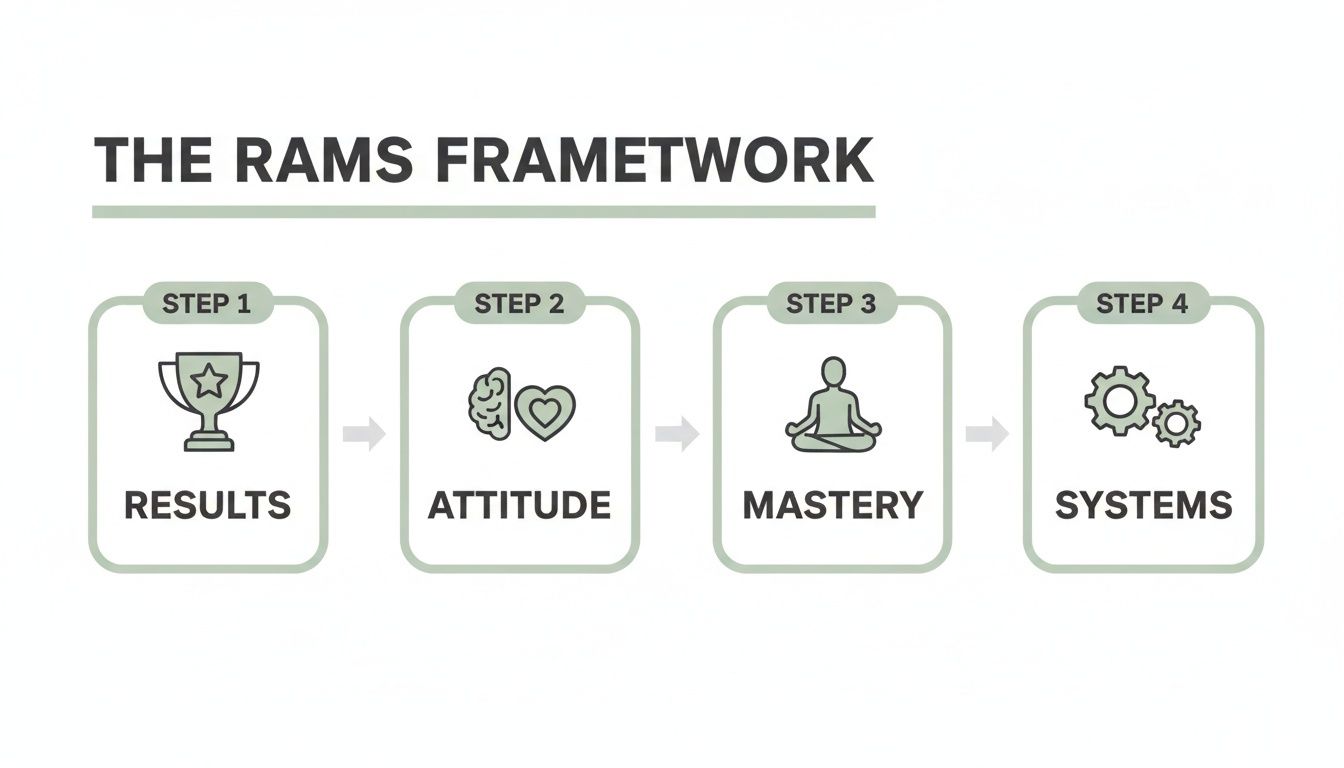
This visual flow shows how each component builds on the last, creating a reinforcing cycle of awareness and action that leads to lasting change.
The Daily 5-Minute Nervous System Check-In
Your day probably starts with a mad dash—emails, strategic plans, the immediate needs of your team. The most powerful act of self-awareness you can practice is to claim the first five minutes for yourself. Before the phone, before the chaos, commit to this simple check-in.
Find a quiet space: Just sit comfortably, feet flat on the floor.
Scan your body: Close your eyes and bring your focus inward. Notice the tension. Is your jaw clenched? Are your shoulders creeping up toward your ears? Is there a knot in your stomach?
Name the sensation: Without judgment, just label what you feel. "Tension in my neck." "Shallow breathing." This simple act of naming creates a sliver of space between you and the physical reaction.
Breathe into it: Take three slow, deep breaths. Imagine the breath traveling to that area of tension and loosening its grip.
This isn't meditation; it’s data collection. You're gathering real-time intelligence on your internal state before the day's pressures start messing with the signal. This simple practice builds the foundation for nervous system Mastery, one morning at a time.
The Weekly 360-Degree Feedback Ritual
High-achievers often build an armor of competence that makes them deflect feedback. But true self-awareness requires punching a few holes in that armor. A weekly feedback ritual is your structured way to gather honest insights and cultivate an Attitude of radical self-honesty.
This doesn't have to be some formal, HR-led review process. It’s about creating small, consistent opportunities for genuine reflection.
Choose One Interaction: Pinpoint a single significant meeting or conversation from the past week.
Ask One Direct Question: Go to a trusted colleague who was there and ask something specific and non-defensive. Try this: "During the budget meeting on Tuesday, what was one thing I could have done to make that discussion more productive?"
Listen and Document: Your only job is to listen. Don't defend, don't explain, and don't justify. Just receive the information as data and write it down later.
This will probably feel incredibly vulnerable at first. That discomfort is a sign you’re stretching beyond your blind spots. To really put this into practice and elevate your interactions, look at how you can build emotional intelligence as a core leadership skill.
The Monthly Self-Review and Overcoming Hurdles
While daily check-ins and weekly feedback give you immediate data, a monthly self-review helps you zoom out to see the bigger picture and track your progress. This is the "Systems" part of RAMS in action, creating a reliable structure for sustained growth.
Set aside 30 minutes at the end of each month to reflect on these questions:
Pattern Recognition: What recurring emotional triggers or reactions did I notice this month?
Feedback Integration: What key themes emerged from the feedback I received?
Progress Mapping: Where did I successfully regulate my nervous system instead of just reacting?
Course Correction: What is one small adjustment I can make to my daily practices for next month?
Of course, this journey isn't without its hurdles. The two most common are a deep-seated resistance to feedback and the raw discomfort of confronting your own difficult emotions.
When Feedback Stings: The impulse is to discredit the source. Don't. Instead, get curious. Ask yourself: *"What part of this, even if it's only 1%, might be true?"* Let the data sit with you for 24 hours before you form a conclusion.
When Emotions Surface: The high-achiever’s instinct is to suppress or "power through" uncomfortable feelings. The self-aware leader learns to sit with them. Acknowledge the feeling without needing to immediately fix it. Just name it: "This is anxiety." "This is frustration." This simple act reduces its power over you.
Through these consistent, practical applications of the RAMS framework, you aren't just learning about yourself; you are actively rewriting your internal operating system for a more grounded, effective, and sovereign way of leading.
Reclaim Your Personal and Professional Power
The journey we've just taken—from spotting your own awareness gap to seeing how a framework like RAMS can bridge it—is a profound one. It's a deliberate and courageous process of finally turning your focus inward.
It all started by acknowledging that silent collapse. That frustrating, isolating chasm between the success everyone else sees and the emptiness you feel on the inside.
From there, we pulled back the curtain on the hidden neurological patterns that keep so many high-achievers like you stuck. Trapped in endless cycles of stress and reaction. Simply understanding this is the first real step toward self-compassion and a genuine commitment to doing things differently. It's about finally seeing that your patterns aren't personal failures; they're just outdated survival strategies that no longer serve you.
The RAMS framework then gave you the scaffolding to build a new way of operating. By redefining your Results, cultivating an Attitude of radical honesty, achieving Mastery over your nervous system, and building sustainable Systems, you’re creating an integrated, embodied practice of leadership.
The Return to Wholeness
Let's be clear: this work isn't about adding another "to-do" to your already overflowing plate. It’s about subtraction.
It’s about peeling back the layers of conditioning, shedding the heavy armor of perfectionism, and letting go of that relentless drive for external validation that has kept you from your true self.
Learning to be genuinely self-aware is the ultimate act of leadership and self-respect. It’s the process of reclaiming your energy, your clarity, and your very presence. It’s about returning to a state of wholeness where your ambition is fueled by purpose, not fear, and your actions are in perfect alignment with your core values.
This is what nervous system sovereignty feels like. It’s the ability to navigate immense pressure without losing yourself in the storm. It’s the quiet, unshakable confidence that comes from knowing you can handle whatever comes your way because you are anchored in your own centered presence.
This shift from a reactive state to a sovereign one isn’t just a minor tweak in your behavior. It’s a fundamental upgrade to your internal operating system. It allows you to lead with an authenticity that inspires deep trust and creates true psychological safety for your teams, unlocking innovation and genuine collaboration.
Your Next Logical Step
You've now seen the real cost of disconnection and the clear path toward a more integrated, powerful way of leading. But this journey doesn't end after reading an article. It begins with a decision—a commitment to move from intellectual understanding to embodied practice.
This isn't a sales pitch. It’s an invitation to take the next logical step in your evolution as a leader. It's a call to return to yourself.
If the concepts we've explored here resonate with the leader you know you are meant to be, then the real work is simply to begin. A critical part of this journey involves consciously resetting your mindset to support this new, more authentic way of operating.
True power isn't found in controlling the world around you. It’s found in the mastery of your internal world. When you reclaim that, you become unstoppable—not just in your career, but in every aspect of your life. This is the foundation of a legacy built on wholeness, impact, and unshakable self-respect.
Common Questions on the Path to Self-Awareness
Stepping onto the path of real self-awareness always kicks up a few questions and, let's be honest, a few hurdles. I’ve heard them all from leaders just like you. Here are some straight answers to the most common ones that come up as you begin this work.
How Long Does This Actually Take?
There’s no finish line here. True self-awareness isn't a destination you arrive at; it's a practice you commit to for the long haul.
That said, you can absolutely feel a significant shift in how you feel and how you show up in the first 30 to 60 days of consistent practice. The key word there is consistent. A five-minute daily check-in, done every single day, is infinitely more powerful than a two-hour deep dive you do once a month. The goal is to build the muscle of self-observation, and just like any other kind of training, it's the reps that build lasting strength.
What’s the Hardest Part of This Journey?
For most high-achievers I work with, the toughest moment is confronting the gap between their intentions and their actual impact. It's that raw, gut-punch of a moment when you get feedback that your well-intentioned actions landed as controlling, dismissive, or even aggressive.
Your nervous system is almost guaranteed to read that as a threat and fire up your defenses. The real work—the hard work—is learning to stay present with that discomfort without immediately jumping to justify your actions or explain what you "really meant."
Experiential Insight: That initial sting of honest feedback is a signal flare showing you exactly where a blind spot is. Your ability to just sit with that feeling, get curious instead of defensive, and find even the 1% of truth in what you heard is the single greatest accelerator for your growth.
How Do I Handle Tough Feedback From My Team?
Learning to receive feedback gracefully is a non-negotiable skill for a self-aware leader. When you get hit with critical input, your first instinct will probably be to explain your logic or defend your position. Don't.
Instead, try this:
Listen to Understand: Give the person your complete, undivided attention. Don't interrupt, don't formulate your response while they're talking. Just listen.
Clarify, Don't Argue: Your goal is to understand their world, not win the point. Ask questions like, "Can you tell me more about what that was like for you?" or "Help me understand the impact that had."
Acknowledge Their Courage: You don't have to agree with every detail, but you absolutely must acknowledge the risk they took to speak up. A simple, "Thank you for trusting me with this feedback," can completely change the dynamic of the conversation.
This isn't about being passive; it's about being powerful. This approach builds the psychological safety your team craves and turns a potentially volatile moment into a profound opportunity for connection and real growth.
This journey back to yourself is the most important work any leader can do. At Baz Porter, we provide the frameworks and unflinching support to make that journey not just possible, but transformative.
If you’re ready to shift from reactive burnout to a state of embodied, sovereign leadership, let's explore how we can guide you.
Find your path to sovereign leadership at https://bazporter.com.

Voted number #1 for Leadership by the Best of the Best 2024. Real growth for High performing women who love life & demand more.
⭐⭐⭐⭐⭐
1630 30th Street Ste A - 418
Boulder Colorado 80301
United States
Phone: +1-646-212-4807
CUSTOMER CARE
NEWS
LEGAL


© 2019 - 2025 | Baz Porter LLC. All rights reserved.
Protected by all the possible laws. If you wanna try and copy it. We are gonna come after you. Liam Neeson Style.
Terms Of Use | Privacy Policy | Disclaimer