Beyond Burnout: Why Women Business Coaches Are a Strategic Imperative
You've built the empire. You shattered the ceilings, collected the accolades, and rewrote the rules in industries not built for you. From the outside, you are the picture of success.
So why does it feel like you’re one missed deadline from it all crashing down?
This is the “Silent Collapse”—that private moment when peak performance sours into high-functioning burnout. It’s the paradox of the powerful woman: you’ve won the game, but feel like you’re losing yourself. You're a master at managing external chaos by completely ignoring the internal cost.
Key Takeaways
Your Burnout is Systemic, Not a Personal Flaw: The exhaustion you feel is the predictable cost of operating at an elite level within systems that reward masculine-coded leadership and tax your nervous system.
Vetting is Non-Negotiable: You will learn to see past generic "empowerment" fluff and identify coaches with proven, embodied methodologies that address the physiological roots of burnout, not just business strategy.
Embodied Leadership is the Only Sustainable Path: Frameworks like the RAMS Method are designed to create lasting success that doesn’t demand your soul as payment by focusing on nervous system regulation first.
The True ROI is Sovereignty: The ultimate return on this investment is reclaiming your energy, your time, and your purpose—building a legacy that is both powerful and authentic to you.
A specialized woman business coach provides an embodied approach that addresses the root of the problem: the nervous system dysregulation and profound isolation that come from thriving in systems built on a masculine blueprint. It's not about more strategy; it's about reclaiming your power from the inside out.

The Hidden Pattern: The Neuroscience of the Silent Collapse
The story is brutally familiar. You’re at the top of your game, celebrated for your grit and relentless drive. Your calendar is a monument to your own capability, a back-to-back gauntlet of board meetings and strategic imperatives. You have the title, the income, the influence—everything you bled for.
And yet, a quiet, corrosive monologue runs on a loop in the back of your mind.
"I've hit every target I ever set. Why do I feel like I’m running on fumes?"
"If I let my foot off the gas for one second, will this whole thing just disintegrate?"
"I’ve never felt more alone, especially when I’m in a room full of people."
This is the internal dialogue of the Silent Collapse. It’s not a dramatic, public flameout. It’s a slow, internal erosion—the grim reality of being outwardly successful while waging a war against your own nervous system. You've become a fortress of capability, perfectly defended on the outside but crumbling from within.
Caught in the Success Dysregulation Trap
High-achievers are uniquely vulnerable to this. The very drive that fueled your rise becomes a weapon turned against you. You’ve conditioned yourself to override your body’s signals for rest, treating them as weaknesses to be crushed rather than vital intelligence to be honored.
This is a phenomenon I call success dysregulation. It’s a state where the very act of achieving creates a self-perpetuating cycle of stress, disconnection, and adrenal fatigue. Your nervous system is stuck in a state of high alert. The adrenaline that once felt like rocket fuel now just feels like anxiety. You can learn more about the specifics of success dysregulation here.
The paradox of the high-achieving woman is that the armor she needed to win the war becomes a cage, trapping her from the peace she's earned.
This isn’t a personal failing. It is the predictable outcome of succeeding within systems that reward constant output and masculine-coded leadership traits. The "hustle and grind" dogma taught you to build a magnificent external empire while the foundation of your own well-being crumbled. What you need is a fundamentally different approach—one that targets the root cause: a dysregulated system that has forgotten how to come back to baseline.
A Market Responds: The Rise of Female-Led Coaching
The world of executive coaching is no longer a boys' club. What we're seeing isn't just a trend; it's a fundamental reshaping of an entire industry, driven by women leaders demanding more than a playbook built on a masculine blueprint.
This isn't a subtle shift. It’s a groundswell. And the numbers tell a story that's impossible to ignore.
A stunning 72% of all coaches worldwide are women, according to the 2023 ICF Global Coaching Study. They are the driving force behind a professional and business coaching market projected to reach $40.38 billion by 2032.
For too long, the default coaching model was designed by men, for men. It was all about more aggression, more strategy, more "pushing through." For high-achieving women, this approach isn't just ineffective—it's actively destructive. It reinforces the very patterns of over-functioning that lead directly to the "Silent Collapse."
The rise of female-led coaching is a direct market response to a need that has been systematically ignored. Women business coaches, especially those trained in embodied methodologies, don't just bring a different perspective; they bring a lived understanding of the unique pressures you face:
The Double Bind: The constant tightrope walk between being assertive versus "aggressive."
The Emotional Load: The invisible work of managing team dynamics that almost always falls on female leaders.
The Systemic Hurdles: Trying to thrive in environments that were never designed for a woman's nervous system.
This shared context is the foundation for the immediate psychological safety and trust often missing in traditional coaching. This chart from Grant Thornton's "Women in Business 2023" report visually confirms the growing wave of women stepping into senior leadership.
As more women claim their power, the demand for support that truly resonates skyrockets. Hiring a woman business coach is not a "soft" decision. It’s a strategic weapon. For the women building coaching practices to meet this demand, learning how to build an online presence that actually works becomes a non-negotiable part of the mission. If you're ready to explore this path, our guide on the top female executive coaches is an excellent place to start.
How to Vet a Women's Business Coach: The Shift from Cheerleader to Architect
Choosing a coach isn't about finding a cheerleader. It's about sourcing a strategic partner for your evolution. You're past needing surface-level advice. You need someone with a concrete framework for building sustainable, embodied leadership.
This decision demands a vetting process that cuts through the noise of impressive testimonials and gets to the core of what matters: methodology, credentials that actually count, and the coach's proven ability to guide you through nervous system regulation—not just another strategic plan.

Credentials Beyond the Certificate
A coaching certificate is the bare minimum. True expertise shows up in lived experience, a clearly articulated methodology, and a track record of repeatable, documented outcomes.
You need a coach who can speak fluently about the neuroscience of burnout and the physiology of high performance. This is non-negotiable. A coach offering strategic frameworks without addressing the nervous system patterns driving your burnout is just giving you a faster car with a failing engine. An effective coach has also thought deeply about how they facilitate transformation, often having a background in instructional design principles because they're obsessed with creating programs that actually work.
Vetting the Methodology: The Core of Transformation
This is where you separate the strategists from the true architects of transformation. Your problem isn't a lack of strategy; you're brilliant at that. The breakdown is in the system that's supposed to execute it—you. The coach's methodology must prioritize repairing that system first.
Ask brutally direct questions:
"What is your specific framework for moving a leader from burnout back to sustainable performance?"
"How do you integrate nervous system regulation into your business coaching?"
"Walk me through a case study of a client who had 'success dysregulation.' What was the process and what was the outcome?"
A powerful coach won't just hand you a map. They teach you how to recalibrate your internal compass so you can navigate any terrain, even when they're not there.
The table below compares the old way of coaching with the new, embodied paradigm.
Evaluating Coach Methodologies: A Comparison
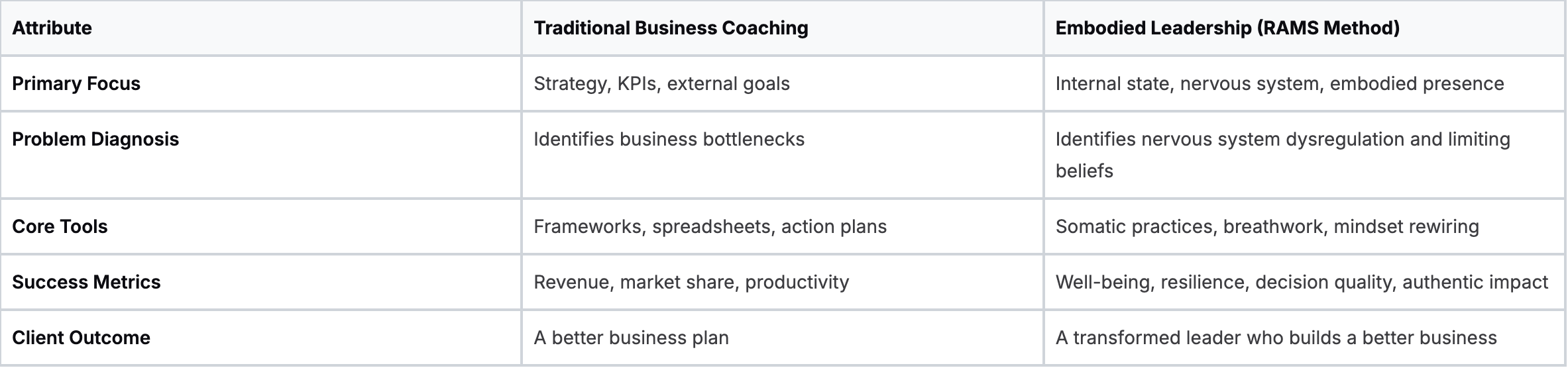
This comparison makes it clear: if you’re looking for more than just another playbook, you need a methodology that works from the inside out.
Questions That Reveal True Fit
Your consultation calls are not sales pitches; they are diagnostic sessions. Your questions need to slice through the polish and get to the heart of their practice.
Instead of asking: "What results can I expect?"
Ask this: "How do you help clients redefine 'results' to include well-being and personal sovereignty, not just financial KPIs?"
Instead of asking: "What's your process?"
Ask this: "My biggest challenge is the feeling of being 'always on.' What's the very first step your methodology takes to address this at a physiological level?"
Instead of asking: "Are you certified?"
Ask this: "What is your personal and professional experience with the specific pressures high-achieving women face in male-dominated industries?"
These questions force a real conversation. They reveal a coach's depth and whether they truly understand the unique intersection of ambition and exhaustion that defines your reality. Our extended guide offers even more insights on finding the right coaches for women leaders. Make your choice a deliberate one.
The Solution: The RAMS Reframe from Burnout to Embodied Power
You don't need another lecture on hustle. You need a system that generates sustainable power from within. That system is the RAMS Method—a framework I developed for high-achieving women caught in the "Silent Collapse." This isn't about pushing harder. It’s about leading from a place of deep, internal regulation, rebuilding your foundation across four critical pillars.

Results: Redefined and Reclaimed
In RAMS, Results are defined as hitting ambitious goals while enhancing your well-being, not in spite of it. This isn't about lowering your standards; it's about surgical precision with your energy. You learn to pinpoint the 20% of efforts that drive 80% of your impact, giving you permission to drop the draining busywork that fuels your exhaustion.
Attitude: From Self-Criticism to Self-Sovereignty
The internal monologue of a high-achieving woman can be a brutal battleground. The Attitude pillar is about systematically dismantling that inner critic and installing an unshakeable sense of self-sovereignty. This is deep work to rewire the belief that your worth is tied to your productivity, allowing you to make decisions from core values, not fear.
Mastery: Of Your Nervous System
This is the core of the RAMS Method and what makes it different. Mastery here isn't about your market; it's about your own physiology. You cannot lead effectively from a state of chronic fight-or-flight. Here, you learn practical, somatic tools to regulate your nervous system in real-time.
Strategic Breathwork: Down-regulating anxiety before a high-stakes meeting.
Somatic Awareness: Recognizing and discharging stress held in the body.
Physiological Resets: Pulling yourself out of the "freeze" response when overwhelm hits.
When you master your internal state, you stop being a reactor to external pressure. You become the one who sets the tone. This is the bedrock of embodied leadership.
Systems: For Sustainable Support
No leader thrives in a vacuum. The final pillar, Systems, is about engineering your life to support your well-being, not drain it. We audit and rebuild the structures for restoration.
Boundary Systems: Implementing non-negotiable rules around your time and energy.
Delegation Systems: Moving from "doing" to "leading" by truly empowering your team.
Recovery Systems: Scheduling and honoring real rest as a strategic imperative.
RAMS Case Study: The CMO Who Reclaimed Her Power
A Chief Marketing Officer at a fast-growing tech firm came to us at her breaking point. She was a rockstar, celebrated for her results, but privately battling panic attacks and insomnia.
We started with Mastery, giving her immediate tools to regulate her nervous system. Then, we rebuilt her Attitude, dismantling the belief that "always on" meant valuable. Finally, we implemented Systems for delegation and firm boundaries.
The Result: Within six months, she not only blew past her KPIs but took her first two-week vacation in five years—without checking her email once. She was leading with more impact and far less effort.
The RAMS Method is a complete overhaul of the operating system that has been driving you toward burnout. It’s the path back to leading as your most powerful, authentic self. To see how this framework demolishes traditional models, you can learn more about the RAMS Method in our detailed article.
Your Questions About Women Business Coaches Answered
Choosing a partner for your next level of growth is a critical decision. Smart women ask tough questions. Here are the answers you need to move from consideration to confident commitment.
What Is The Typical Cost And Engagement Model?
Let's be direct. High-caliber, executive-level coaching is a significant investment. For deep partnership that creates real transformation, anticipate retainers from $2,500 to over $10,000 per month. Most serious engagements require a commitment of six to twelve months. Why? Because dismantling a lifetime of programming and embedding new, regulated ways of leading doesn’t happen in a weekend seminar. Be cautious of anyone selling single sessions as a solution to deep-seated patterns. True transformation requires sustained partnership.
How Do I Measure The ROI Beyond Financial Metrics?
The industry loves to quote impressive financial returns like a 7-to-1 ROI (according to an ICF study). That’s great, but for a woman leader on the verge of burnout, the real metric is reclaimed sovereignty. What does that actually look like?
Reclaimed Time: Hours back each week from strategic trust and delegation.
Nervous System Regulation: The value of sleeping through the night and entering a negotiation with calm, centered power.
Decision Quality: The potency of leadership when every choice comes from deep clarity, not adrenal fatigue.
The most profound ROI isn't just a healthier bottom line; it's the end of the war with yourself. It's leading your company and your life with an authority that feels as good as it looks on paper.
Red Flag: High-Pressure Sales and Scarcity Tactics
Your first conversation with a potential coach should feel like a strategic diagnostic, not a sales pitch. A confident coach gives you space to decide. Be wary of manipulative tactics:
Extreme Urgency: "This price is only available if you sign up on this call."
False Scarcity: "I only have one spot left and five other people are interested."
Emotional Manipulation: Making you feel that not signing up is a sign of self-sabotage.
These are classic manipulation tactics. An authentic coach trusts that the right clients will recognize the value without being coerced. You can learn more about separating genuine guidance from sales-driven spin by exploring the truth about business growth consulting.
What's The Difference Between a Coach, a Therapist, and a Mentor?
These roles are not interchangeable. Getting the right support requires understanding their distinct functions.
Therapy looks backward to heal, processing past trauma and treating mental health conditions.
Mentorship looks to a similar path, where a mentor shares their specific map and experiences.
Coaching—especially embodied coaching—is relentlessly forward-focused. It's about creating new capabilities, regulating your system for high performance, and holding you accountable to your highest potential.
A coach is your strategic partner for evolution. A therapist is a healer for your history. A mentor is a guide for your path.
The Return to Yourself
You've built your success on making smart, decisive choices. Choosing your next guide is no different. This isn't about adding another strategy to your over-full plate. It’s about a radical return to the source of your true power: a regulated nervous system and an unwavering sense of self.
At Baz Porter, we architect leadership that is both powerful and sustainable, moving you from the silent collapse of burnout to the sovereign self you were always meant to be.
If you are ready to stop running on fumes and start leading from a place of deep, embodied power, the next step is not a sale. It is a return to yourself. Book your diagnostic call today and begin.