Why You Doubt Yourself as a Leader
Why You Doubt Yourself as a Leader
You made the call before. You would not make it now. You read the same email five times and still cannot send it. This is self-doubt, and if you lead anything, it has found you.
You have decided you are the problem. You are not. What you feel has a name. It is called Silent Collapse™, the quiet state where a strong performer keeps working while trust in themselves drains out. I lay out the whole case for this in the manifesto.
By Baz Porter®
What This Article Covers
Key Takeaways
Self-doubt is a state signal, not proof you are failing.
The most capable people doubt the most. That is a known effect.
Doubt spikes when the role that defined you shifts.
You do not think your way out. You rebuild your way out.
A short, honest read of your state ends the loop faster than more effort.
The Short Answer
Here is the short answer. You doubt yourself because the ground you stood on moved. The role, the win, the title that told you who you were has shifted. Your worth was quietly built on it. Now it wobbles, and so do you. This is not a skills problem. It is an identity problem wearing a skills mask. You will try to fix it with more preparation. The doubt will come back next week anyway. You are not the first strong leader to feel this. It arrives most often right after a season of success, not failure. That timing is the tell. Fix the mask and the doubt returns. Rebuild the ground and it goes for good.
The Hidden Pattern Under Self-Doubt
There is a pattern here that almost no one names. The people who doubt themselves the most are usually the most capable. Kruger and Dunning proved this in 1999. In study after study, skilled people underrated their own work. Unskilled people overrated theirs. The same skill that makes you good lets you see your own gaps. In plain terms, the sharper you are about the work, the clearer you see what you have not mastered yet. So the doubt you feel is often a marker of competence, not a lack of it.
There is a second layer, and it matters more. Self-doubt spikes at a turning point. A leadership piece in Forbes named it plainly. Doubt is normal, and it rises most when the stakes and the change are highest. You did not get worse. Your ground moved. A promotion, an exit, a loss, a new season. When the thing that made you special starts to fade, the mind reads it as danger. It turns the alarm on you. That is the hidden pattern. Your doubt is not a verdict on your worth. It is an alarm about a shift.
The Five-Pillar Way Back
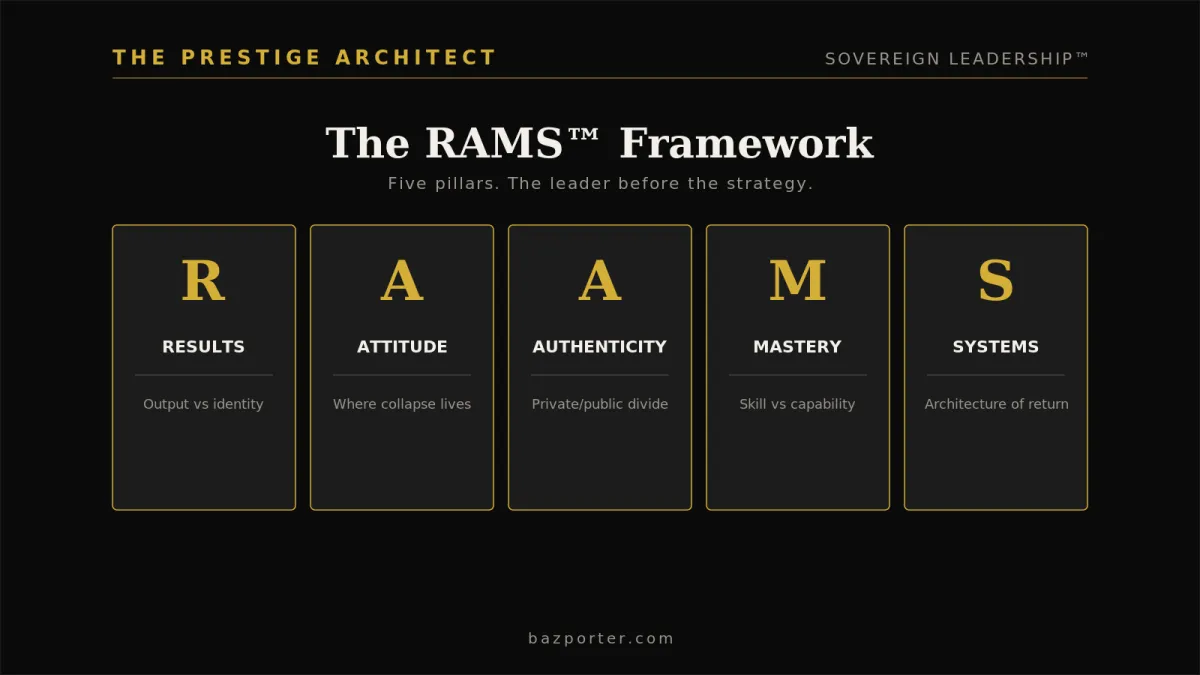
The way back runs through five pillars. I call the system RAMS™. It stands for Results, Attitude, Authenticity, Mastery, Systems. It works on the business and the nervous system at the same time.
Results. Stop grading your worth on how you feel. Grade it on outcomes you can point to. Feelings lie under pressure. Results do not. One clean, finished result quiets doubt faster than an hour of thinking about it.
Attitude. Your state runs your output, not the reverse. Doubt is not truth. It is weather moving through. You can feel it and still act well. Name it as weather, then take the next right action anyway.
Authenticity. This is the pillar that ends the doubt. You doubt because you are performing a self that is not yours. The performance is tiring, and part of you knows it is not real. Come home to the real one. The doubt was only ever guarding a mask.
Mastery. Doubt shrinks when proof stacks up. So build proof in inches, not leaps. Small, clean reps, finished and counted. Competence you can see is the quietest cure there is.
Systems. Do not hand the decision to your mood. Build a rule and follow the rule. A decided rule beats a shaky feeling every time. The system carries you on the days the confidence does not.
Here is the split I see in every client.
Collapsed vs Sovereign:
Collapsed waits to feel sure. Sovereign moves, and the sureness follows.
Collapsed treats doubt as a verdict. Sovereign treats it as data.
Collapsed defends a borrowed self. Sovereign returns to the real one.
Collapsed second-guesses in private. Sovereign decides and moves on.
Power Without Performance. Peace Without Retreat.™
If you cannot tell which side you are on, that is the exact reason to look. The free Silent Collapse Diagnostic™ shows you your real state in one honest read.
One Leader Who Stopped Doubting
One client ran a real company. They sat across from me and said it straight. They no longer trusted a single decision they made. Every call felt like a coin toss. They called it a confidence problem and asked me to fix the confidence. It was not a confidence problem. It was Silent Collapse™. We did not add confidence. We found the mask their worth was pinned to, and we took it off. Within weeks the second-guessing eased. The doubt did not leave because they got braver. It left because it had nothing left to guard.
The Architecture of Your Return
Your return is not a pep talk, and it is not more willpower. It is an architecture. You rebuild the ground your worth stands on, and the doubt loses its job. You do not need a new personality. You need the real one back, with the ground rebuilt underneath it. That is slower than a slogan and far more durable. That work has a first move, and it is small. It begins with naming the state you are actually in, without spin. Take the free Silent Collapse Diagnostic™. It is the first step of the return.
Questions Leaders Ask
Why do I doubt myself as a leader?
You doubt yourself because leadership raised the stakes and moved your ground. Every call now lands on other people. Your mind reads that weight as risk and turns the alarm inward. It feels like a flaw. It is a signal about a shift, not a verdict on your ability.
Is self-doubt a sign of weakness?
No. Research shows the most capable people often doubt the most, while the least capable doubt the least. Doubt can push you to prepare, listen, and grow. The weakness is not the doubt. It is letting the doubt make your decisions for you. Read it, then act anyway.
How do I stop doubting myself at work?
You do not think your way out. You act your way out. Name the state first. You cannot rebuild what you will not look at. Then make one small, clean decision and finish it. Proof stacks up and doubt shrinks. Underneath, rebuild the ground your worth stands on so the doubt has nothing to feed on.
What is the difference between self-doubt and imposter feelings?
Self-doubt questions a specific choice or ability. The imposter feeling says the whole success was a fluke and you will be found out. They often travel together. Both ease when your worth stops depending on the next win and starts standing on who you are.
Can self-doubt ever be useful?
Yes. In small doses it keeps you humble and open to feedback. It guards you against overconfidence, which is the more dangerous state. The goal is not to erase doubt. The goal is to keep it as a quiet advisor, not the voice that runs the room.
About the Author
Baz Porter® is the founder of Baz Porter LLC® and The Prestige Architect™. He guides high achievers from Silent Collapse™ to Sovereign Leadership™. Power without collapse. Success without self-betrayal.