Why You Can't Ask for Help When You're Drowning
You are drowning. And you still will not ask for help.
You tell yourself it is fine. You tell everyone it is fine. Inside, the water is at your chin.
This is the Silent Collapse™. It is the felt state of the leader who carries everyone. You became the one they lean on. Now you cannot lean on anyone. The manifesto starts here, with the feeling you keep hiding.
By Baz Porter®, The Prestige Architect™.
On this page
Key takeaways
Not asking for help is not strength. It is a learned reflex.
You protect your image of competence. The cost is your health.
People say yes far more often than you predict.
Asking is a skill. You can rebuild it in small steps.
Being held does not make you less. It makes you whole.
Why you cannot ask for help even when you are drowning
You cannot ask because asking feels like exposure. Somewhere, you learned that need is danger. You learned that being useful is how you stay safe and loved. So you hide the need. You carry more. You call it being the strong one. The real fear is quieter. If you ask, you might learn you were only wanted for what you do. That fear runs the whole machine. The way out is not to carry smarter. It is to let yourself be held, on purpose, before you break.
The hidden pattern under the strong one
The pattern is old. It is not about this week. It started long before the title.
You were praised for coping. You were the reliable child, or the one who held the room. Need got you very little. Competence got you love. So you built a self out of output.
Research names this clearly. Fiona Lee studied help-seeking at work. In her 1997 paper in Organizational Behavior and Human Decision Processes, people avoided asking for help to protect how competent they looked. The more they cared about status, the less they asked. Asking felt like admitting a flaw.
You know this feeling in your body. You would rather stay late than say you are stuck. You would rather bleed quietly than look like you are failing. The hidden pattern is not weakness. It is a survival rule that outlived its use. This is the self the manifesto was written for.
The RAMS reframe: from carrying to being carried
RAMS™ is how I rebuild a leader from the inside. It runs across five pillars. Here is the cannot-ask self, seen through each one.
Results
You think asking slows results. The opposite is true. A drowning leader makes slow, foggy calls. Help restores your judgment. Results come from a clear mind, not a martyr.
Attitude
You treat need as shameful. Shift the frame. Need is information. It tells you where the load is too heavy. Read it like a dashboard light.
Authenticity
Here is the deepest wound. You hide the need to stay acceptable. But a self that cannot be seen is a self alone. Authenticity means letting people meet the real you, including the tired part. That is where real closeness lives.
Mastery
Asking is a skill, not a collapse of standards. Most of us misjudge it badly. Vanessa Bohns, in a 2016 review in Current Directions in Psychological Science, found that people underestimate how willing others are to help. We brace for no. We get yes. You have run on a false forecast for years.
Systems
One person cannot be the only load-bearing wall. That is a design flaw, not a virtue. A sound system spreads the weight. Build one that holds you too. Name your load-bearing points. Put a second person on each. A wall with no backup is a risk, not a strength. Redundancy is care, not weakness.
Collapsed versus Sovereign. The difference is not effort. It is structure.
Collapsed hides the need. Sovereign names it early.
Collapsed waits until breaking. Sovereign asks before the crack.
Collapsed proves worth by output. Sovereign knows worth without proof.
Collapsed carries alone. Sovereign lets the load redistribute.
Collapsed fears the yes. Sovereign receives it.
You are not tired from the work. You are tired from never being allowed to need anything.
If this is you, start with the free audit. Take the Fast Future Freedom Blueprint. It shows you where the weight is sitting and what to set down first.
A story you may know
A client sat across from me last year. Call them a founder in their late forties. The company worked. The family was fine. The money was there.
They had not slept well in months. Every thread ran through them. One morning they could not get out of the car.
I asked a simple question. When did you last ask someone for help? They went quiet. They could not remember.
We did not touch the calendar first. We rebuilt the capacity to need. They told one partner the truth. They let one task go unowned. The sky did not fall.
Within weeks, the fog lifted. Not because the work shrank. Because they stopped carrying it alone.
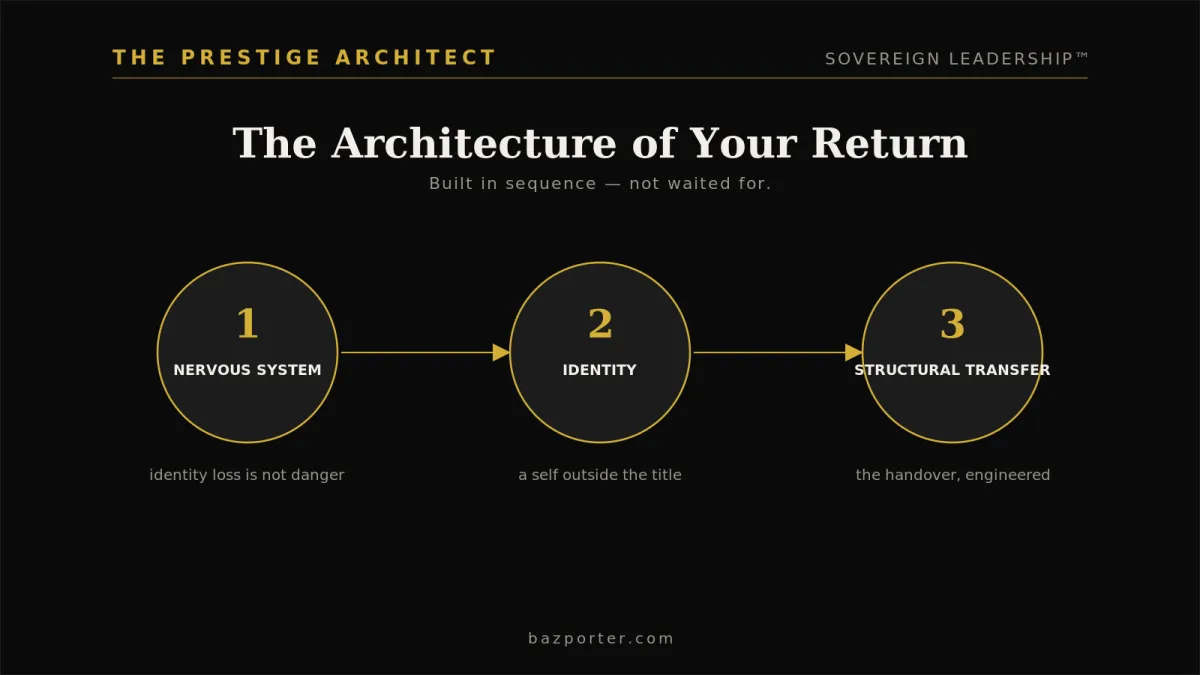
The architecture of your return
Return is not a grand rescue. It is a set of small, deliberate moves. This is the move I call RETURN, not a reinvention.
Start smaller than feels useful. Name one need out loud this week. Pick one safe person. Say the real sentence. I am struggling with this, and I could use a hand.
Then let them help. Do not supervise it. Do not repay it fast. Just receive it, and notice you are still standing.
Do that a few times and the reflex loosens. The water drops below your chin. You remember you are a person, not a pillar.
When you are ready for the full map, begin with the Fast Future Freedom Blueprint. It is the first step home.
Questions people ask
Why is it so hard for me to ask for help?
Because you learned early that need was unsafe or unwelcome. You built worth around being useful instead. Asking feels like risking the thing that keeps you loved. It is a protective reflex, not a true measure of what you are allowed to need.
Does asking for help make me look weak as a leader?
No, though the fear is real. Studies show we overestimate how harshly others judge a request. Most people read a clear ask as trust, not failure. Done well, asking raises your standing rather than lowering it.
What if the person I ask says no?
A no is one answer from one person on one day. It is not a verdict on your worth. Research finds people agree to direct requests far more than we expect. You can also ask someone else. The cost of one no is small next to the cost of drowning.
I am the one everyone depends on. Who can I even ask?
Start with one person who is safe, not one who is convenient. It can be a peer, a partner, a mentor, or a counsel figure. You are not handing over the whole load. You are letting one piece be carried by someone else.
How do I start if asking feels impossible right now?
Make it tiny. Ask for something small and low-stakes first. Let yourself receive it without earning it back. Each small ask rebuilds the muscle. The Fast Future Freedom Blueprint gives you a guided first step.
About the author
Baz Porter® is The Prestige Architect™. I work with capable leaders who have become the load-bearing wall for everyone around them. My work is RETURN: helping you set the weight down and come home to a self that is more than useful. If you are ready to start, take the Fast Future Freedom Blueprint.