Why Founders Can't Let Go: The Exit Is an Identity Problem
You built it. You cannot leave it. Not won't — cannot. The thought of stepping back tightens something in your chest. You name it timing. You name it a team that is not ready. It is neither. What you carry is Silent Collapse™ — the quiet erosion that lives underneath visible success. The company runs. You do not. Read the pattern before it names you: Read The Manifesto.
Table of Contents
Key Takeaways
The exit is an identity problem, not an org-chart problem. The succession plan fails because the founder fused self and company.
Founder-CEO transitions fail at two to three times the rate of non-founder transitions. The cause is rarely the successor. It is the founder's nervous system.
Holding on is not loyalty. It is a regulation strategy. The company became the way you stayed calm.
You rebuild the exit through architecture, not willpower. Structure releases the grip that talk cannot.
The Definitive Answer
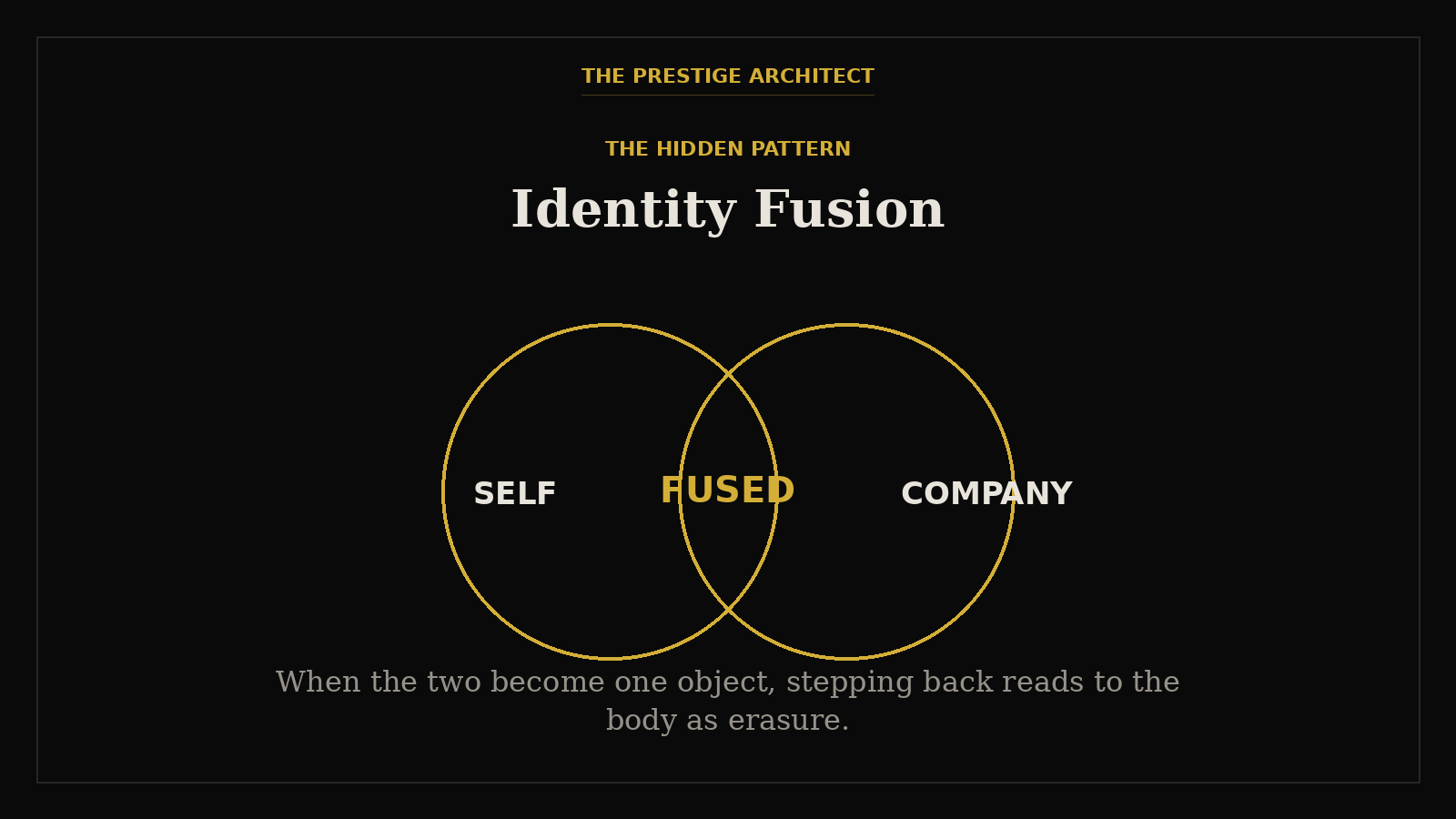
Founders cannot let go because they did not build a company — they built a self. When the business and the identity are the same object, stepping back reads to the body as erasure. This is why a founder can't let go even when the numbers say it is time. The fix is not more readiness in the team. It is Sovereign Leadership™: separating who you are from what you run, then engineering the handover as a system.
The Hidden Pattern: Why the Exit Feels Like Death
Look at the timeline. You started with nothing. The company became proof you were not nothing. Every late night wrote the same sentence into your body: I am the one who holds this. That sentence is now load-bearing.
Researchers call it identity fusion. The self-concept and the venture stop being two things. A peer-reviewed editorial in the journal Frontiers in Psychology documents how an entrepreneur's identity drives wellbeing — and how the same identity creates rumination that depletes the founder over time (National Library of Medicine). The company that made you also quietly consumes you.
So the exit does not feel like a decision. It feels like a threat. Your nervous system does not file succession under strategy. It files it under loss. That is Silent Collapse™ wearing a board agenda. The chest tightens. The reasons multiply. The plan stalls — not from logic, from physiology.
A founder who can't let go is not protecting the company. The company is protecting the founder from a question they have never sat with: who am I when I am not needed?
Name the mechanism and it loosens. Most founders never name it. They reorganize the chart instead. The chart was never the problem. Read the broader pattern in the Sovereign Leadership Resource Hub.
The RAMS Reframe
The RAMS Framework™ runs at two levels at once — the business and the nervous system. Results, Attitude, Mastery, Systems. When one is dysregulated, both are compromised. Succession is where this becomes visible. Here is the reframe across all four pillars.
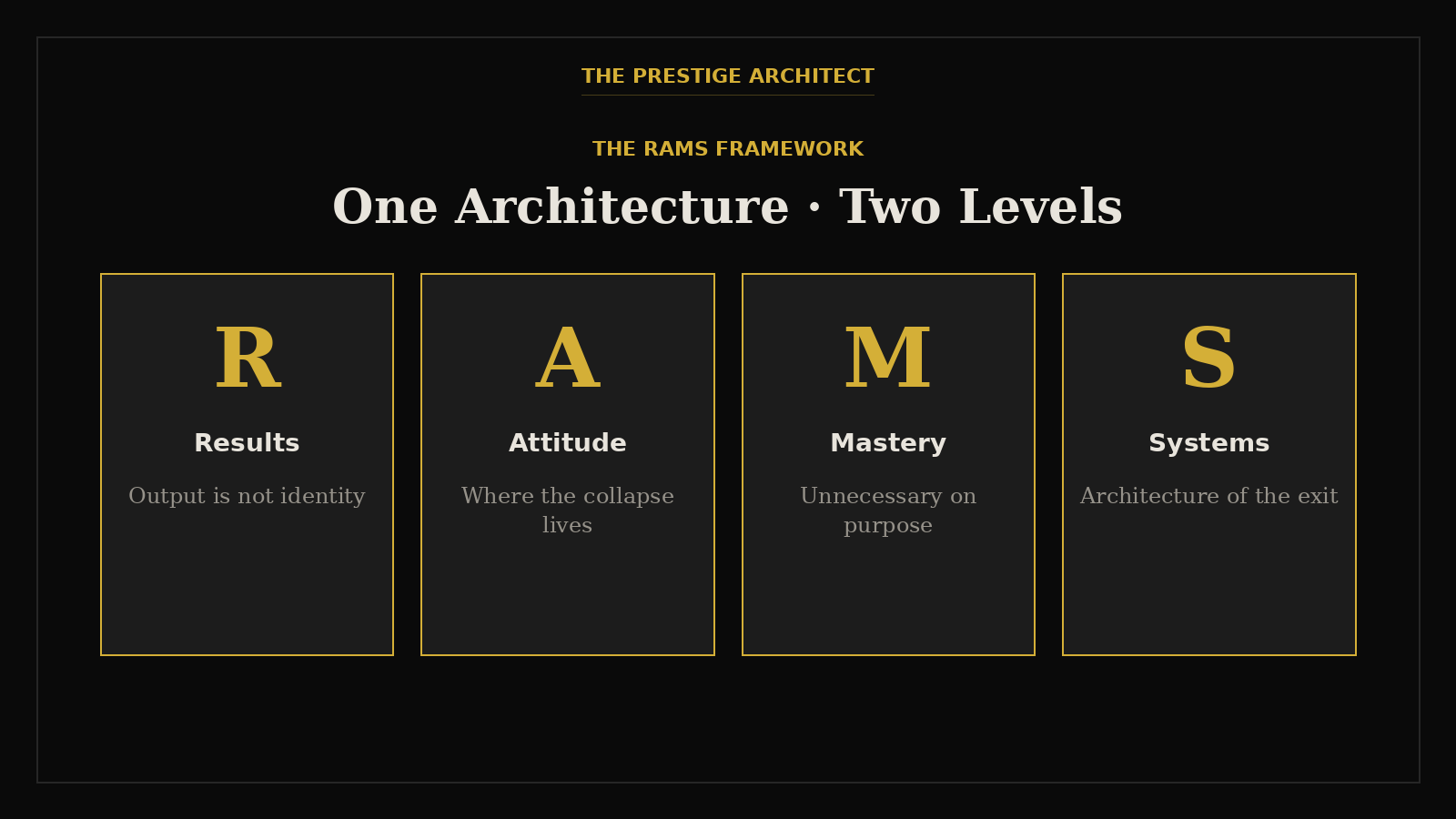
Results: Output Is Not Identity
You measured yourself in output for decades. Revenue. Headcount. The room going quiet when you spoke. The exit removes the scoreboard. The gap that opens is not financial. It is the distance between what you produce and who you are.
The trap: you treat stepping back as a drop in performance.
The truth: your performance was never you. It was a metric you mistook for a mirror.
Operational rule: separate the number from the name. The company can post records without you. That is the design working, not your worth shrinking.
Attitude: Where the Collapse Lives
Attitude is the internal operating system. For the founder who can't let go, the OS runs one program: if I stop holding, it falls. That belief felt true at the start. It is no longer true. It is residue.
Harvard Business Review, reviewing why these handovers break, found founder-CEO transitions carry a failure or downturn risk two to three times greater than non-founder transitions (Harvard Business Review). The data points at the successor. The cause sits in the founder's body. The grip is the risk.
Command decision: the next time the chest tightens at the word succession, do not solve it on the org chart. Treat it as a nervous-system signal, and regulate first.
Mastery: Holding On Is Not Capability
You are skilled. Nobody disputes it. But skill at running the company is not the same as the capability to leave it well. Those are different muscles. One you trained for twenty years. The other you have never used.
Skill: being indispensable. You mastered this.
Sovereign capability: becoming unnecessary on purpose, and staying whole.
Mastery of the exit means building people who do not need you, then tolerating what that brings up. Most founders can build the people. Few can tolerate the silence after.
Systems: The Architecture of the Exit
The calendar is not the problem. The architecture is. A founder cannot let go because every critical decision still routes through one node — them. That is a design flaw, not a character flaw. You can re-engineer it.
Collapsed Founder vs Sovereign Leadership™:
Decisions: route through one node → route through a system.
Identity: fused to the company → sovereign of the company.
Safety: holds on to feel safe → builds structure that holds the safety.
The exit: feels like erasure → reads as a designed handover.
The founder: indispensable and exhausted → unnecessary and intact.
Collapsed FounderSovereign Leadership™Decisions route through one nodeDecisions route through a systemIdentity fused to the companyIdentity sovereign of the companyHolds on to feel safeBuilds structure that holds the safetyExit feels like erasureExit reads as a designed handoverIndispensable and exhaustedUnnecessary and intact
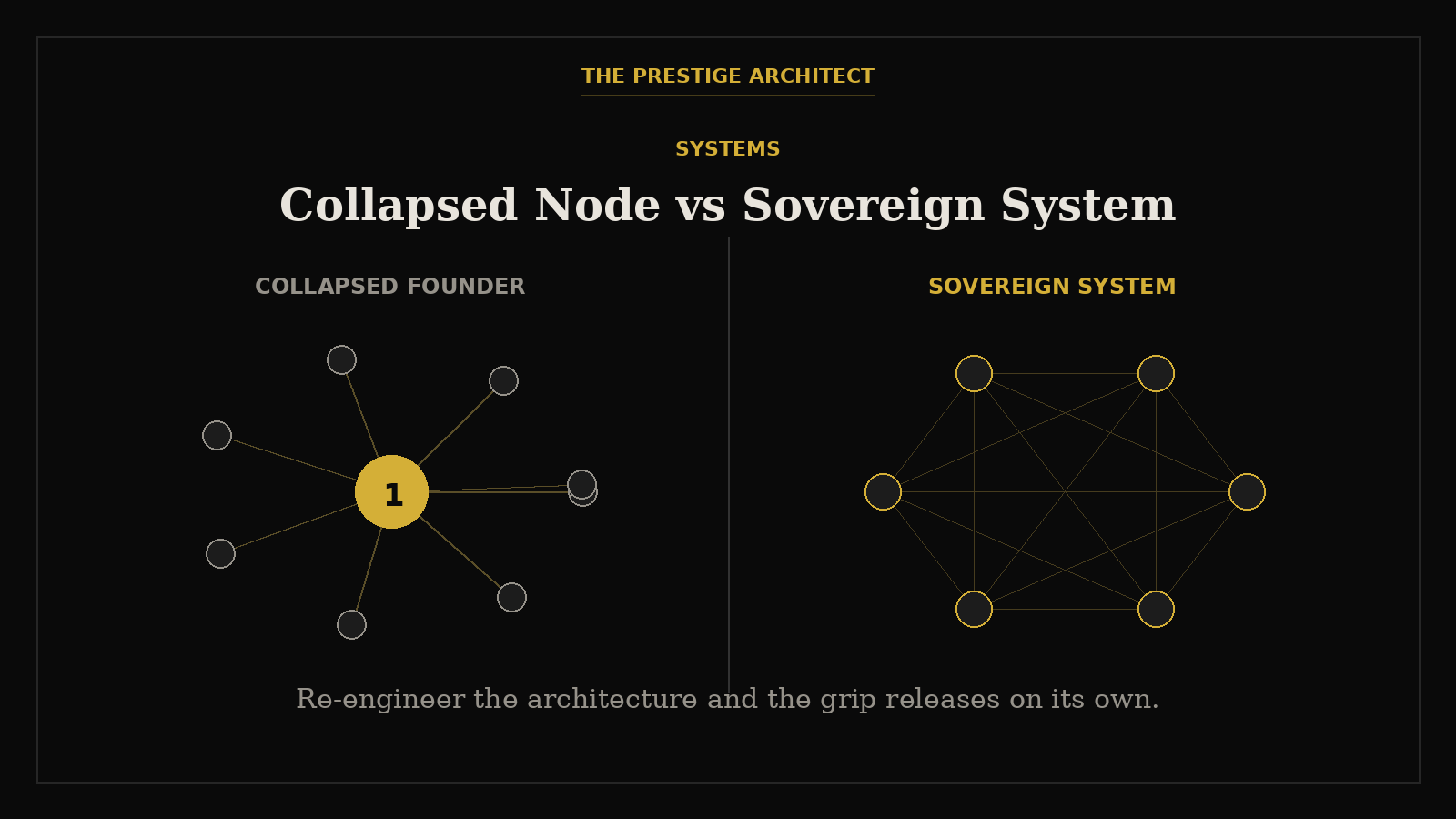
Build the architecture and the grip releases on its own. You do not talk a founder out of holding on. You engineer the conditions where holding on is no longer required.
Find out where your own collapse is hiding. Take the Silent Collapse Diagnostic.
Case Vignette: The Chair No One Filled
A founder ran a nine-figure firm. Three succession plans, three quiet collapses. Each successor was capable. Each one left. The board blamed the hires. I did not.
We mapped the architecture, not the people. Every decision of consequence still pinged the founder's phone — by midnight, by design, by reflex. The successors were not failing. They were never given the node. We rebuilt the decision system first. Then we sat with the founder's real fear: a life with no one needing them by 11 p.m.
Six months on, the founder works two days a week. The firm posted its strongest quarter. Nothing changed in the org chart. Everything changed in the architecture — and in the founder's nervous system. The chair was never empty. The founder was.
The Architecture of Your Return
You do not need to be talked into leaving. You need a body that does not read the exit as a threat. That is nervous-system sovereignty. The grip is not weakness. It is an old regulation strategy that outlived its use.
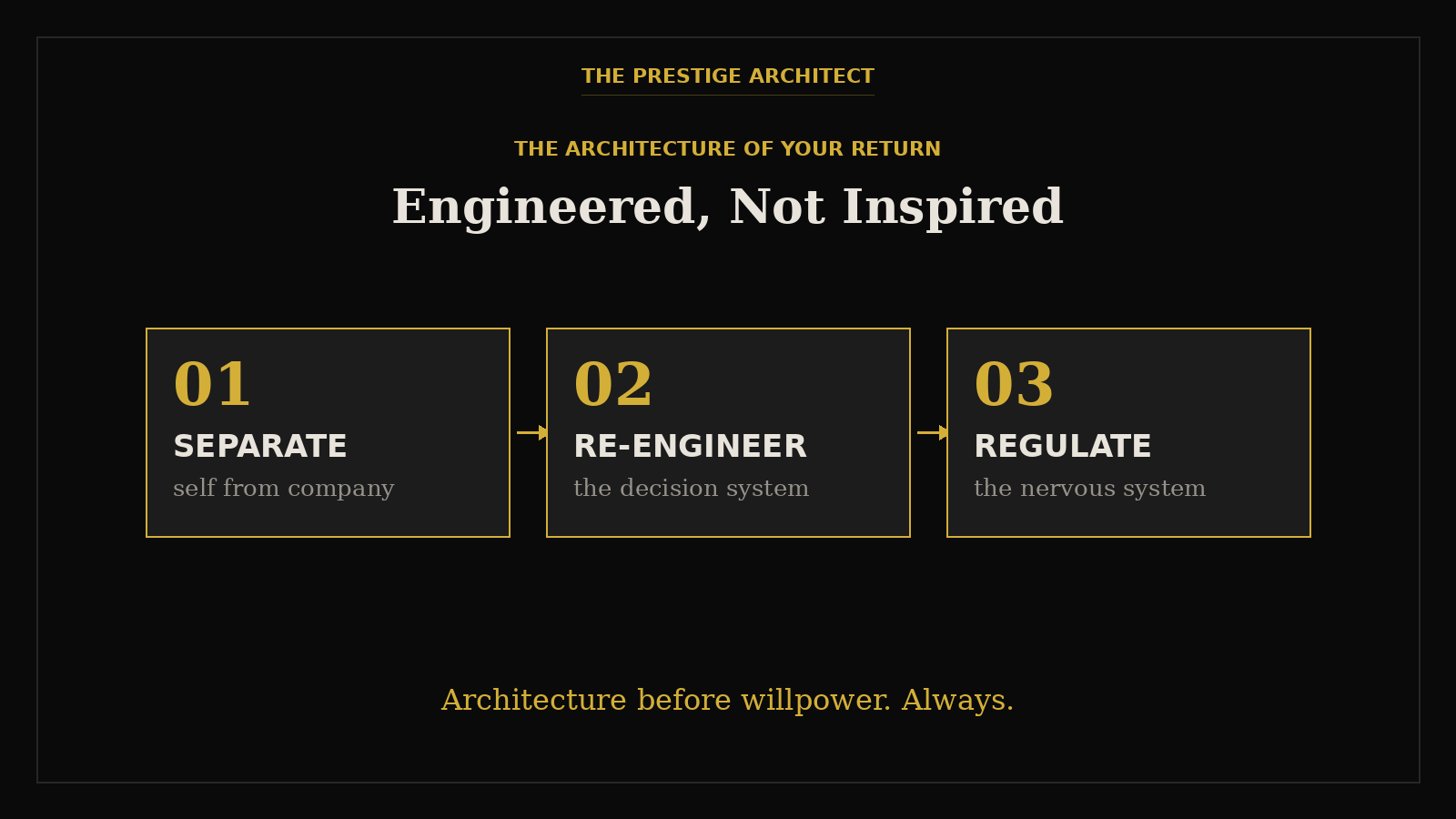
The return is engineered, not inspired. First, separate the self from the company — name where they fused. Second, rebuild the decision architecture so the system holds what you held. Third, regulate the founder's nervous system so the silence after is survivable. In that order. Architecture before willpower. Always.
The founder who can let go is not the one with the best plan. It is the one whose identity no longer depends on being needed.
When you are ready to build that architecture, Apply to Work With Baz.
Frequently Asked Questions
Why can't I let go of my company even though I know it is time?
Because the company and your sense of self became one object. Stepping back does not read as a decision to your body — it reads as loss. The fix is to separate identity from enterprise, then rebuild the handover as a system, not a feeling.
Is founder succession anxiety normal or a warning sign?
It is common and it is a signal. The tightness you feel at the word succession is your nervous system filing the exit under threat. That is Silent Collapse, not a flaw in your plan. Treat it as physiology to regulate, not logic to argue.
Why do my successors keep failing?
Often they are not failing. Every consequential decision still routes through you. Harvard Business Review found founder-CEO transitions fail at two to three times the rate of non-founder ones. The fix is architectural — give the system the node, not just the title.
How do I exit without losing myself?
You build the architecture before you build the willpower. Separate self from company, re-engineer the decision system, and regulate the nervous system so the silence after is survivable. Sovereign Leadership is staying intact while becoming unnecessary on purpose.
About the Author
British military veteran. Two-time international bestselling author. Founder, The Prestige Architect®. Host, Rise From The Ashes podcast, C-Suite Network. Boulder, Colorado.