What to Do When You Feel Restless at Work
What to Do When You Feel Restless at Work
You are not bored. You are restless. That is a different thing, and it changes what you do next.
I am Baz Porter®, and I built The Prestige Architect™ for one kind of leader. The one whose life works on paper and still feels the pull to walk away from all of it. If that is you, read this. Then read the manifesto.
Restlessness is not a flaw in you. It is a signal with nowhere to go. Tonight we give it somewhere to go.
On this page
Key takeaways
Restlessness is energy, not a defect.
Left undirected, it becomes the urge to blow everything up.
Directed, it becomes your next real move.
The fix is a system, not a leap.
You do not have to torch the life you built to answer it.
What restlessness actually means
What do you do when you feel restless at work? You give the restlessness a direction.
Restlessness is stored energy that lost its target. You do not suppress it. You do not obey it either. You channel it. You name the exact thing you have outgrown. You run one small test toward what you actually want. Then you let evidence, not impulse, pick the next move.
That is the whole difference between a reckless exit and a real one. Silent Collapse™ is the quiet state underneath the restlessness. The move out of it is return, not escape. You are not trying to become someone new. You are coming back to what you actually wanted before the life got loud.
The hidden pattern under it
Here is what most people miss. The restlessness is rarely about the job.
It is about a gap. The gap between who you are now and who your built life still expects you to be. Psychologists call this self-discrepancy. When your actual self drifts from your ideal self, the mind makes agitation and a restless drive to close the distance (Higgins, 1987, Psychological Review). The restlessness is the closing mechanism. It is trying to move you.
The signal is not the problem. The problem is that the signal has no channel. So it points at the biggest, loudest door in view. Quit. Leave. Disappear. Start over. Work on human motivation shows people run well when autonomy, competence, and relatedness are met, and stall when those needs starve (Ryan and Deci, 2000, American Psychologist). Restlessness at the top is often one of those needs going hungry inside a life that looks complete.
So the itch is real. The exit door it keeps pointing at is usually wrong.
The RAMS™ way to channel it
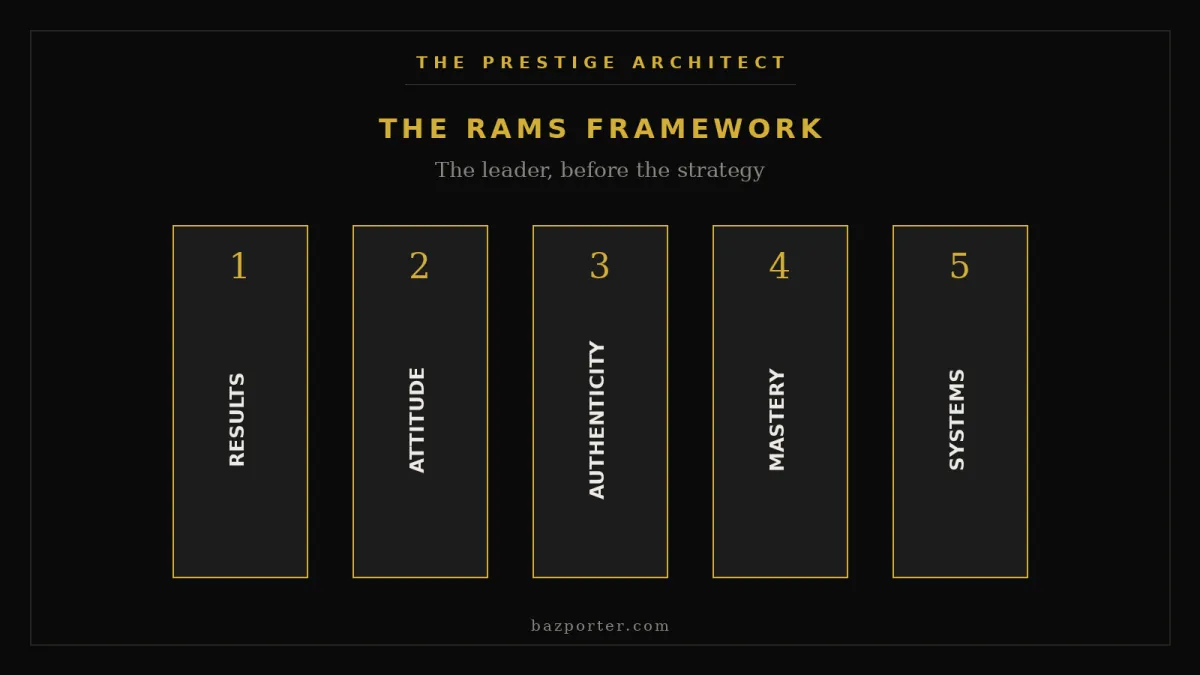
RAMS™ is how I rebuild a restless leader into a directed one. Five pillars. Each one turns a symptom into a system.
Results. Restless leaders chase a bigger result and feel nothing when it lands. So we change the measure. We stop counting output and start counting alignment. One question sets the bar. Does this move me toward the life I actually want, or further from it. That question is now your metric.
Attitude. You have been treating the restlessness as a threat. It is not. It is data. The shift is small and total. You stop asking how do I make this feeling stop. You start asking what is this feeling trying to move me toward. The energy is on your side once you stop fighting it.
Authenticity. Most restless leaders are loyal to a version of themselves that expired years ago. Being real is not blowing up the marriage or the company. It is admitting, in private and on paper, the one true thing you have outgrown. Name it exactly. Vague restlessness cannot be directed. A named one can.
Mastery. You already know how to build things. That skill did not leave. It just got pointed at the wrong target. Mastery here means running small, reversible tests toward what you want. Not a leap. A probe. A weekend, a conversation, a single project that tells you the truth cheaply.
Systems. This is the pillar that holds the rest. Impulse says decide now. A system says gather evidence first. You build a simple loop. Name the thing you outgrew, run one small test, read what actually happened, then choose. Repeat. The restlessness gets a channel, and the channel produces a real next move instead of a detonation.
Here is the difference in plain terms.
Collapsed waits for the feeling to pass. Sovereign gives the feeling a job.
Collapsed treats the exit as the only door. Sovereign builds a third one.
Collapsed decides in one loud night. Sovereign decides on evidence over weeks.
Collapsed torches the whole life. Sovereign changes the one part that stopped fitting.
Collapsed calls it a breakdown. Sovereign calls it a signal, and answers it.
The restlessness was never the enemy. It was the part of me still awake, trying to get my attention. Once I gave it a direction, it stopped screaming.
If you cannot yet tell your restlessness from a real decision, start with the Fast Future Freedom Blueprint. It is my free entry audit. It is the fastest way to see what your restlessness is actually pointing at, before you act on it.
One leader's turn
A managing director came to me sure of one thing. He was going to resign and move his family across the country. The restlessness had been loud for a year.
We did not touch the resignation. We built the loop instead. He named the real thing he had outgrown. It was not the company. It was a role that had turned him into a manager of other people's work when he wanted to build again. That was the named thing.
Then one small test. He asked to lead a single new build inside the same firm. Ninety days. Reversible. He read the result honestly. The restlessness quieted, not because he escaped, but because the energy finally had a channel. He kept the life. He changed the one part that had stopped fitting. That is directed restlessness.
The architecture of your return
You do not need a new life. You need the life you have to fit the person you became.
Restlessness is the raw material for that. Channelled, it is the most useful signal you have. It shows you exactly where you and your life have drifted apart. The work is to close that gap on purpose, with a system, instead of waiting for a night loud enough to make you leap.
This is what I do with leaders inside the work. We build the loop, name the outgrown thing, run the tests, and design the return. If you want that structure applied to your situation, apply for the Fast Future Freedom Blueprint and we will start with what your restlessness is really telling you.
Questions leaders ask
Is restlessness at work a sign I should quit?
Not on its own. Restlessness tells you something has drifted, not that the exit is the answer. Name the exact thing you have outgrown first. Often it is one part of the role or the routine, not the whole life. Test that part before you touch anything permanent.
How do I channel restlessness instead of acting on it?
Build a small loop. Name what you outgrew, run one reversible test toward what you want, read the result honestly, then decide. The loop turns raw energy into evidence. Evidence, not impulse, makes the next move a real one instead of a reckless one.
Why do I feel restless when everything is going well?
Because success and alignment are not the same thing. You can hit every target and still be starving a need for autonomy or real building. Restlessness at the top is usually one of those needs going hungry inside a life that looks complete on paper.
What is the difference between restlessness and burnout?
Burnout is depletion. You have nothing left to give. Restlessness is the opposite. You have energy with nowhere aimed to send it. Burnout needs rest and recovery. Restlessness needs a direction and a channel, so the energy finally has somewhere to go.
Can I answer my restlessness without blowing up my life?
Yes, and that is usually the better move. Reversible tests let you change the one part that stopped fitting without detonating the parts that still work. You keep the life you built and redesign the piece you outgrew. That is return, not escape.
About the author
Baz Porter® is the founder of The Prestige Architect™ and the creator of the RAMS™ system for leaders in Silent Collapse™. He works with successful people who feel the quiet pull to walk away, and helps them build a return instead of a wreckage. Start with the free Fast Future Freedom Blueprint.