What Is Revenue Architecture? The Founder's System
I build systems, not motivation. Sovereign Leadership Architecture™ starts with one hard truth: most revenue runs on a single nervous system. Yours. The company looks scaled. The founder is the load-bearing wall. Pull her out for a week and the numbers wobble. That is not a growth problem. It is an architecture problem. Revenue architecture is the answer to it. I wrote the Manifesto for the leader who already senses this.
On this page
Key takeaways
Revenue architecture is the design of how revenue is created. It is not the daily running of it.
Revenue operations executes. Revenue architecture is the blueprint operations runs against.
When revenue depends on one founder, the system has a single point of failure.
The business and the body run on the same architecture. Dysregulation shows in both.
Return begins when the system holds without your collapse.
What revenue architecture means
Revenue architecture is the structured design of how a company turns demand into revenue. It defines four layers: data, process, ownership, and technology. It sets what to measure, how the layers connect, and who holds each part. The term was made popular by Jacco van der Kooij at Winning by Design. It has grown into the standard language of scaled revenue.
Here is the distinction that matters. Revenue operations runs the engine day to day. Revenue architecture is the design of the engine. Operations executes the plan. Architecture is the plan. One keeps the machine moving. The other decides what the machine should be. Most founders build the second by accident. They never draw it. They become it.
That is the quiet failure. The founder is the data model. The founder is the process. The founder is the accountability layer. The system works because she is in the room. Then the room empties, and revenue stalls. A real architecture removes the founder from the load path. It lets revenue run on structure, not on her presence.
The hidden pattern founders miss
The pattern is concentration risk. In organizational research, this is called key-person dependency. One node carries the weight of the whole. Remove it and the network fails. Noam Wasserman documented this in The Founder's Dilemmas (Princeton University Press, 2012). His data showed founders resist building systems that outlast them. Control feels safe. Control is the trap.
Harvard Business Review has tracked the same fault line for years. Companies with a single point of decision scale slower and break harder. McKinsey research on organizational resilience points the same way. Resilient revenue is distributed revenue. It does not live in one head.
I see the physical version of this every week. The founder's calendar is the true org chart. Her nervous system is the true operating system. When she dysregulates, forecasts slip. When she recovers, they return. The business and the body run on the same architecture. Silent Collapse™ is what happens when both are load-bearing and neither is designed to hold.
The RAMS™ reframe
RAMS™ is my operating system for this. It has five pillars: Results, Attitude, Authenticity, Mastery, and Systems. It works at the business level and the nervous-system level at once. Here is revenue architecture read through all five.
Results. Design the outcome first. Name the revenue the system must produce without you. Then build backward from that number. Results are the specification, not the hope.
Attitude. Stop treating dependency as loyalty. Your presence in every deal is not devotion. It is a design flaw. The strong move is to make yourself removable.
Authenticity. Build a revenue system that matches how you actually sell. Copied playbooks fail because they are not yours. Architecture is honest or it is fiction.
Mastery. Know your own model cold. Know the data, the motion, and the handoffs. Mastery is not doing every task. It is understanding the whole so you can leave it.
Systems. Encode the whole thing. Write the flow from first contact to renewal. Assign an owner to each stage. The system is finished when it runs while you rest.
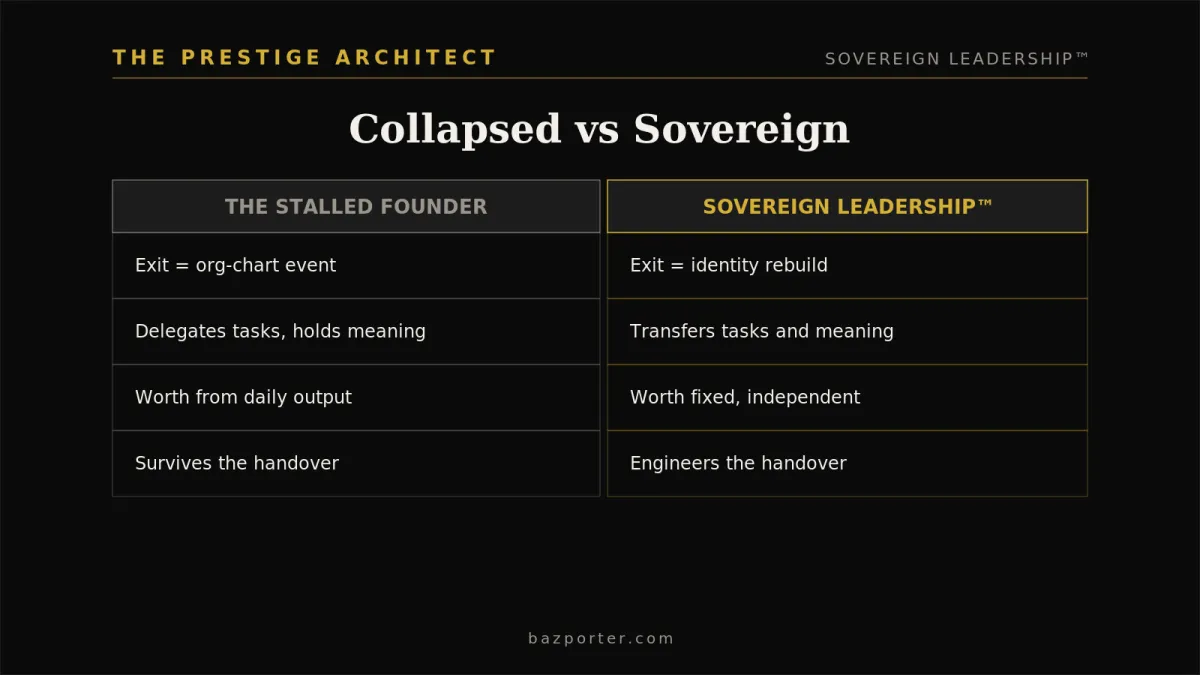
Now the contrast, held plainly.
The Collapsed founder is the system. Revenue tracks her energy. She cannot take a week off. Growth means more of her. The exit is impossible because there is nothing to sell but her.
The Sovereign founder designed the system. Revenue tracks the structure. She can step out and the numbers hold. Growth means more of the architecture. The exit is possible because the asset exists apart from her.
Baz Porter does not motivate. He does not inspire. He does not sell tactics. He architects the system that lets a founder leave the room without the revenue leaving with her.
Before you build, you have to read the load you are carrying now. Take the Silent Collapse Diagnostic™. It shows where you have become the load-bearing wall.
A case from the room
A founder came to me with an eight-figure company. On paper, she had scaled. In truth, she was the engine. Every large deal closed because she flew in. Every forecast held because she chased it. She had not taken a clear week in three years. Her body was sending the bill.
We did not add motivation. We drew her revenue architecture for the first time. We found four stages that only she could run. We assigned each one a design and an owner. We rebuilt the data so the truth lived in one place, not in her memory. Ninety days later, two deals closed without her in the room. She took the week. Revenue held. That is the return.
The architecture of your return
Your return is not a mindset. It is a build. It starts by naming every place revenue runs through you and only you. Then you design each one out. This is the work of Sovereign Leadership Architecture™. The business and the body, rebuilt on structure so neither collapses.
If you are the load-bearing wall of your own revenue, we should draw the new architecture together. Apply for a private session and we will map where the system depends on you, and how it stops.
Frequently asked questions
What is revenue architecture in simple terms?
It is the design of how your company makes money. It defines the data, the process, the owners, and the tools that turn demand into revenue. It is the blueprint, not the daily work.
What is the difference between revenue architecture and revenue operations?
Revenue operations runs the system that exists. Revenue architecture designs the system before anyone runs it. Operations executes. Architecture decides what should be executed.
Why does revenue architecture matter for founders?
Because most founder-led revenue runs on the founder. That is a single point of failure. A real architecture removes the founder from the load path so revenue survives her absence.
How do I start building revenue architecture?
Name every stage of revenue that runs through you alone. Assign each stage a design and an owner. Put the data in one place. The system is done when it holds while you rest.
What does revenue architecture have to do with burnout?
Everything. When you are the system, the system runs on your nervous system. Revenue tracks your energy, and your energy runs out. Design the revenue out of your body, and the collapse loses its cause.
Baz Porter® is the founder of Baz Porter LLC® and The Prestige Architect®. A British Army veteran and international bestselling author, he guides high-achieving founders and executives from Silent Collapse™ to Sovereign Leadership™ using RAMS™ — the system where the business and the body are rebuilt on the same architecture. He hosts the Rise From The Ashes podcast on the C-Suite Network.