Why Walking Away Feels Like the Only Way to Breathe
You are sitting in a meeting you used to want. A picture arrives, uninvited. You are in the car. You are driving. You are not turning around.
The daydream is specific now. Not a holiday. An exit. You hand back the badge, the keys, the whole built life. You walk into air you can finally pull all the way down.
I want to name that picture before you act on it. It is not a plan. It is a signal. In my work as The Prestige Architect™, I call the state underneath it Silent Collapse™: a life that still runs perfectly while the person inside it has quietly stopped being able to breathe. If you want the fuller map of that, read the manifesto.
What this piece covers
Key takeaways
The urge to walk away is rarely about the door. It is about your breath.
An escape fantasy is a nervous system report, not a life plan.
Research names two escapes: one that shrinks you, one that expands you.
You do not lack willpower. You lack a place to exhale.
The move is return, not reinvention. You come back to air, not to a blank slate.
The escape fantasy is about air, not leaving
Here is the short answer. Walking away feels like the only way to breathe because leaving is the one place your body expects relief. The fantasy is not a verdict on your marriage, your title, or your company. It is a signal that you have stopped being able to exhale where you stand.
Think about what actually happens in the daydream. Your shoulders drop. Your jaw unclenches. You breathe out. Notice what your mind chose as the trigger for that exhale. It chose absence. It chose the door.
That is the tell. Your body has learned that relief lives somewhere you are not. So it keeps drawing the exit. It is trying to help you. It just has the map upside down.
The hidden pattern: two kinds of escape
Escape is not one thing. Researchers who study it draw a clean line through the middle. Frode Stenseng, whose work on escapism appears in the Journal of Happiness Studies, describes two forms. One is self-suppression. One is self-expansion.
Self-suppression escape wants the self switched off. It wants numbness, distance, silence, gone. Self-expansion escape wants the self back. It wants room, air, a wider life. Same daydream. Opposite engines.
Most high performers assume their exit fantasy is the reckless kind. It usually is not. Underneath it sits an unmet need, not a death wish. Self-determination theory, the body of research from Edward Deci and Richard Ryan, names autonomy as a basic human need. When autonomy is starved for long enough, the mind starts rehearsing flight.
So the picture in the meeting is doing real work. It is telling you that a core need has gone unfed. The problem is that the fantasy points at a location. The need is not about location at all.
The RAMS™ reframe across five pillars
I use a framework called RAMS™ to move a person from the collapsed version of a state to the sovereign one. It runs across five pillars: Results, Attitude, Authenticity, Mastery, and Systems. Here is how the escape fantasy looks in each.
The difference between collapse and sovereignty is not the feeling. It is what you do with it.
Results, collapsed: you measure a life by output and wonder why the numbers no longer move you. Sovereign: you count what you can actually feel, not only what you can report.
Attitude, collapsed: you treat the urge as a flaw to suppress. Sovereign: you treat it as data and ask what it is protecting.
Authenticity, collapsed: you perform fine while starving in private. Sovereign: you let one true sentence out loud.
Mastery, collapsed: you white-knuckle the routine and call it discipline. Sovereign: you build small pockets of air on purpose.
Systems, collapsed: your calendar has no room to breathe, so your mind invents the door. Sovereign: you design exhale into the structure itself.
"He did not need a new life. He needed to be able to breathe inside the one he had already built." That line, from a review of my counsel, holds the whole point.
You do not have to torch anything to test this. You can find out whether you need a new life or a returned one. The free entry audit, the Fast Future Freedom Blueprint, is built to tell you which it is before you make a single move.
What this looked like for one leader
A managing partner came to me last year. On paper, nothing was wrong. Two decades in, respected, well paid, a family that loved them. And every Sunday, the same scene played out. They sat in the parked car in the driveway and did not want to go inside.
They were certain the answer was to leave. Leave the firm. Leave the city. Maybe leave more than that. It felt like the only way to breathe.
We did not touch the exit. We looked at where the air had gone. Every hour was assigned. Every space had been sold to someone else. There was no room in the whole structure to simply be a person.
So we built one pocket. Ninety unowned minutes, three mornings a week, defended like a client meeting. Within a month the driveway scene faded. The escape fantasy did not vanish because they left. It faded because they could finally exhale where they were.
They kept the firm. They kept the marriage. What changed was the breathing.
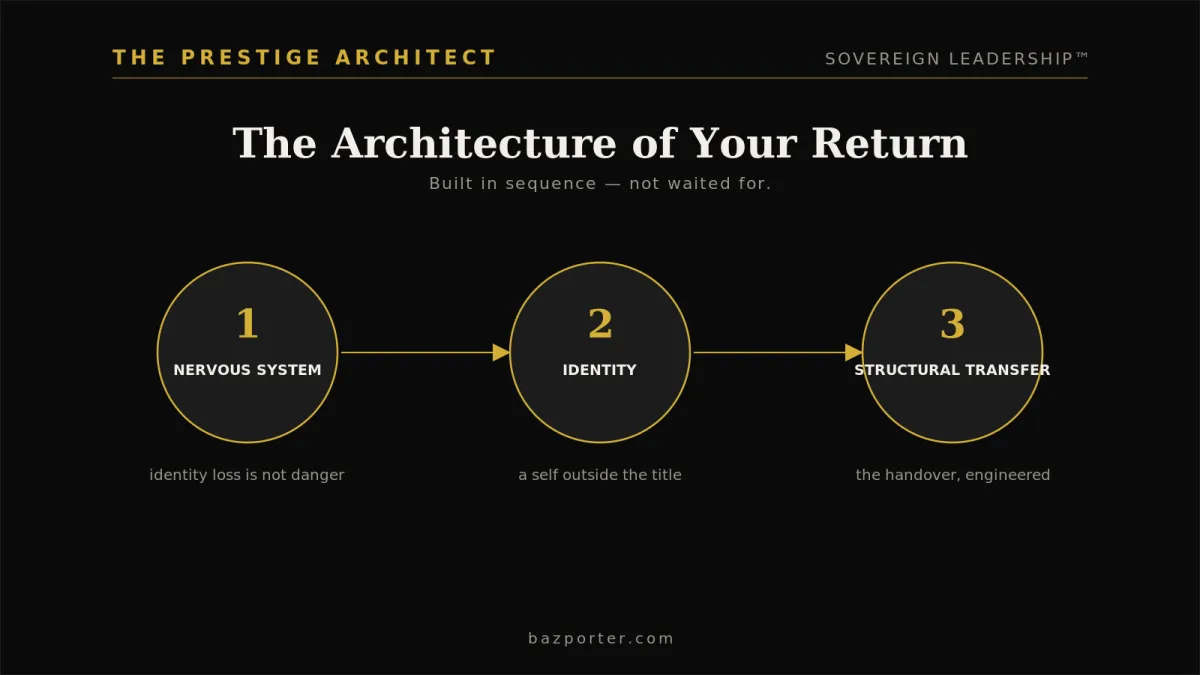
The architecture of your return
Return is not resignation. It is not settling for the life that is quietly costing you. Return means you go back to what you actually want, and you build the structure that lets you have it in the open.
The escape fantasy asked one honest question: where can I breathe? Most people answer it with a door. I want you to answer it with a design.
Start small enough that it cannot fail. One defended hour. One true sentence to one safe person. One space on the calendar that belongs to no one but you. Air first. Big decisions later, and only from a place where you can already breathe.
If you want a clear read on whether you need to leave or to return, that is exactly what the Fast Future Freedom Blueprint maps. It is the first honest look, and it costs you nothing but a little truth.
Frequently asked questions
Does wanting to walk away mean I should actually leave?
Not on its own. The urge tells you a real need is unmet. It does not tell you the door is the answer. Read it as information first. Some leaders do need to go, but most need to change the conditions, not the address. Get clarity before you act, not after.
Why do I only feel like I can breathe when I imagine being gone?
Because your body learned that relief lives where you are not. Every hour is spoken for, so your mind places the exhale somewhere outside the structure. Build one pocket of air inside your real life and the fantasy usually loosens its grip.
Is the escape fantasy a sign of burnout?
It can be, but it is often something quieter. Burnout is depletion. This is more like suffocation with a full tank. You still function. You just cannot find room to be a person. That is the felt state I call Silent Collapse.
What if I feel guilty for wanting out of a good life?
The guilt is common and it is not proof of ingratitude. You can love your life and still feel you have outgrown its current shape. Both are true at once. The guilt only becomes a problem when it silences the signal instead of letting you read it.
What is the first move if I cannot breathe in my own life?
Build one defended pocket of unowned time this week and protect it like a meeting. Do not redesign everything yet. Prove to your body that air exists here. From there, the bigger questions get calmer and clearer.
About Baz Porter®
Baz Porter® is The Prestige Architect™, counsel to successful leaders who look fine on the outside and feel the quiet pull to walk away on the inside. His RAMS™ framework moves people out of Silent Collapse™ and back into a life they can actually breathe in. The move is always return, never reinvention.