Why You Wait to Be Asked Before You Speak
Why You Wait to Be Asked Before You Speak
You had the point ready. You held it. The meeting moved past the moment, and you told yourself you would speak if someone turned to you. No one did. You left with the words still in your chest. You are not shy, and you are not out of ideas. You wait for an invitation that used to be automatic. This is Silent Collapse™, the quiet state where a capable leader still has the read but waits for permission to say it. I built my work, The Prestige Architect™ method, because I watched myself start waiting too. The voice that built your career did not leave. It began asking the room for a pass first. If you want the full map of what is happening underneath, start with the manifesto.
Written by Baz Porter®
On this page
Key takeaways
Waiting to be asked is not patience. It is a request for permission.
The invitation you are waiting for rarely comes in a busy room.
You call it respect or timing. Underneath it is a held breath.
The room reads your silence as having nothing to add.
You do not need a better moment. You need to take the one in front of you.
What waiting to be asked really is
Here is the plain answer. You are not waiting for the right moment. You are waiting for someone to hand you the floor.
Watch what happens the next time you sit on a point. The topic comes up. You know your read is good. You wait for a gap, then a cleaner gap, then for someone to turn to you and say, what do you think. The turn does not come. The subject closes. You carry the point home unsaid.
This is the trap. A busy room does not hand out invitations. It rewards the person who steps in. You are waiting for a signal the room has no reason to send. So your best thinking stays in your head, and the room decides you had nothing to add.
That is the part that stings. The silence you chose gets read as the silence of someone empty. You know it is the opposite. You went quiet while full.
Waiting feels safe. It is not. It is a slow way of removing yourself from the room you are paid to shape.
The hidden pattern underneath it
There is a mechanism here, and it is not about your rank or your right to speak. It is about who starts, and who waits to be started.
Grant and Ashford, writing in Research in Organizational Behavior in 2008, mapped what they called proactivity at work. Their finding was clear. Some people treat a situation as something to act on. Others treat it as something to respond to. The second group waits for a cue before they move, even when they hold the better read. The difference is not ability. It is whether you believe it is yours to start.
Detert and Edmondson, writing in the Academy of Management Journal in 2011, named the belief that keeps the words in. They called them implicit voice theories. These are the quiet rules a leader carries without noticing. Speaking unasked looks presumptuous. Wait until you are invited. Do not step on the room. The rules feel like manners. They are a cage. And the most accomplished people carry the strictest version of them.
Read those together. You are not holding back because you doubt the idea. You are holding back because somewhere you decided your voice needs a permission slip. The room never issued one. It was never going to.
The RAMS™ reframe
I do not teach you to interrupt more. I rebuild the self that decides whether your voice needs clearance before it moves. My framework is RAMS™. It runs across five pillars. Here is how waiting to be asked looks through each one.
Results. You measure yourself by whether you behaved well in the room. Did you wait your turn, stay polite, not crowd anyone. The sovereign measure is different. Did the room get your read while it still mattered. That is the result that moves the work.
Attitude. This is where it lives for most leaders. You treat your own contribution as something that needs inviting. Change that posture and the waiting stops. Your read belongs in the room the moment it is true, not the moment someone asks for it. Carry it that way.
Authenticity. Every time you wait to be asked, you let the room meet a smaller version of you. The careful one. The one who defers. The return is to let the room meet the leader who speaks because the thing is true, not because the floor was offered.
Mastery. Mastery is not perfect timing. It is stepping into the live moment with one clear sentence before the subject closes. The leader who lands does not wait for the gap. They make the gap by speaking.
Systems. A room that only hears from the people who push in is a flawed system, and you have been coping by standing back. You do not fix it by waiting more politely. You fix it by changing your own rule. You stop asking the room for a turn and start taking the one in front of you.
Look at the two states side by side.
Collapsed: waits for the invitation. Sovereign: steps into the moment.
Collapsed: calls the silence good manners. Sovereign: calls it a cost.
Collapsed: speaks only when asked. Sovereign: speaks when it is true.
Collapsed: lets the subject close. Sovereign: opens it before it does.
Collapsed: waits for permission. Sovereign: already has it.
The room does not hand the floor to the one who waits most politely. It belongs to the one who stops waiting.
If you want to see which state you are living in right now, I built a free tool for exactly that. It is the Fast Future Freedom Blueprint™, a sixty-minute identity audit. You can book it here.
A leader I worked with
One client led a division inside a company of several thousand. Sharp. Trusted with the hardest calls. They came to me because they had gone quiet in the meetings that set direction. They had the read every time. They waited to be asked for it. Often the ask never came, and a weaker plan went forward.
We did not work on their meetings. We looked at the rule underneath. Every point waited behind the same thought. Not yet. Let someone open the door. They were not being careful. They were asking the room for a permission it was too busy to give.
So we changed the rule. One true sentence, spoken into the live moment, before the subject closed. It felt forward at first, almost rude to them. Then the room started turning to them earlier, because they had already stepped in. The read was always there. What changed was that they stopped waiting to be invited to say it.
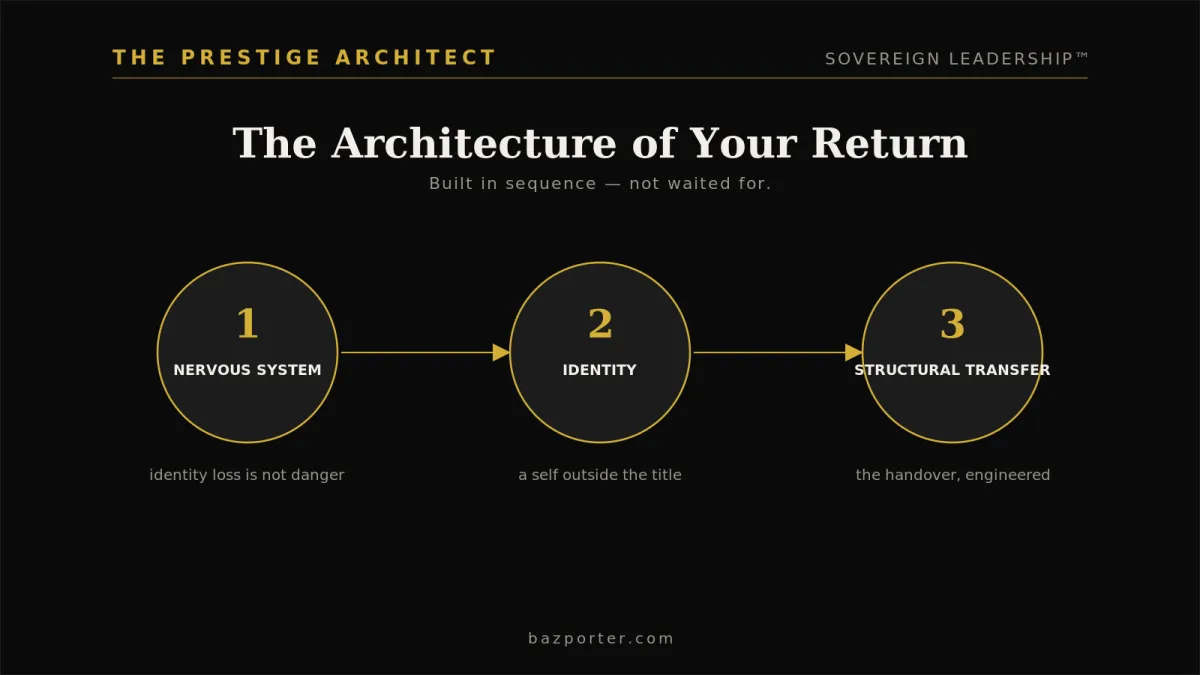
The architecture of your return
Here is the part most people miss. You do not need a course on speaking up. Your read is sharp and your words are fine. You need to retire the belief that your voice requires an invitation before it is allowed to move.
The research backs this. When a leader stops waiting for a cue and treats the moment as theirs to act on, the contribution lands on its own. The skill was never the gap. The permission you kept waiting for was. And permission you grant yourself does not have to be requested.
This is the RETURN. Not pushing harder, and not learning to barge in. Coming home to the leader who spoke because the thing was true. You stop waiting for the turn. You take the moment that is already in front of you.
This is the work I do with leaders in private counsel. It begins at the same door for everyone. A free sixty-minute conversation, the Fast Future Freedom Blueprint™, where we find what is actually in the way. If you are ready to stop waiting and start speaking while it still counts, apply for your audit here.
Questions leaders ask me
Why do I wait to be asked before I speak up?
Because somewhere you decided your voice needs an invitation to be allowed in. It feels like respect or good timing. Underneath it is a request for permission the room has no reason to send. The read is yours to offer the moment it is true, not the moment someone asks.
Is waiting to speak just being polite?
Sometimes it is, and often it is cover. Real courtesy is not holding your best thinking until invited. When the point would help and you sit on it, the room loses the read and reads you as empty. That is a cost, not a manner.
Why does the invitation to speak never come?
Because a busy room does not hand out turns. It moves on the people who step in. Waiting for someone to turn to you is waiting for a signal the room is not built to send. The gap is made by speaking, not by being offered one.
How do I speak up without being asked and without barging in?
Lead with one true sentence into the live moment, before the subject closes. You are not interrupting. You are contributing while it still matters. One clear line, spoken early, reads as command, not noise.
Why do I only have this problem at work?
Because the stakes feel highest where your standing feels most watched. The old rule that you must wait to be invited grips hardest in the rooms that matter most. That is exactly where dropping it changes the most.
About Baz Porter
Baz Porter® is a Sovereign Leadership Architect. He rebuilds the identity beneath high performance, so leaders can decide, lead, and live from a self that is genuinely their own. He works with accomplished people who look strong on the outside and feel unseen on the inside. His method, The Prestige Architect™, begins where the real problem lives, underneath the visible one.