How to Make Your Voice Carry Weight Again
You used to speak and the room moved. Now you wait. You rehearse what you already know. You soften the point before it leaves your mouth. When you finally say it, it lands flat. You wonder if anyone heard you at all. This is Silent Collapse™, the felt state of a leader whose voice built the whole thing and has quietly gone quiet. It is not a skills gap. It is weight that left your words. The real question is quieter than loudness. How do you make your voice carry weight again. You can read the deeper account of this state in the manifesto.
Your voice did not fail. You stopped standing behind it. That is a different problem, and it has a way back.
On this page
- Key takeaways
- The definitive answer
- The hidden pattern behind a flat voice
- The RAMS™ return: five pillars
- A pattern I see again and again
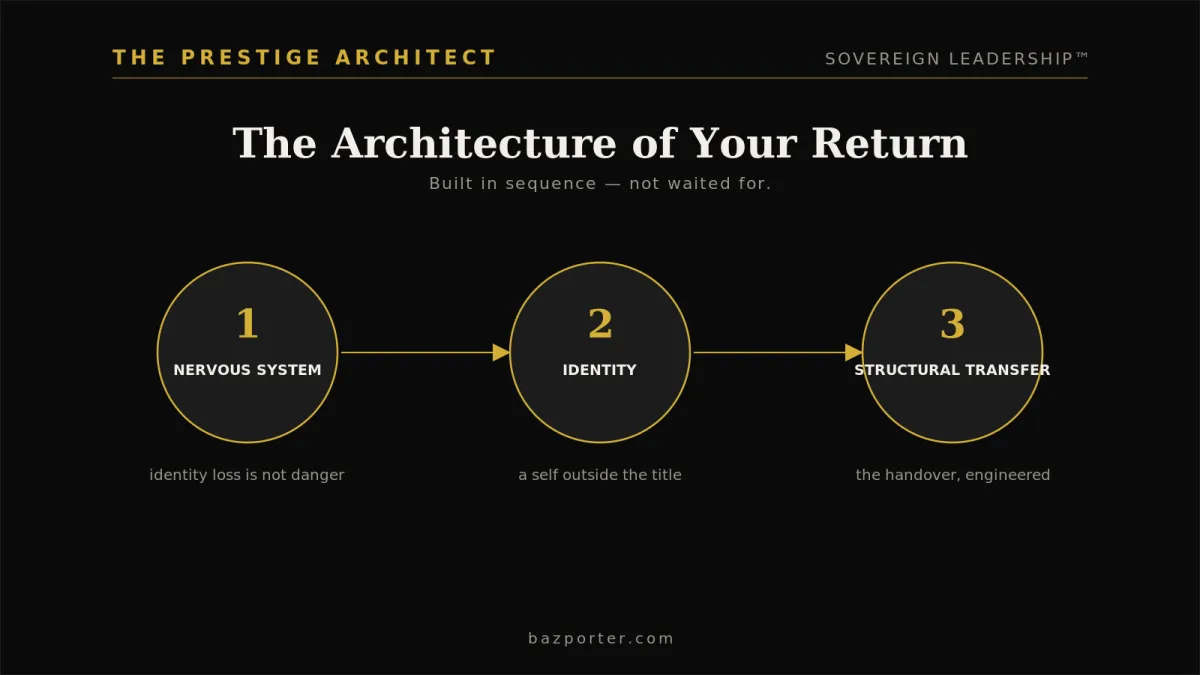
- The architecture of your return
- Questions leaders ask
Key takeaways
- Weight is not volume. A voice carries weight when the person behind it is fully present, not when it is loud.
- Going quiet is rarely a confidence skill. It is a slow retreat from your own position.
- Hedged, qualified speech lowers how much weight others give your words. The research is clear on this.
- The return is built, not performed. You rebuild it pillar by pillar, starting this week.
- The part you cannot reach alone is the identity underneath the voice. That is where the deeper work happens.
The definitive answer
To make your voice carry weight again, stop treating it as a volume problem. Treat it as a weight problem. Weight is the sense that a real person stands behind the words. It comes from presence, not force. When you hedge, qualify, and wait to be asked, you strip the weight out before anyone hears you. The fix is not to speak louder. The fix is to return to your own position and let the sentence land unguarded. Baz Porter®, The Sovereign Leadership Architect, rebuilds this at the level of state of being, not technique.
The hidden pattern behind a flat voice
Here is what almost no one names. Your words lose weight long before anyone judges them. They lose it in your own mouth. You add a soft opener. You tag a question onto the end. You bury the point in context so no one can push back on it. You call this being measured. It is not measured. It is a quiet apology for speaking at all.
The research is blunt about the cost. Fragale, in a 2006 study in Organizational Behavior and Human Decision Processes, showed that powerless speech, full of hedges, disclaimers, and tag questions, lowers the status other people confer on the speaker. Direct speech raises it. The same content lands with more weight when the speaker stops padding it.
There is a second layer. Anderson and Kilduff, in a 2009 paper in the Journal of Personality and Social Psychology, found that people who speak with steady conviction gain influence because the room reads them as competent, even before the facts are in. Weight is conferred on presence first. Your retreat is not neutral. The room feels you leave, and it stops leaning in.
So the flat voice is not a volume failure. It is a presence leak. You are editing yourself out of your own words, and the weight drains with you.
The RAMS™ return: five pillars
RAMS™ is the framework: Results, Attitude, Authenticity, Mastery, Systems. It rebuilds the identity beneath the voice. Here is the return, pillar by pillar.
Results
Stop measuring a sentence by whether the room agrees. Measure it by whether you said the true thing. A voice carries weight when it is accountable to truth, not applause. Name one point this week you have been swallowing. Say it plainly, once, without the padding.
Attitude
You have been treating your own view as a liability. Flip it. Your read of the room is an asset the room needs. When you wait to be asked, you teach people your voice is optional. Decide, before the meeting, that your position deserves the air.
Authenticity
Weight comes from congruence. When your words match the person underneath, the room feels it and settles. When you perform a safer version of yourself, the room feels that too, and discounts you. The return is not a louder you. It is the real you, unhidden. This is the center of the work.
Mastery
Master the unguarded sentence. Say the point first, then the context, not the other way around. Drop the tag question. Let the thought finish before you soften it. This is a practice, not a personality. You rebuild the muscle one clean sentence at a time.
Systems
Weight needs structure to hold it. Build a simple one. Before each key meeting, write the one line you will not leave unsaid. After it, note whether you said it. The record will show you the pattern faster than any feeling can.
Here is the contrast, laid plain.
- Collapsed: waits to be asked, hedges the point, speaks and hopes it lands, blames the room for not listening.
- Sovereign: claims the air, states the point clean, stands behind it under pushback, and lets the weight carry.
You do not get your weight back by pushing harder. You get it back by stopping the retreat.
If you want the honest read on where your voice went, the Fast Future Freedom Blueprint™ is the free 60-minute identity audit. It names the state underneath the quiet.
A pattern I see again and again
The leaders I sit with who have gone quiet almost always trace it to one room. A room where they spoke plainly, and it cost them. A board that did not back them. A boss who talked over them. A moment they were right and no one moved. They did not decide to go quiet. They learned it. One room at a time, they taught themselves that speaking plainly is unsafe.
So the voice did not break. It went into hiding to protect them. That is the trap. The strategy that kept them safe is the same one draining their weight now. You cannot think your way out of a lesson your body learned. You can start to, this week, with one true sentence. But the room that taught you to go quiet is not the room you can rebuild in alone.
The architecture of your return
You can do the first moves yourself. Say the one point you keep swallowing. Drop the hedges. Build the one-line meeting record. These are real, and they work, and you will feel the shift inside a week.
Here is the limit of self-help. The flat voice is a symptom. Underneath it is an identity that decided, in some old room, that your voice is not safe to spend. You cannot see that decision from inside it. It runs quietly, the way the floor holds you up without asking. That is the part the practice cannot reach. It is identity-level, and it is where the weight actually lives.
That is the counsel work. The return is not a technique you add. It is a self you rebuild, so your voice carries weight because you are finally standing behind it. Not a performance you add. A return to what was always yours. When you are ready for the part you cannot reach alone, apply through the Fast Future Freedom Blueprint™, the free 60-minute identity audit.
Questions leaders ask
How do I make my voice carry weight without being aggressive?
Weight is not aggression. Aggression is force, and the room resists it. Weight is presence, and the room settles into it. You get there by removing the hedges and standing behind the point, not by raising the volume. A calm, direct sentence carries more weight than a loud, padded one.
Why does my voice sound flat even when I know I am right?
Being right is content. Weight is presence. You can hold the right answer and still drain the weight by qualifying it, waiting to be asked, or burying it in context. The flatness is the sound of you not fully behind your own words. Close that gap and the same point lands.
Is going quiet in meetings a confidence problem?
Usually not. It is more often a learned retreat. Somewhere a room cost you for speaking plainly, and you adapted. That is protection, not low confidence. The work is to see the old lesson and decide it no longer rules the room you are in now.
What is Silent Collapse™ and how does it relate to my voice?
Silent Collapse™ is the felt state of a capable leader who looks strong outside and has gone quiet inside. The flat voice is one of its clearest signals. You are not out of things to say. You have stopped spending your voice. Naming the state is the first step back to it.
Can I rebuild my voice on my own, or do I need help?
You can start on your own, and you should. Say the thing you keep swallowing this week. The deeper cause is identity-level, the old decision that your voice is not safe to spend, and that part is hard to see from inside. The Fast Future Freedom Blueprint™ is the free 60-minute identity audit built to find it.
About the author
Baz Porter® is The Sovereign Leadership Architect. He rebuilds the identity beneath high performance, so leaders decide, lead, and live from a self that is genuinely their own. He works with accomplished people who look strong on the outside and feel unseen on the inside. His work begins underneath the visible problem, at the level of state of being.