The Power of the Pause for Leaders Who Went Quiet
You have gone quiet in rooms you used to own. You wait now. You trim the point before it leaves your mouth. When you do speak, it lands flat, and you wonder if anyone heard you at all. This is Silent Collapse™, the felt state Baz Porter® names in the leaders he sits with. The power of the pause is your way back.
Here is the part no one told you. Your voice did not get weaker. It got faster. You fill every gap before the room can feel the weight of what you said. Authority does not live in the words. It lives in the space around them.
This is the architecture of the returned voice. Not volume. Not more words. The pause. If you want the whole shape of the return first, read the manifesto.
On this page
- Key takeaways
- The power of the pause, defined
- The hidden pattern under the rushed voice
- The RAMS™ reframe: five pillars of the returned voice
- A pattern I keep seeing
- The architecture of your return
- Questions leaders ask
Key takeaways
- The quiet leader did not lose their voice. They lost the pause.
- Speed reads as anxiety. A held pause reads as authority.
- A short silence in a room is a signal, not a failure.
- You can return to the room this week with one practice.
- The deeper cause sits under the behavior, at the level of state of being.
What is the power of the pause for a leader who went quiet?
The power of the pause is this. When you stop filling the gap, the room turns toward you. A leader in Silent Collapse™ rushes. They answer fast, qualify fast, and hand the moment away. The pause holds the moment instead. It tells the room that what you said carries weight, and that you trust it to. This is not a speaking trick. It is Sovereign Leadership™ made audible. The voice returns when the person behind it stops apologizing for taking up time. You are not out of things to say. You have gone quiet, and quiet is a state you can leave.
The hidden pattern under the rushed voice
Watch a leader who has gone quiet. They do not stay silent. They over-talk. They crowd their own point with caveats. The silence they fear is the exact thing that would carry them.
Researchers have measured this. Koudenburg and colleagues, in the Journal of Experimental Social Psychology (2011), found that a silence of about four seconds in a group makes people feel the social order has shifted. The pause is not neutral. It moves the room. A leader who fears those four seconds will fill them with noise. A leader who can hold them owns the room without raising their voice.
So the pattern is plain. You went quiet because you stopped trusting the space. You filled it to feel safe. The filling is the thing that made you disappear. Every caveat was a small apology. The room heard the apology, not the point.
The RAMS™ reframe: five pillars of the returned voice
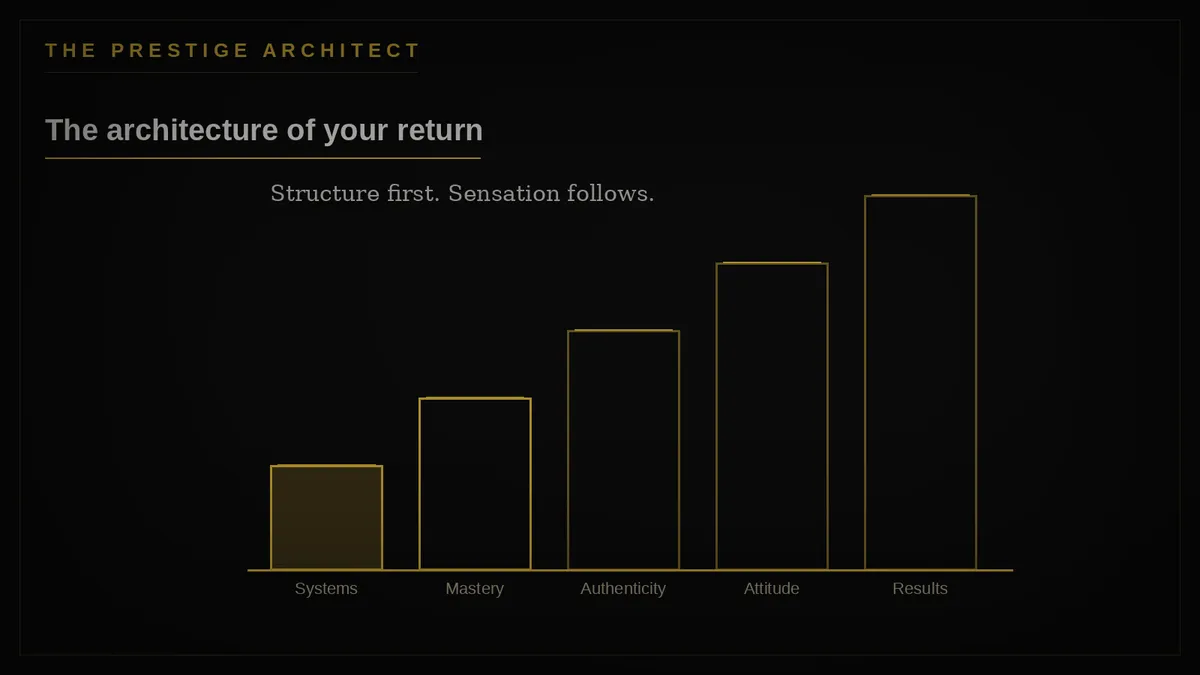
The RAMS™ framework rebuilds the voice at five levels. Results, Attitude, Authenticity, Mastery, Systems. The pause lives in all five.
Results
Stop counting words. Start counting whether the room moved. One clear line that lands beats five that scatter. Measure the result, not the volume. The leaders who carry a room say less and mean more. Their restraint is the result.
Attitude
The rushed voice believes it has to earn the air. The returned voice assumes the air is already yours. You do not audition for the room you built. You enter it. That shift in posture happens before a single word, and the room reads it first.
Authenticity
A pause is honest. It says you are thinking, not performing. The room trusts a person who is willing to be seen deciding. Fast answers hide you. The pause shows you. When you let the room watch you choose your words, they meet the real person, and the real person is who they wanted to hear from.
Mastery
Craft one practice. Say your point. Stop. Count three seconds in your head. Let the room answer first. This is the single move you can run this week. It feels long inside your own head and reads as calm to everyone else. That gap between how it feels and how it lands is the whole skill.
Systems
Build it into how you enter every room. Before a meeting, pick the one point that matters. Say it once, early, and hold. A repeatable rule beats willpower every time. Willpower fails under pressure. A system you trust carries you when the pressure is highest, which is the exact moment the old habit wants you to rush.
Here is the contrast, plainly.
- Collapsed: fills every gap, qualifies the point, lets the room move first.
- Sovereign: states the point once, holds the pause, lets the room come to it.
- Collapsed: speed as armor, words as apology.
- Sovereign: silence as weight, stillness as command.
- Collapsed: talks to stay safe.
- Sovereign: stops to stay seen.
The leader who went quiet does not need more words. They need the nerve to stop talking and let one true sentence stand.
If you want the room to feel this shift in you, start at the door. The Fast Future Freedom Blueprint™ is a free 60-minute identity audit. It finds the exact place your voice went quiet and names what will bring it home. Book the Fast Future Freedom Blueprint™.
A pattern I keep seeing
The leaders I sit with who have gone quiet almost always trace it to one room. A room where speaking plainly once cost them. After that, the voice learned to hurry. It learned to get the point out before anyone could push back.
They are not timid people. They ran teams. They carried the numbers. In private they tell me the same thing. "I used to own the room. Now I wait." The waiting is not weakness. It is a worn-in habit of self-protection, built to keep them safe after the room turned on them once.
There is real research under this. Amy Edmondson at Harvard showed that people speak up only when the room feels psychologically safe (Administrative Science Quarterly, 1999). Here is what most people miss. For a senior leader, the room that has to feel safe is the one inside them. You cannot hold a pause in front of others if you do not feel safe in your own authority first. The outer silence cracks when the inner one is not settled. That is the part self-help cannot reach, and it is the part that matters most.
The architecture of your return
You can run the three-second pause this week. You will feel the room turn. That is the first move, and it is real. Start there.
But the pause only holds when the person behind it is settled. If your authority still flinches, the silence will crack, and you will rush again. That flinch is not a skill gap. It is an identity-level signal, and it is the exact thing Baz Porter® rebuilds. This is a return, not a repair. We do not add a technique on top of a worn-out self. We rebuild the self the voice comes from.
The Fast Future Freedom Blueprint™ is where that work starts. Sixty minutes. No cost. We find where the voice went quiet and name what it will take to bring it home. Apply for the Fast Future Freedom Blueprint™.
Questions leaders ask
What is the power of the pause in leadership?
It is the authority that comes from holding a short silence instead of filling it. When a leader states a point and then pauses, the room turns toward them. The pause signals that the words carry weight. It is how a quiet leader is heard without raising their voice.
Why did I go quiet in rooms I used to own?
Usually one room taught your voice to hurry. Speaking plainly cost you once, so the voice learned to rush the point out before pushback. Over time the rushing reads as absence. You did not lose the voice. You lost the pause that gave it weight.
How do I use a pause without seeming unsure?
Say your point as a full, clear statement first. Then stop. A pause after a finished sentence reads as confidence. A pause in the middle of a half-formed thought reads as doubt. Finish the line, then hold the silence. The order is the whole trick.
Is the power of the pause just a speaking technique?
No. The technique is the surface. A leader in Silent Collapse™ cannot hold the pause because their own authority has eroded underneath. The real return happens at the level of state of being, which is the work of Sovereign Leadership™, not a speaking drill.
What is one move I can make this week?
Pick the one point that matters most before your next meeting. Say it once, early, and clearly. Then count three seconds before you add anything. Let the room respond first. Run it every meeting for a week and watch what returns.
Baz Porter® is The Sovereign Leadership Architect. He rebuilds the identity beneath high performance, so leaders decide, lead, and live from a self that is genuinely their own. He works with accomplished people who look strong on the outside and feel unseen on the inside. His work begins underneath the visible problem, at the level of state of being.