Why You Feel Trapped in a Life You Chose
Part of you wants out. Not a vacation. Out. You built this life with your own hands, and now it feels like a room with no door. You feel trapped in a life you chose. That is the quiet horror of it. Nobody did this to you. You said yes to all of it. The title. The house. The calendar that runs your week. And now some part of you wants to set it down and walk. This is not weakness. It is a signal. I name the state underneath it Silent Collapse™: the high-functioning fracture, where you keep performing while something inside has already left the building. If that lands, read the manifesto before you read anything else.
What this covers
Key takeaways
Feeling trapped in a life you chose is an autonomy signal, not a character flaw.
You stay loyal to what you built, so you keep paying for a life that no longer fits.
The move is return, not escape. You come back to what you actually want.
Small acts of real choice rebuild the felt sense of authorship.
The exit you fantasize about is usually pointing at a boundary you never set.
The short answer
You feel trapped in a life you chose because a choice made once is not consent given daily. You picked this years ago. You are a different person now. The structure stayed the same while you changed. That gap is the cage. Autonomy, the felt sense that your actions come from you, is a basic psychological need. When it is thwarted long enough, the mind reads the whole life as a trap, even one you built. The way out is not a bigger decision. It is returning to your own wanting, one honest choice at a time.
The hidden pattern: you outgrew your own consent
Here is what almost nobody names. Decades of research in self-determination theory, published across peer-reviewed psychology, show autonomy is not a preference. It is a need, as basic as food (Deci and Ryan, American Psychological Association). When people feel their actions come from inside, they hold steady. When volition is blocked, wellbeing falls. Anxiety and low mood follow.
Now add the trap you built yourself. You have years invested. The house. The reputation. The role. So you stay loyal to the cost, not to the want. Psychologists call this the pull of sunk cost. You keep paying because you already paid. The life becomes a debt you service instead of a choice you make. That is why a chosen life can feel like a cage. The bars are your own past decisions, held long after they stopped being true.
The RAMS™ reframe
RAMS™ is how I rebuild the structure under a life, not the mood on top of it. Five pillars. Here is the trapped state, read through each.
Results. You have the results. That is the cruel part. The numbers are good. The cage is not failure. It is success that stopped meaning anything. Results without authorship feel like someone else won.
Attitude. Attitude is not positivity. It is your stance toward your own life. Trapped is a stance. It says the walls are fixed and you are not. Both halves are usually false. Change the stance and the walls start to move.
Authenticity. Authenticity closes the gap between the private self and the public self. Silent Collapse™ lives in that gap. You perform the life in public while the private self plans an exit. The trap is that gap widening in silence.
Mastery. You mastered one game and forgot you can choose the game. Mastery is not the role. It is the capacity you carry into any room. That capacity is portable. The cage is not.
Systems. Your week is a system that runs you. You did not design it on purpose. It accreted. A life you did not design will always feel like a place you got stuck, not a place you chose.
Collapsed versus Sovereign, in the trapped state:
Collapsed: I have no choice. Sovereign: I have not made the choice yet.
Collapsed: I have to blow it all up. Sovereign: I get to change one true thing first.
Collapsed: I am stuck in this life. Sovereign: I outgrew this version of it.
Collapsed: leaving is the only way out. Sovereign: returning to my own wanting is the way through.
Collapsed: the walls are fixed. Sovereign: I built the walls, so I can move them.
You are not trapped by the life. You are trapped by loyalty to a decision you already outgrew.
If you want the felt sense of the trap named and mapped, start with the Fast Future Freedom Blueprint™, a free audit hour. Begin the Fast Future Freedom Blueprint.
A leader I sat with
A composite, details changed. A senior operator, mid-forties, ran a division most people would envy. On paper, everything worked. In private, he drove the long way home to sit in the car for ten more minutes. He did not want a new life. He wanted to want this one again. We did not torch anything. We found three things the calendar owned that he never agreed to. He took one back. Then another. The urge to disappear did not vanish overnight. It got quieter. Because the pull to walk away was never about the life. It was about the choices he had stopped making inside it.
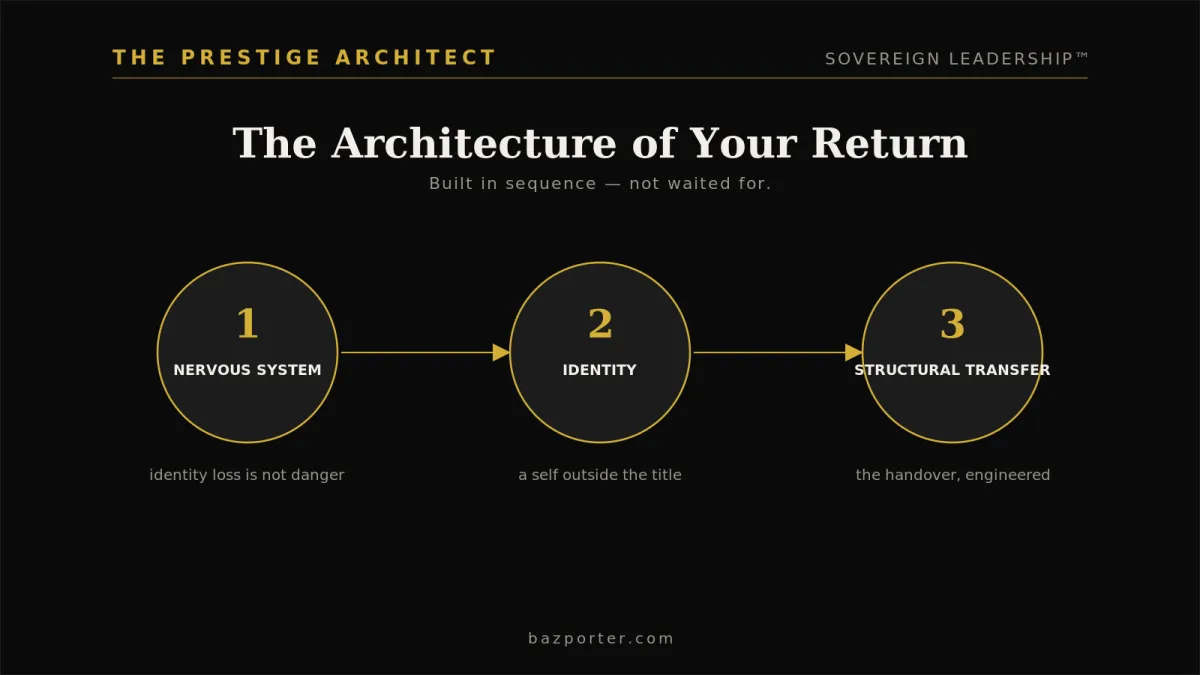
The architecture of your return
Here is the architecture, not the pep talk. Herminia Ibarra of Harvard Business School studied how people actually reinvent. Her work, Working Identity, found that successful changers do not reject the old self. They rework it, slowly, as the new one takes shape. And fewer than one in five who want a real change ever make it. The ones who fail usually try to leap. The ones who return start small and stay honest.
Your return has three moves. First, name what you outgrew, out loud, without apology. Second, find one choice the life makes for you that you never agreed to, and take it back this week. Third, protect that return like it is the work, because it is. This is not a rebuild from zero. It is a return. You come home to what you actually want, with the competence you already built intact.
When you are ready to map yours, the door is the same one. Apply for the Fast Future Freedom Blueprint.
Questions people ask
Why do I feel trapped in a life I chose?
Because a choice made once is not consent given daily. You changed. The structure did not. Autonomy, the sense your actions come from you, is a basic psychological need. When it stays blocked, the mind reads even a chosen life as a trap.
Is wanting to walk away from my life a sign something is wrong with me?
No. It is usually a signal, not a defect. The urge to leave often points at a boundary you never set or a want you stopped honoring. Read it as information about the structure, not a verdict on you.
Should I blow up my life and start over?
Rarely, and almost never first. Most people who feel trapped do not need a new life. They need to make real choices inside the one they have. Start with one honest choice this week before any large exit.
How do I stop feeling stuck without quitting everything?
Take back one decision the life currently makes for you. Then protect it. Small recoveries of real choice rebuild the felt sense of authorship. The stuck feeling loosens as your daily consent returns.
What is Silent Collapse and how does it relate to feeling trapped?
Silent Collapse™ is the high-functioning fracture, where you keep performing while something inside has left. Feeling trapped in a chosen life is one of its clearest signs. The work is to close the gap between the private self and the public self, and return to Sovereign Leadership™.
About the author
Baz Porter® is the Sovereign Leadership Architect and creator of RAMS™. He guides high-achieving leaders from Silent Collapse™ to Sovereign Leadership™: power without collapse, success without self-betrayal. His work rebuilds the identity infrastructure beneath high performance, so the life you built becomes a life you actually chose.