The Cost of the Climb: When Success Costs You Yourself
You got everything you were told to want. The title. The number. The respect in the room when you walk in. And still, some quiet night, a thought surfaces that you never say out loud: I don't recognize the person I became to get here.
This is not ingratitude. It is not weakness. It is the specific ache of Silent Collapse™, the felt state under a life that looks complete from the outside. You did not fail. You succeeded, and the success quietly cost you more of yourself than you meant to give. Before we go further, read the manifesto that names what most leaders at your level feel and never confess.
What this page covers
Key takeaways
The cost of the climb is rarely time or health first. It is self. You traded pieces of who you were for the version the role required.
This is not burnout and not only emptiness. It is self-betrayal, paid in small daily compromises you barely noticed.
The performed version of you can feel more real than you do. That is the collapse, not the breakthrough.
The move is not reinvention. The move is return. You come back to the self you traded, without torching the life you built.
Recognition is the first step. You cannot reclaim what you refuse to name.
The short answer: why success cost you more of yourself than you meant to give
Success cost you yourself because every rung asked for a trade, and you kept paying. You said yes when you meant no. You performed certainty you did not feel. You buried the part of you that wanted a different life so the capable part could keep delivering. None of these trades felt large. That is why the bill stayed hidden. The cost of the climb compounds quietly, one small self-betrayal at a time, until the person you built stands where the person you were used to be. This is the felt state of Silent Collapse™: not a breakdown, a slow disappearance.
The hidden pattern beneath the climb
Here is the pattern almost no one names. You did not lose yourself in one dramatic moment. You gave yourself away in installments, and each installment was rewarded. The market paid you for the trades. The promotion followed the performed confidence. The bonus followed the yes you should have refused. So the cost never looked like a cost. It looked like ambition working.
Research on identity supports this. Harvard Business School professor Herminia Ibarra named it the authenticity paradox. The behaviors that advance a career can pull a leader further from who they are (Harvard Business Review, 2015). The role rewards a self. Over years, that self hardens into a mask you forget you are wearing. Research from the American Psychological Association on self-concept clarity shows what follows. When your inner sense of who you are grows fuzzy, wellbeing declines with it (American Psychological Association). You are not imagining the erosion. It has a name.
The trap is that the climb never signals the cost. Your calendar stays full. Your results stay strong. The built life keeps standing. And inside it, the real you keeps getting smaller. Then one ordinary Tuesday you catch your own reflection. You feel like a stranger in your own success.
The RAMS™ reframe across five pillars
The RAMS™ framework separates the leader from the strategy. It reads the cost of the climb across five pillars. You see exactly where the self got traded. You see where the return begins.
Results. You measured yourself by output for so long that output became identity. When the numbers were the only proof you were enough, you stopped asking what the numbers were costing. The return starts here: results are what you produce, not who you are. That single distinction gives the self room to come back.
Attitude. The climb taught you to override. Push through, feel later, never let them see the doubt. That override kept you moving and quietly trained you to ignore your own signals. The self-betrayal lives in the override. Sovereign leadership begins the moment you let a true signal count again.
Authenticity. This is the center. You built a self the role could use, then confused it for the whole of you. The performed version is competent and hollow. Coming home to the real self does not mean burning the competent one. It means the mask stops being the only face you have.
Mastery. You mastered the job. You never mastered the return to yourself, because no rung of the climb required it. Self-mastery is a smaller skill than it sounds. You notice the daily trade before you make it. You choose yourself in one place today.
Systems. A life that costs you yourself is usually a system, not a moral failure. Your calendar, your commitments, your default yes: all of it quietly extracts the self. Rebuild the system and the self stops leaking. Willpower cannot out-run a structure built to drain you.
Set side by side, the two states are unmistakable.
Collapsed: measures worth by output; overrides every internal signal; wears the performed self as the only face; makes small self-betrayals on autopilot; runs a life engineered to extract more of you.
Sovereign: holds results as work, not identity; lets true signals count; carries the real self back into the room; catches the daily trade before it happens; builds a life that returns you to yourself.
The people who climb the highest are often the ones who abandon themselves the most efficiently. The return is not a retreat. It is the most disciplined thing a leader ever does.
If you want a clear read on where your own climb cost you the most, the Fast Future Freedom Blueprint is the free entry audit. It maps the exact trades under your success, so the return has a starting point instead of a wish.
What this looks like in a real life
Picture a leader at fifty-one. Two decades of climbing, a title most people would envy, a family, a home that is fully paid for and fully quiet. On paper, arrived. In private, a stranger. They tell me the same sentence I hear again and again: I don't like who I had to become to succeed.
We do not tear anything down. We find the trades. The yes to the board that cost a decade of weekends. The certainty they performed so long they forgot how to say I don't know. The version of themselves that reads the room perfectly and feels nothing. One by one, we name what was given away. Then we start the return, in small places first, so the built life stays standing while the self walks back in. Nothing dramatic. Just a leader, slowly, becoming recognizable to themselves again.
The architecture of your return
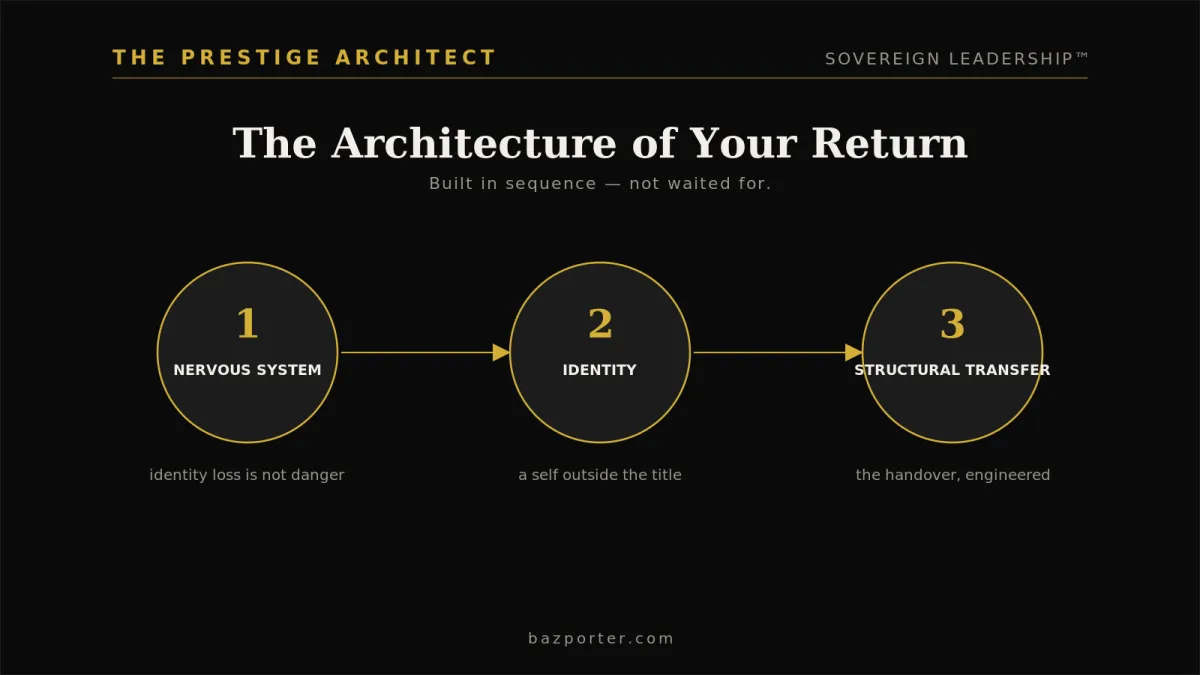
The return to yourself is not a leap and not a blow-up. It is architecture. You do not quit, torch the life, or reinvent into someone new. You come back to the self you already were, and you rebuild the structure so it stops costing you. That is the whole move: return, not reinvention.
It begins with recognition, which is why naming the cost matters more than any tactic. You cannot reclaim what you refuse to see. Once the trades are named, the work is steady and unglamorous: one honest signal honored, one daily self-betrayal caught, one part of the system rebuilt to hold you instead of drain you.
If you are ready to see the trades under your own success and where the return begins, start with the Fast Future Freedom Blueprint. It is the free audit that turns the ache into a map.
Questions leaders ask about the cost of the climb
Is the cost of the climb the same as burnout?
No. Burnout is depletion of energy and capacity. The cost of the climb is depletion of self. You can be well rested, well paid, and still feel like a stranger inside your own success. The ache is about identity, not fatigue, which is why more rest never fixes it.
How do I know if I betrayed myself or just made normal sacrifices?
Healthy sacrifice serves a self you still recognize. Self-betrayal trades away the self itself. Ask a simple question: did the choice cost me a weekend, or did it cost me a piece of who I am? If the answer is who I am, and it happened again and again, that is the cost of the climb, not ordinary sacrifice.
Do I have to leave my career to come back to myself?
Almost never. The return is architecture, not exit. Most leaders rebuild the self inside the life they already have. You name the trades. You change the system that keeps extracting them. Walking away is rarely the move. Coming home is.
Why does the performed version of me feel more real than I do?
Because you have practiced it for years and been rewarded every time. Repetition plus reward makes the mask feel like the face. That is a sign of how long the climb ran, not a sign that the real self is gone. The real self is recoverable. It has been waiting.
Where do I start if I recognize myself in this?
Start with recognition, then a map. The Fast Future Freedom Blueprint is the free entry audit that names the exact trades under your success and shows where the return begins. Naming the cost is the first honest step back to yourself.
About the author
Baz Porter® is the founder of Baz Porter LLC and the architect behind Sovereign Leadership™ and the RAMS™ framework. He works with accomplished leaders who have built the life and quietly lost themselves in it, guiding the return to the real self without torching what they built. His work names the felt state of Silent Collapse™ and turns it into a clear architecture for coming home.